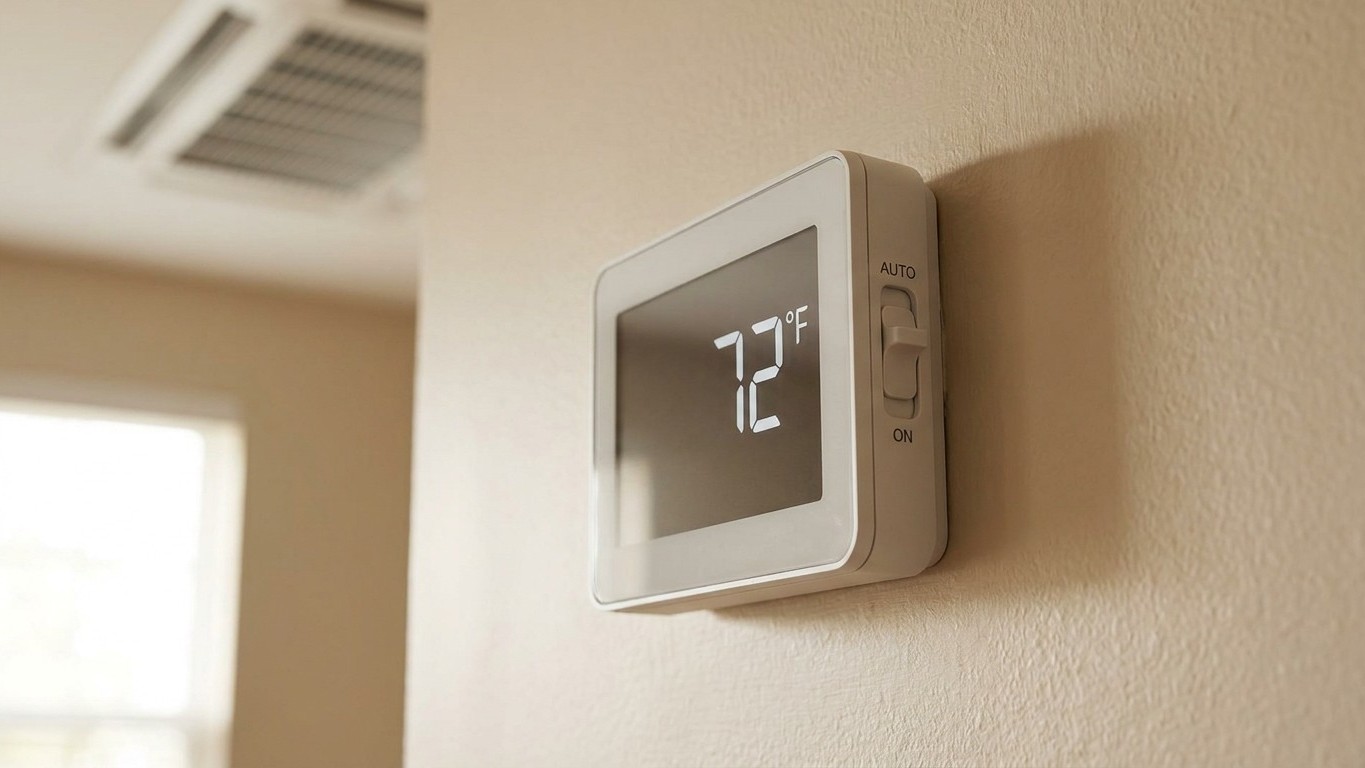

Set it to AUTO for most homes, most of the year. The fan should only run when the furnace or air conditioner is actually producing heated or cooled air. ON has real uses, but for the average household it usually means higher electric bills and, in summer, muggier air blowing through the vents.
What the switch actually controls
The fan switch on a thermostat has nothing to do with the burner, the compressor, or the heat pump’s reversing valve. It only controls the blower motor, the fan that pushes air through the ducts and out the registers. On AUTO, that blower turns on when the thermostat calls for heat or cooling and shuts off once the system satisfies the setpoint. On ON, the blower runs all the time, cycle after cycle, day and night, whether or not the burner is firing or the compressor is spinning.
That distinction matters more than it sounds like it should. A blower moving air is not the same as a blower moving conditioned air. Once the compressor shuts off in cooling mode, the coil stops pulling heat out of the house. Once the burner shuts off in heating mode, the heat exchanger stops adding warmth. But if the fan is set to ON, the blower keeps running anyway, pushing whatever temperature air happens to be sitting in the ducts and around the equipment out into the rooms.
In practice this creates a lag between what the fan is doing and what the house actually needs. Right after a heating cycle ends, the air coming off a cooling furnace’s heat exchanger is still warm, so a few extra minutes of fan running helps recover that leftover heat. But an hour later, with the burner long since off, that same continuously running fan is just moving room-temperature (or slightly cooler) air around, doing nothing to warm anyone up. In cooling mode the effect flips: the fan keeps drawing air across a coil that is no longer actively cold, and eventually across one that is wet from condensation.
Most residential systems ship from the factory with AUTO as the default fan setting, and most manufacturers assume that’s how the system will spend the majority of its life. Switching to ON is an intentional override, not a manufacturer-recommended baseline. Understanding what the switch touches, and what it doesn’t, is the starting point for deciding which setting actually fits a given house.
The case for ON
Continuous fan operation isn’t a mistake by default. It solves specific, real problems, and dismissing it outright would be unfair to the households where it earns its keep.
The clearest benefit is temperature evenness. In a two-story house, warm air naturally rises and cool air settles, so the upstairs often runs several degrees warmer than the main floor in summer, and the reverse happens in winter. A blower that never stops keeps air moving between levels even when the system isn’t actively heating or cooling, which smooths out some of that stratification. Households with one persistently cold bedroom over a garage, or a stuffy upstairs office, sometimes notice a real difference within a day or two of switching the fan to ON.
The second benefit involves air filtration. A forced-air system’s filter, and any add-on air cleaner tied into the ductwork, only scrubs the air that actually passes through it. On AUTO, that filtration only happens during heating or cooling cycles, which might add up to a few hours a day depending on the season and the size of the equipment. On ON, the same filter is working on the household air around the clock, which matters for homes managing allergies, pet dander, or wildfire smoke infiltration where more filtration passes per day genuinely helps.
There’s also a simpler, almost cosmetic case for ON: some people just prefer the steady low hum of a running blower to the on-off cycling of AUTO, especially in bedrooms where the click and whoosh of a system kicking on can be noticeable at night. That’s a comfort preference, not a performance argument, but it’s a legitimate reason some households make the switch and stick with it.
None of these benefits are free, though, and the next section covers what they cost.
The case for AUTO
The most obvious downside of ON is electrical. A blower motor pulling power 24 hours a day, every day of the cooling or heating season, adds up in a way that a few hours of cycling per day simply doesn’t. Depending on the motor and the local utility rate, that difference shows up clearly on a monthly bill, especially across a full summer or winter.
The cooling-season problem is more specific, and it’s one a lot of guidance skips over. When the air conditioner runs, moisture in the household air condenses on the cold evaporator coil and drips away through the condensate drain, which is exactly how the system dehumidifies a house while it cools it. On AUTO, the blower shuts off with the compressor, and that collected moisture drains away undisturbed. On ON, the blower keeps running after the compressor stops, and it blows across a coil that’s still wet, re-evaporating some of that moisture straight back into the supply air. The result is a house that can feel colder yet clammier at the same time, because a portion of the humidity the system just removed gets recirculated before it has a chance to drain.
Ductwork condition changes the math too. According to ENERGY STAR, “in a typical house, however, about 20 to 30 percent of the air that moves through the duct system is lost due to leaks, holes, and poorly connected ducts.” If the ducts leak, running the fan continuously moves air through those leaks continuously too, pushing conditioned air into attics, crawlspaces, and wall cavities around the clock instead of only during active heating or cooling cycles. In a tight, well-sealed duct system that loss is a nuisance. In a leaky one, running the fan nonstop turns a modest inefficiency into an all-day drain, heating or cooling space nobody lives in.
None of this means ON is a bad setting in every home. It means the setting should match a specific problem rather than being flipped on as a general comfort upgrade.
Choosing, by situation
The right setting depends less on personal preference and more on what the house is actually doing structurally. A few common situations make the choice fairly clear-cut.
| Household situation | Better setting | Why |
|---|---|---|
| Humid summer climate | AUTO | Keeps the blower off after the compressor stops, so condensed moisture drains instead of getting blown back into the supply air |
| Uneven multi-story house (hot upstairs, cold downstairs) | ON | Continuous circulation blends air between floors and reduces temperature swings from one level to another |
| Allergy or smoke filtration priority | ON | The filter only cleans air while the blower runs, so nonstop operation means more filtration passes per day |
| Known duct leaks in attic, crawlspace, or garage | AUTO | Continuous fan operation pushes conditioned air through those leaks around the clock instead of only during active cycles |
| Heat pump in cold weather | AUTO | A continuously running fan blows air that’s cooler than body temperature between defrost and heating cycles, and it reads as a draft rather than warmth |
Two of these deserve a closer look. In humid climates, the moisture argument tends to outweigh the comfort benefit of continuous circulation for most households, since damp air undercuts the whole point of running the air conditioner in the first place. And with heat pumps specifically, the supply air is rarely as hot as a gas furnace’s output even during an active heating cycle, so a blower running between cycles, moving air that’s noticeably below skin temperature, tends to feel like a cold draft rather than gentle circulation. That’s a common complaint from heat pump owners who switch to ON expecting even warmth and get chilly air instead.
One thing neither setting fixes: a clogged filter. According to ENERGY STAR, “airflow problems can reduce your system’s efficiency by up to 15 percent.” A dirty filter restricts airflow whether the blower runs on AUTO or ON, so switching the fan setting is not a substitute for checking and replacing the filter on a regular schedule. If a house feels stuffy or uneven no matter which setting is chosen, the filter, not the fan switch, is usually the first thing worth checking.
Common questions
Does switching from AUTO to ON change the temperature the house reaches?
No. The fan setting only controls blower operation, not the heating or cooling output itself. A house set to ON will still only get as warm or as cool as the thermostat setpoint allows; the fan just moves air more continuously while getting there.
Will running the fan on ON wear out the blower motor faster?
Continuous operation does add running hours to the motor compared with cycling on AUTO, which can shorten the interval between routine motor maintenance or eventual replacement. Most residential blower motors are built to handle extended run time, but it’s still additional wear that a cycling motor on AUTO doesn’t accumulate at the same rate.
Can I switch between AUTO and ON seasonally?
Yes, and many households do exactly that, using AUTO through a humid summer and switching to ON in a mild season, or in a multi-story house that needs help evening out temperatures during shoulder months. There’s no equipment risk in changing the setting as often as the household wants; it only affects blower behavior, not the compressor or burner.
If the ducts are leaky, is sealing them worth it before deciding on a fan setting?
Sealing known leaks addresses the underlying problem rather than just avoiding one symptom of it. Since ENERGY STAR notes that a typical house loses about 20 to 30 percent of duct airflow to leaks, holes, and poor connections, sealing those leaks improves efficiency regardless of which fan setting is ultimately chosen, and it removes one of the strongest arguments against running the fan on ON.