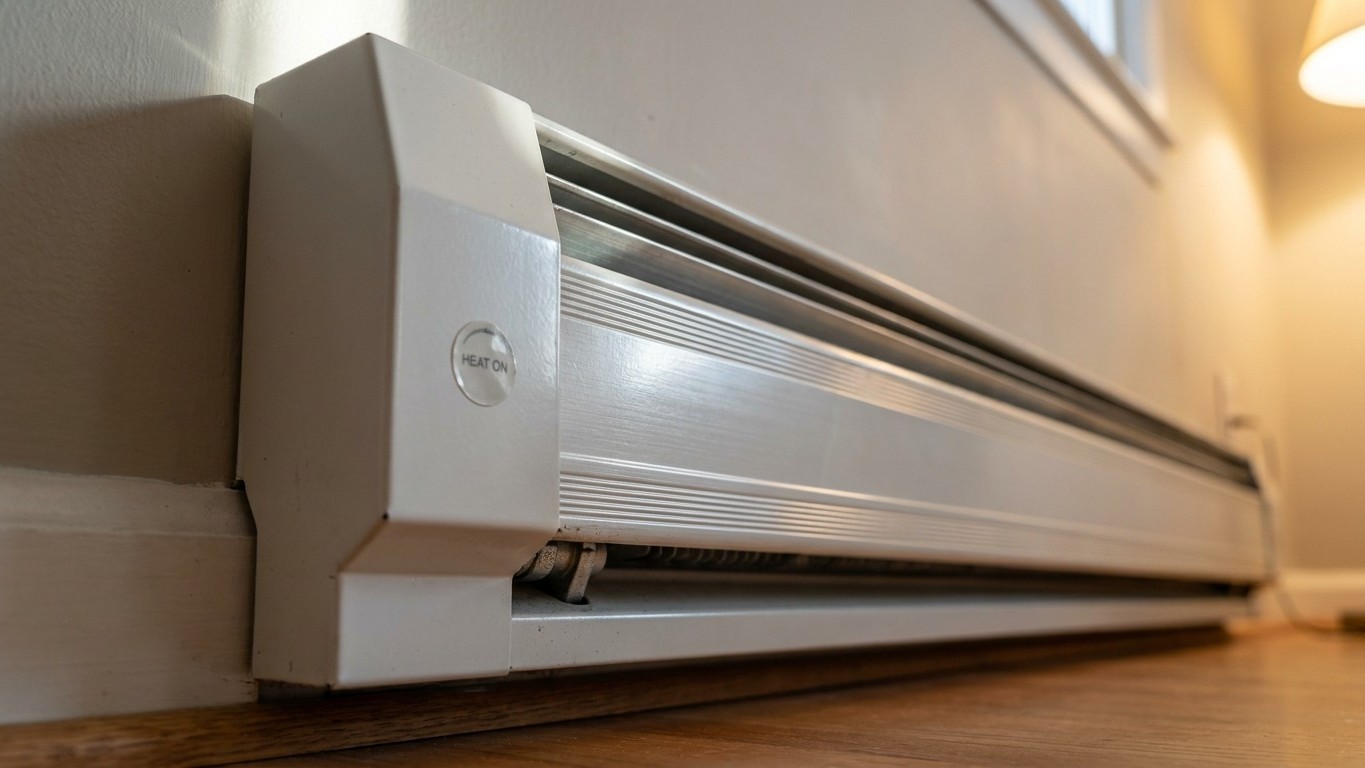

Most baseboard heater noise is the metal inside the unit expanding as it heats and contracting as it cools. That’s true whether you have an electric fin-tube heater or a hydronic one running on a boiler loop, since both hide a metal element inside a metal enclosure. A soft tick or click a few minutes into a heating cycle is normal wear on hardware doing exactly what it was built to do. A bang, a knock, or a rattle that repeats every cycle is a different story, and it usually traces back to one of a handful of fixable causes.
Most of it is metal growing
Inside every baseboard heater, whether the heat source is a resistance element or hot water, there’s a long, thin metal piece fixed at both ends inside a sheet-metal enclosure. When the heat comes on, that element warms up and grows in length. When the thermostat cuts the heat, it cools and shrinks back. That length change is tiny per inch, but stretched across a six or eight foot unit, it adds up to enough movement that the metal rubs against whatever is holding it in place: mounting brackets, the enclosure itself, and sometimes the wall or floor it’s tucked against.
That’s the ticking or clicking you hear starting roughly a minute after the heat kicks on, and again for a while after it shuts off as everything settles back down. It’s the same reason a cooling car engine ticks in the driveway. The metal isn’t damaged, and the noise doesn’t mean the heater is failing. It’s friction, plain and simple, from a part sliding against a surface it was designed to slide against.
What makes it loud instead of quiet
The volume of that expansion noise depends less on how much the metal moves and more on what it’s rubbing against and what’s amplifying the sound. A thin sheet-metal cover acts like a drum head; tap it anywhere and the whole length resonates. A wall cavity behind the heater can do the same thing, turning a small tick into something you hear two rooms away. Brackets with too little clearance let the element bind instead of glide smoothly, so instead of a soft slip you get a sharper snap. None of that means something is broken. It means the geometry around the moving part is amplifying a sound that would otherwise be barely noticeable.
What turns a tick into a bang
A loud, repeating bang or knock (as opposed to a soft tick) usually means the element isn’t free to expand the way it’s supposed to. Something is restricting its movement, and instead of a smooth slide, you get a stick-and-release, which is what produces the sharper sound. Here are the most common culprits, roughly in order of how often they show up.
| Condition | How to recognize it | What to do |
|---|---|---|
| Element pinched by a mounting bracket | Noise is sharp and localized to one spot along the unit’s length, often near a wall stud or corner | Loosen the bracket screw slightly so the element can slide through it instead of catching |
| Cover screwed tight against the enclosure | Noise seems to come from the whole cover, and pressing on the cover changes the sound | Back the cover screws off just enough that the cover can flex and isn’t clamped rigid to the frame |
| Unit bearing directly on the floor | Banging is worse on cold starts and seems to come from underneath | Check for missing floor clearance; the unit should sit with the gap specified on its label, not resting flush |
| Fin assembly resting on its cradle without the glide | A grinding or scraping sound accompanies the tick, not just a click | Confirm the small plastic or metal glide/shim that lets the fin tube slide in its cradle is still in place; it’s often lost during a repaint or a floor job |
| Cover painted shut against the base | Noise appeared or worsened after a repainting job, and the cover doesn’t move at all when pushed | Score along the paint seam with a utility knife to free the cover from the base so it can move again |
The painted cover is more common than most people realize, and it rarely gets mentioned when this topic comes up. A cover and base painted as one continuous surface look tidy, but they’ve also been welded together by the paint film. When the metal underneath tries to expand, the cover can’t slide with it the way it’s designed to, so the whole assembly pops instead of gliding. A thin utility-knife score along the seam where cover meets base is often the entire fix.
The noises only a boiler makes
None of what follows applies to an electric baseboard heater. If your unit is wired to a thermostat and has no pipes running to it, skip this section; the noise you’re hearing is metal expansion or one of the mechanical issues above, not water. What follows is specific to hydronic baseboard, where hot water moves through a finned copper tube fed by a boiler loop.
A trickling or gurgling sound, distinct from the metallic tick of expansion, usually means air trapped in the loop. Air moves and bubbles as water pushes past it, and that produces a softer, wetter sound than the sharp tick of metal sliding on metal. If you can hear something that sounds like a stream rather than a click or knock, that’s air, not expansion.
A knock that happens at the start or end of a heating call, often near the boiler or a wall where pipe hardware is mounted, can be a zone valve closing. That’s a mechanical thump from the valve seating, not something wrong with the baseboard unit itself. And a creak, especially one that seems to come from inside a wall or floor rather than from the heater, is often a pipe rubbing against a joist or a hole it passes through as it expands lengthwise, the same expansion principle as the baseboard element, just happening somewhere you can’t see it.
Here’s the part worth taking seriously: air that keeps coming back every fall isn’t a maintenance ritual, it’s a symptom. Air doesn’t appear from nowhere in a sealed loop. It’s getting in somewhere, whether through a fitting, an expansion tank losing its charge, or a spot where the system is drawing in air as it cools. Bleeding the same radiator or baseboard loop every heating season without the air ever staying gone is a sign the source needs to be found, not just repeatedly worked around.
What can be quietened
A realistic goal here is quieter, not silent. Some amount of ticking is built into how these units work, and trying to eliminate it completely usually means fighting the physics of metal expansion, which isn’t a fight you win. What you can do is remove the things that turn normal movement into loud movement.
- Back off a cover that’s screwed hard against its base. A quarter turn on each screw is often enough to let the metal flex instead of clamping it rigid.
- Restore any glide, shim, or plastic spacer the unit is supposed to sit on. These small parts get lost during floor replacement or repainting and are rarely reinstalled, and their absence is one of the most common causes of a grinding or scraping sound.
- Free an element that’s pinched by a bracket. Loosening the bracket just enough to let the metal slide through it, rather than catch on it, usually turns a bang back into a soft tick.
- Bleed a hydronic loop properly, at the right point in the system and repeated until the air stops returning. If it keeps coming back, treat that as a sign to look for where air is entering rather than a routine you repeat every season.
Do all four and most units settle down to a soft, occasional tick that’s barely noticeable once you know what it is. That residual sound is normal wear on hardware doing its job, not a problem waiting to be solved.
Common questions
Is a clicking baseboard heater dangerous?
No. Clicking or ticking from thermal expansion is a normal mechanical sound and isn’t a safety concern on its own. A persistent electrical buzz, burning smell, or scorch marks are different matters and warrant shutting the unit off and having it checked.
Why does my baseboard heater get louder in cold weather?
Colder starting temperatures mean a bigger temperature swing when the heat comes on, so the metal expands over a longer range and the noise can be more noticeable, especially on the first cold snap of the season when everything has settled into a slightly different position over the summer.
Can I stop baseboard heater noise by adjusting the thermostat?
Not directly. Lowering the setpoint reduces how often the unit cycles, which means fewer expansion events, but it won’t address a pinched element, a painted-shut cover, or missing glides. Those need a physical fix, not a thermostat change.
How do I know if my baseboard heater is electric or hydronic?
Check for pipes entering the enclosure at each end; hydronic units connect to a boiler loop. An electric unit has only wiring, usually entering through a knockout near one end, and no water lines at all. Some electric models use a fluid-filled element marketed with the word “hydronic,” but if there’s no boiler and no pipe loop, it’s still an electric appliance.