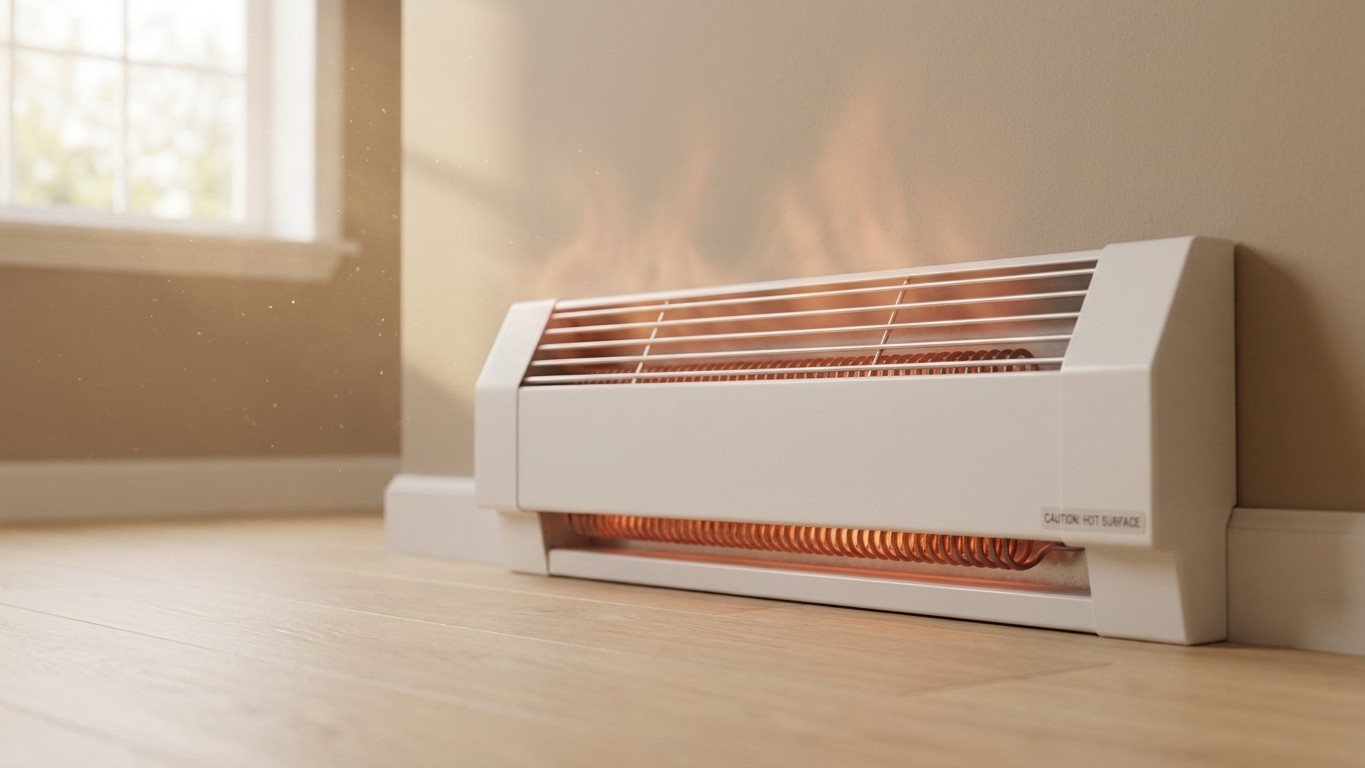

Electric baseboard heat earns its expensive reputation for a simple, physical reason: it turns electricity into heat at a fixed ratio, with nothing extra squeezed out. That’s not a design flaw or a cheap build, it’s how resistance heating works. The reputation gets worse or better depending on habits, room conditions, and what else is available in a given house. Here’s where the reputation actually comes from, what makes it worse than it has to be, the one advantage almost nobody credits it for, and when swapping it out actually makes sense.
Where the reputation comes from
Resistance heat, the kind inside an electric baseboard unit, converts electricity into heat one for one. Every unit of electricity that goes in comes out as heat. There’s no trick to make it produce more warmth than the power it draws, because the wire simply gets hot and radiates that heat into the room. That’s the entire mechanism, and it hasn’t changed in decades.
A heat pump works on a different principle entirely. Instead of generating heat from an internal element, it moves heat from outside air (or a loop of fluid, or the ground) into the house. Because it’s transferring existing heat rather than manufacturing it from scratch, a heat pump can deliver more heat energy into a room than the electrical energy it consumes to run its compressor and fans. That gap, between generating heat and moving it, is the entire basis of the comparison people make when they call baseboard heat “expensive.” It’s a difference in mechanism, not a verdict on quality or durability.
Where electric heat shows up most
Electric heat isn’t evenly distributed across the country, and that unevenness shapes how the reputation spreads. According to the U.S. Energy Information Administration’s Residential Energy Consumption Survey (RECS 2020), the share of homes using electricity as their main heating fuel varies sharply by state.
| State | Homes heating with electricity (main fuel) | Also reported on a furnace | Also reported on a central heat pump |
|---|---|---|---|
| Washington | 55% | 47% | 9% |
| Maryland | 41% | not reported | not reported |
| Maine | 10% | not reported | not reported |
Notice that RECS tracks electricity as a fuel and equipment types like furnaces and central heat pumps, but it does not publish a separate figure for built-in electric units such as baseboards. Subtracting one published number from another doesn’t produce a third published number, so there’s no way to say from this data alone how many of those Washington households specifically run baseboard heaters. “Not reported” and “estimate suppressed” mean exactly that, not zero.
Before going further, one distinction matters more than anything else on this topic. There are two different appliances that both get called “baseboard heat.” An electric baseboard heater is a resistance element sealed in a metal enclosure, wired at line voltage and controlled by a thermostat rated for that voltage. A hydronic baseboard is something else entirely: a finned copper tube carrying hot water supplied by a boiler loop. There’s also a third option sold under the hydronic name that’s actually electric, a sealed unit filled with fluid that gets heated by an internal element rather than a boiler. It looks similar and gets marketed similarly, but it’s still an electric appliance. Knowing which one is installed in a given room comes before any decision about what to do with it.
What makes it worse than it needs to be
Because electric resistance heat has no efficiency variable to fall back on, every inefficiency shows up directly on the bill. A few habits and conditions make baseboard heat perform worse than its baseline, and each one is fixable without replacing the unit itself.
| Problem | What it costs in behavior terms | What to do about it |
|---|---|---|
| Heating rooms nobody is using | Full output goes to empty space, all day, every day the thermostat is left up | Turn the unit down or off in rooms that sit empty; baseboard heat is controlled room by room, so this takes seconds |
| Thermostat mounted on the heater instead of the wall | The sensor reads the heater’s own warmth, not the room’s actual air temperature, so it cycles off before the room is comfortable | Move to a wall-mounted, line-voltage thermostat positioned away from the heater; see the guide on baseboard heater thermostat placement |
| Dust built up on the fins | Dust insulates the element, slowing how fast heat gets into the room, which keeps the unit running longer to reach the same setpoint | Vacuum the fins each fall before the heating season; details in the baseboard heater maintenance guide |
| Furniture or curtains blocking airflow | Convection heat needs a clear path up and out; anything blocking the front traps heat against the unit instead of the room | Keep a clear gap in front of and above the heater |
| An uninsulated wall or unsealed window in that room | The room loses heat faster than the baseboard can replace it, so the thermostat never seems to catch up | Address the envelope first; see the insulation and air sealing guide before assuming the heater is the problem |
None of these fixes changes the underlying mechanism. They just stop paying for heat that never reaches a person or leaks straight back out of the house.
The advantage nobody mentions
Baseboard heat gets criticized so often that its one real structural strength gets skipped over: it’s per-room by design, not as an upgrade someone paid extra for. Every room on baseboard heat has its own unit and its own control. A whole-house furnace or a ducted heat pump moves conditioned air through the entire home from one central point, which means heating a single occupied room usually means heating the hallway, the spare bedroom, and everything else tied to that duct run too. Baseboard heat skips that problem by default. Close the door and turn down the heater in a guest room, and that room simply uses less electricity while the rest of the house runs normally.
That per-room control also makes setbacks straightforward. The U.S. Department of Energy states: “You can save as much as 10% a year on heating and cooling by simply turning your thermostat back 7-10°F for 8 hours a day from its normal setting.” That’s the Department’s own figure, tied specifically to a 7 to 10 degree setback held for 8 hours a day, and it covers heating and cooling combined, not a per-degree formula.
Resistance heat has one more practical trait worth noting here: it recovers quickly. Because the element heats the moment power is applied, there’s no lag waiting for a large system to build up temperature again after a setback. A baseboard-heated room comes back to setpoint about as fast as the thermostat calls for it, which makes a nightly or workday setback behave in a predictable, uncomplicated way in a house using this kind of heat.
When replacing it makes sense
Deciding whether to replace baseboard heat comes down to what’s actually driving the cost, and that’s different for every room. Some situations call for a change. Others call for fixing the room instead of the equipment.
| Situation | What usually makes sense |
|---|---|
| One room used only occasionally (guest room, home office used a few days a week) | Keep the baseboard heater and control it room by room; the per-room setup already fits this pattern |
| An entire house heated on baseboards throughout | Worth evaluating whole-house alternatives, but the decision should follow an assessment of the building’s insulation and air sealing first, not precede it |
| A frequently used room with an exterior wall available | A ductless heat pump head is a realistic option here, since it needs a wall penetration to the outside rather than ductwork |
| A room that never seems to hold heat, regardless of the heater | The envelope, not the heat source, is likely the actual problem |
That last row deserves emphasis: insulating and sealing a room almost always does more for comfort and consumption than swapping the heater inside it. A new heat source, whatever kind, sized to fight a leaky wall or a drafty window will disappoint no matter how it generates or moves its heat. Fix the box before changing what heats it.
Common questions
Is electric baseboard heat always more expensive than a heat pump?
Not automatically. The comparison depends on the mechanism, resistance heat converting electricity to heat one for one versus a heat pump moving existing heat, but this page doesn’t have sourced cost or efficiency figures to turn that mechanism into a dollar comparison for any specific home.
How do I know if my baseboard heater is electric or hydronic?
An electric unit is wired directly into the home’s electrical system and controlled by a line-voltage thermostat; it has no pipes running to it. A hydronic unit has copper tubing connected to a boiler loop carrying hot water. Some units marketed as hydronic are sealed, fluid-filled electric appliances with no boiler connection at all, so check for pipes rather than trusting the name.
Does turning down one room’s baseboard heater actually save anything?
Yes, because each unit runs independently. Reducing or shutting off the heater in an unused room stops electricity from going to heat that room while the rest of the house continues on its own settings.
Should I insulate the room or replace the heater first?
Insulate and seal first. A heater, electric or otherwise, sized to compensate for an uninsulated wall or a leaky window will underperform regardless of type. Addressing the envelope typically resolves more of the discomfort than a new heat source does.