
Massachusetts gardeners sow carrots by Counting Back From the Last spring frost, using the 70 to 100 days the crop needs to mature from seed, never from a transplant date, since carrots are sown in place and never moved. But that math only pays off if the ground underneath can grow a straight root. The state’s soil starts sandy and well drained on paper. Your own bed may be nothing like it.
The short answer
Massachusetts is represented, in USDA’s own soil records, by the Paxton series: a young Inceptisol that hasn’t had time to develop strong layered horizons. The surface runs 61 percent sand, 7 percent clay and 32 percent silt, with organic matter around 5.5 percent and a surface pH near 5.5, mildly acid. Drainage is classed as well drained. On those numbers alone, Paxton looks like reasonable carrot ground: sandy soils don’t compact into the dense wall a taproot has to fight through, and well-drained soil doesn’t leave a carrot sitting in standing water while it tries to grow.
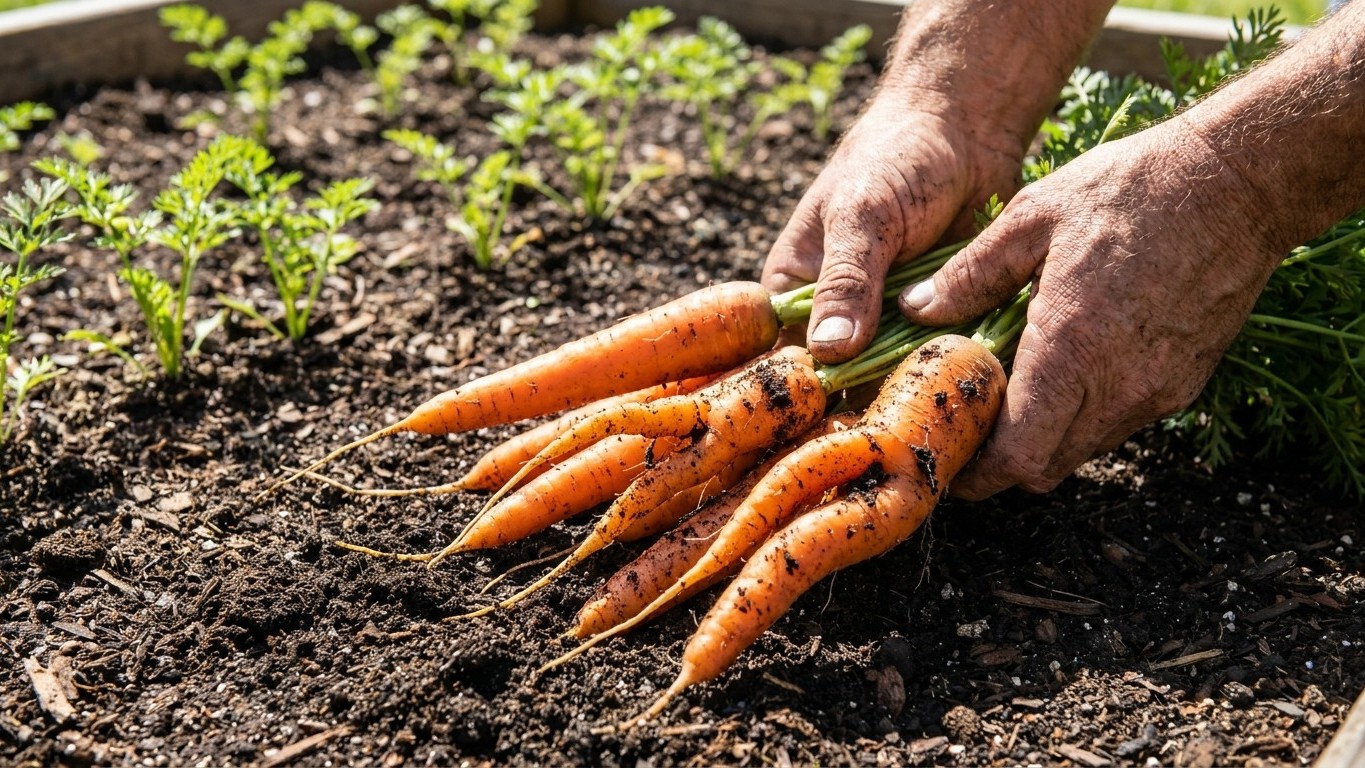
That said, sandy and well drained on a soil survey map is not the same claim as sandy and well drained in your particular raised bed or backyard row. Carrots want deep, loose, well-drained ground rich in organic matter, and the moment that ground turns heavy or full of rock, the root forks rather than growing straight down. A single obstruction, a clay lens, a buried stone, a compacted layer left by a previous owner’s driveway grading, is enough to split a carrot into two or three stubby legs. Utah State University Extension is direct about the fix: heavy soil needs generous compost worked in and double digging to loosen it a full spade’s depth or more, and where the native ground simply won’t cooperate, a raised bed filled with a lighter mix sidesteps the problem entirely.
None of this means a Massachusetts gardener can assume their dirt behaves like the state soil series. Massachusetts, like every state, is mapped into hundreds of distinct soil series, and the Paxton series describes a representative upland soil, not a guarantee about any specific address. Land near a river, ground at the bottom of a hill where clay has washed down for generations, or a lot filled and regraded during construction can all sit on soil with a completely different texture, drainage rate and pH than the numbers above. Paxton is a starting point for understanding what the region’s ground tends to do. It is not a diagnosis of the ground you’re about to plant in, and the only way to get that diagnosis is to go check.
The test that settles it in your own garden
- Dig a hole where you plan to sow. Go down at least a foot, ideally closer to fifteen inches, since that’s roughly the rooting depth a carrot variety bred for longer roots will try to reach.
- Look at what comes out. Note how deep you got before hitting a hard layer, a rock shelf, or dense clay that resists the shovel. Count and feel for stones and rock fragments in the soil you removed, since those are exactly what deflects a growing root sideways and causes forking.
- Feel the texture between your fingers. Rub a moist handful between your palms. Soil that feels gritty and falls apart easily leans sandy. Soil that smears, sticks, and can be rolled into a ribbon leans clay. Most garden soil sits somewhere in between, and that middle ground matters more than a single label.
- Watch how water moves through it. Fill the hole with water and time how long it takes to drain away. Water that lingers for hours points to poor drainage, the kind of ground where carrots sit wet and are prone to splitting and rot. Water that vanishes in minutes points to fast-draining, often sandier ground.
- Compare what you found to what carrots need. Deep, loose, well-drained, and free of obstructions down to at least a foot is the target. Wherever your test falls short, that’s the specific problem to fix, whether it’s adding compost, double digging, or building up a raised bed instead of fighting the native ground.
What goes wrong here
- Forking in heavy ground. Clay-heavy or rocky soil stops a carrot’s root cold and sends it splitting around the obstruction instead of growing straight down. Utah State University Extension’s remedy is straightforward: work in plenty of compost and double dig the bed to break up the resistant layer, or skip the native soil altogether and grow in a raised bed filled with a looser mix.
- Poor germination during a hot spell. Carrot seed is small, sown shallow, and depends on the top inch of soil staying consistently moist to sprout. A stretch of hot, dry weather right after sowing can crust and dry that surface layer faster than a gardener expects, leaving gaps in the row. Keeping that top layer damp with light, frequent watering until seedlings appear is what gets a full stand rather than a patchy one.
- Splitting from uneven watering. A dry stretch followed by a heavy soak, whether from rain or a garden hose, makes an already-forming root swell too fast and crack along its length. Steady, even moisture from sowing through harvest is what keeps a carrot’s growth rate consistent enough to avoid that kind of split.
- Rocky pockets hiding in otherwise decent soil. Even a bed that tests well overall can have a buried stone or a patch of debris the initial dig missed. Sifting the top foot of a new bed before sowing, especially in a yard with any history of construction or fill, catches the kind of small obstruction that a single test hole can miss.
Common questions
Does the Paxton soil series mean my Massachusetts garden is automatically good for carrots?
No. Paxton is the soil series that officially represents the state, and its surface texture and drainage class look favorable for carrots on paper. But a state is made up of hundreds of soil series, and land near rivers, at the base of hills, or reworked during construction can differ completely. Treat the state figures as background, not a reading of your own bed.
Can I sow carrots straight into clay soil if I add compost?
Utah State University Extension’s guidance is that heavy soil needs compost worked in along with double digging to loosen the ground a full spade’s depth or more. If the clay is deep and stubborn even after that effort, a raised bed filled with lighter soil is the more reliable fix than continuing to fight the native ground every season.
Do I count the 70 to 100 days from sowing or from when seedlings appear?
From sowing. Carrots are direct-sown and never transplanted, so every days-to-maturity figure on a seed packet runs from the day the seed goes into the ground, not from germination and not from any transplant date, since there isn’t one with this crop.
Why did my carrots split even though the soil seemed fine?
Splitting is usually a watering problem rather than a soil-structure problem. A dry period followed by a sudden heavy watering swells the root faster than its skin can stretch. Keeping moisture level and consistent from sowing through harvest, rather than letting the bed dry out and then soaking it, is what prevents this even in soil that otherwise tests well.