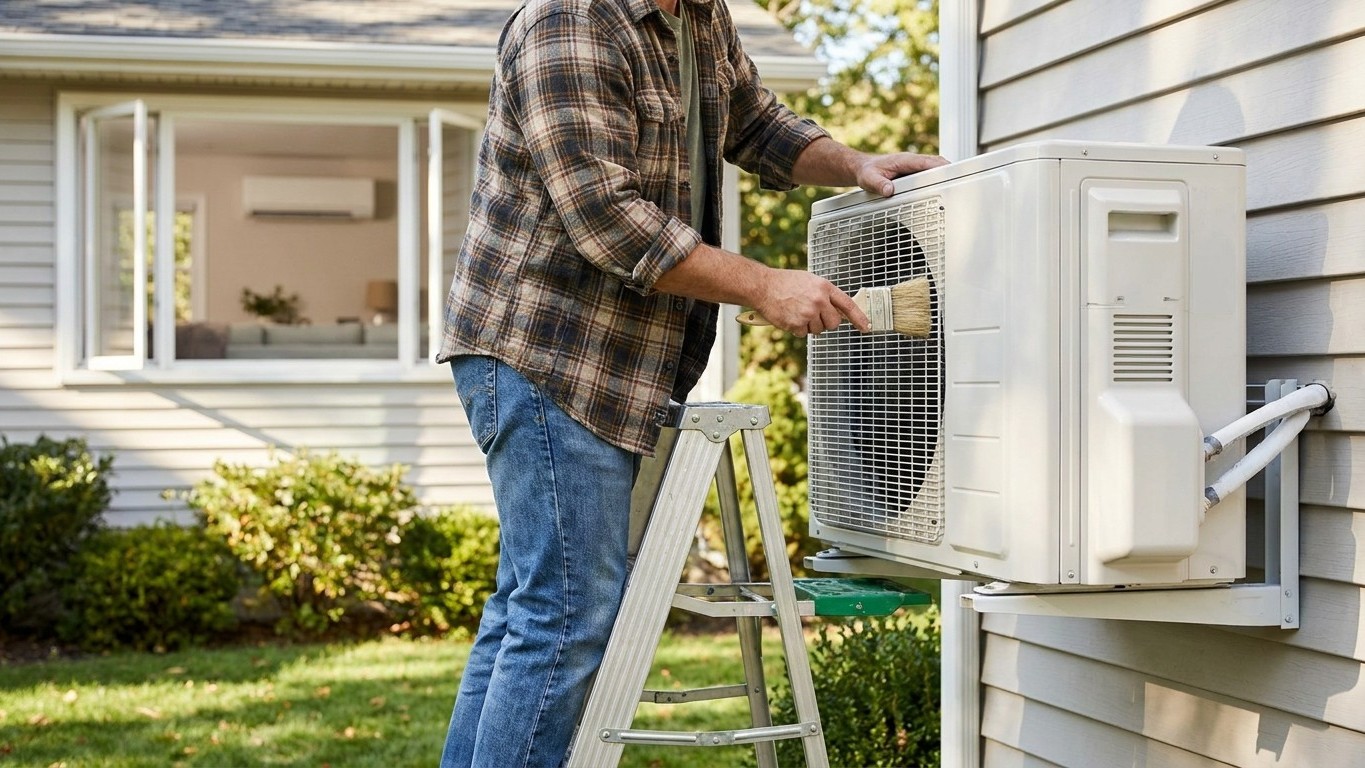

A ductless Mini-Split gets a maintenance pass twice a year: once before cooling season, once before heating season. Each pass takes maybe twenty minutes and covers two spots, the indoor head and the outdoor unit. There’s no ductwork to inspect and no furnace filter to swap, because a Mini-Split doesn’t have either. The system runs on washable screens, a coil, a fan, and a line set, and that shorter list is exactly why the seasonal pass is manageable for most homeowners on their own.
Twice, because it works all year

Here’s what separates a Mini-Split from a window AC unit or a central air conditioner that only runs from May to September: it’s a heat pump, which means it moves heat both directions. In summer it pulls heat out of the room and dumps it outside. In winter it reverses the cycle and pulls heat from the outdoor air into the house. There’s no off-season where the equipment sits idle for six months. That’s the whole reason the maintenance pass happens twice rather than once, the unit works twice as hard, in two different modes, and each mode stresses different parts.
Cooling mode means the indoor coil runs cold and wet, collecting condensate that has to drain properly. Heating mode means the outdoor coil runs cold enough to frost over periodically, and the unit defrosts itself by briefly reversing again. Doing the pass right before each mode starts catches problems before they become the season’s problem, a clogged drain found in April doesn’t turn into a puddle on the floor in July.
Worth saying plainly, because it saves confusion: a ductless mini-split has no ductwork. There’s an outdoor unit, one or more indoor heads mounted on a wall or ceiling, and a line set running between them that carries refrigerant, electrical power, and the condensate drain line. That’s the entire system. Any advice about duct leaks, sealing duct joints, or replacing a furnace filter is advice for a different kind of equipment entirely. If a homeowner has been told to go check their ducts, they’ve been handed someone else’s maintenance guide by mistake.
That distinction matters because it changes what the “twice a year” pass actually involves. Central systems have a duct network that can leak air at every joint, plus a furnace filter that needs monthly attention. A mini-split skips both of those categories completely. What’s left is shorter: two sets of washable screens per indoor head, a coil that needs occasional wiping rather than deep cleaning, and an outdoor unit that mostly needs to be kept clear of debris. The seasonal pass is smaller in scope than what a ducted system demands, and that’s not a downside, it’s one of the practical trade-offs of going ductless in the first place, covered in more detail on the mini-split vs. central air comparison.
The indoor pass
The indoor head is the part homeowners see every day, so it’s usually the easier half to remember. Still, it’s worth doing in order rather than rushing it, because a wet screen refitted too soon undoes the whole point of cleaning it.
- Switch the unit off at the wall control or remote, and let it sit for a few minutes so the coil isn’t actively cold or blowing air.
- Lift or unclip the front panel, most models hinge open without tools, though a few use small release tabs.
- Remove the screens (there are usually one or two per head) and wash them in warm water, using a soft brush if dust has built up in the mesh.
- Let the screens dry completely before touching anything else. This isn’t a five-minute step, plan on air-drying them flat for at least half an hour, longer in humid weather.
- While they dry, wipe the visible fins with a dry or barely damp cloth, working in the direction of the fins rather than across them, since aluminum fins bend easily.
- Wipe down the vanes (the louvers that direct airflow) and the outer housing with a damp cloth to clear dust that’s settled on painted surfaces.
- Check that the drain line running from the unit isn’t blocked, a quick visual check of where it exits the wall is usually enough, done while the unit is powered off and the coil has cooled.
The U.S. ENERGY STAR program puts it this way for the equipment it covers: “Inspect, clean, or change air filters once a month in your central air conditioner, furnace, and/or heat pump.” That sentence names central equipment, systems with ductwork and a furnace filter slot. A ductless head doesn’t have a filter to change; it has washable screens built into the unit itself. But the underlying idea, checking something monthly rather than letting it go a full year, is the same logic applied to those screens. In practice, most homeowners fall short of monthly and instead fold the screen wash into the twice-yearly pass, which is reasonable for a household without heavy dust, pets shedding indoors, or someone smoking inside. Households with any of those should check screens more often, regardless of season.
One thing the homeowner’s pass doesn’t cover: the barrel fan (the cylindrical fan inside the head that pushes air across the coil) and a full deep clean of the coil itself. Both can develop buildup that a wipe-down and a screen wash won’t touch, and both require partial disassembly that’s better left to a technician. If airflow feels weak even after screens are clean and dry, or if a musty smell persists, that’s the point where the pass stops being a chore and becomes a service call.
The outdoor pass
The outdoor unit is the half people skip, mostly because it’s small, tucked against a wall or up on a bracket, and easy to forget about compared to the head sitting in the living room. That’s a mistake, because the outdoor coil is doing just as much work and gets far less protection from the elements.
- Cut power at the disconnect switch near the unit, if one is installed, or turn off the breaker feeding the outdoor unit.
- Clear leaves, grass clippings, cottonwood fluff, and any other debris from on top of and around the unit, keeping at least a foot of open space on all sides where possible.
- Check that the coil (the finned surface, usually visible through the housing’s slats) isn’t smothered in dust, pollen, or matted leaves. A soft brush or a garden hose on low pressure, run from the inside out, usually clears light buildup.
- Check that the wall bracket or ground pad the unit sits on is still level and solid, cracked pads or loosened bracket bolts should be flagged for repair before they get worse.
- Clear the base drain opening at the bottom of the unit, since it’s an easy spot for debris and ice to collect unnoticed.
- Check the trunking (the cover protecting the line set where it runs along the exterior wall) and the lagging (the foam insulation wrapped around the refrigerant lines) for cracks, gaps, or sun damage.
ENERGY STAR’s broader point about airflow applies directly here: “Airflow problems can reduce your system’s efficiency by up to 15 percent.” A coil packed with debris or a unit crowded by shrubs is exactly the kind of airflow problem that quietly costs efficiency all season, whether the mode is cooling or heating.
In a snowy climate, the outdoor pass carries extra weight. Raising the unit clear of drifting snow (many installations already sit on an elevated bracket or stand for this reason) keeps the coil from being buried after a storm, which would force the unit to work through packed snow just to move air. The base drain matters more in winter too, since that’s where meltwater from the defrost cycle exits, a clogged base drain in freezing weather can let water pool and refreeze right where the unit needs to breathe.
What to notice between passes
The twice-yearly pass catches most things, but a handful of signs are worth acting on the moment they show up rather than waiting for the next scheduled check.
| What you notice | Usually points to | Where to check |
|---|---|---|
| Drain stops dripping on a humid day | Blocked condensate drain line | Mini-split leaking or dripping |
| Ice doesn’t clear within a defrost cycle | Frozen outdoor coil, often airflow-related | Mini-split freezing up |
| Head has become noticeably noisier | Loose panel, fan buildup, or worn fan bearing | Mini-split running loud |
| Smell returns within days of cleaning | Moisture trapped in coil or drain pan | Mini-split smells |
| Room takes longer than it used to | Reduced airflow or refrigerant loss | Mini-split not cooling or heating properly |
That last one deserves a plain word on refrigerant, since it comes up often. A mini-split is a sealed system, refrigerant doesn’t get “used up” the way a filter wears out. If a room is taking noticeably longer to reach temperature and the screens are clean, the coils are clear, and airflow checks out, the remaining explanation is usually that refrigerant has leaked out somewhere along the line set. That’s not something to chase down or top off at home; it calls for a technician who can find the leak and repair it properly.
Most of these signs show up gradually, which is exactly why they’re easy to miss between the spring and fall passes. A slightly longer cooldown time in July doesn’t feel urgent in the moment. But tracked against the last pass, a pattern like that is the difference between a five-minute screen wash and a service call three months later.
Common questions
Do I need to hire someone for the seasonal pass, or can I do it myself?
The indoor and outdoor steps described above are within reach of most homeowners with basic tools and no ladder work beyond a stepstool. What’s not a DIY step is anything involving the barrel fan, a deep coil clean, or refrigerant. Those require a technician.
Does a mini-split really not have a filter like a furnace does?
Correct. There’s no filter slot and no filter to buy. Each indoor head has washable screens built in, which get rinsed and dried rather than replaced. The ENERGY STAR guidance about monthly filter checks is written for central systems with actual filters; the screens on a ductless head follow the same rinse-and-dry idea but on a different schedule.
What happens if I skip a seasonal pass entirely?
Nothing breaks immediately, but airflow drops as screens and coils collect dust, and a system working harder to move the same air uses more electricity to do it. Left long enough, reduced airflow is also one of the conditions that can lead to a frozen coil in cooling mode.
Is the outdoor unit safe to hose down?
Light rinsing with a garden hose on low pressure, aimed from the inside of the coil outward, is generally fine once power is cut at the disconnect. Avoid pressure washers or aiming water directly at the electrical components or the fan motor housing.