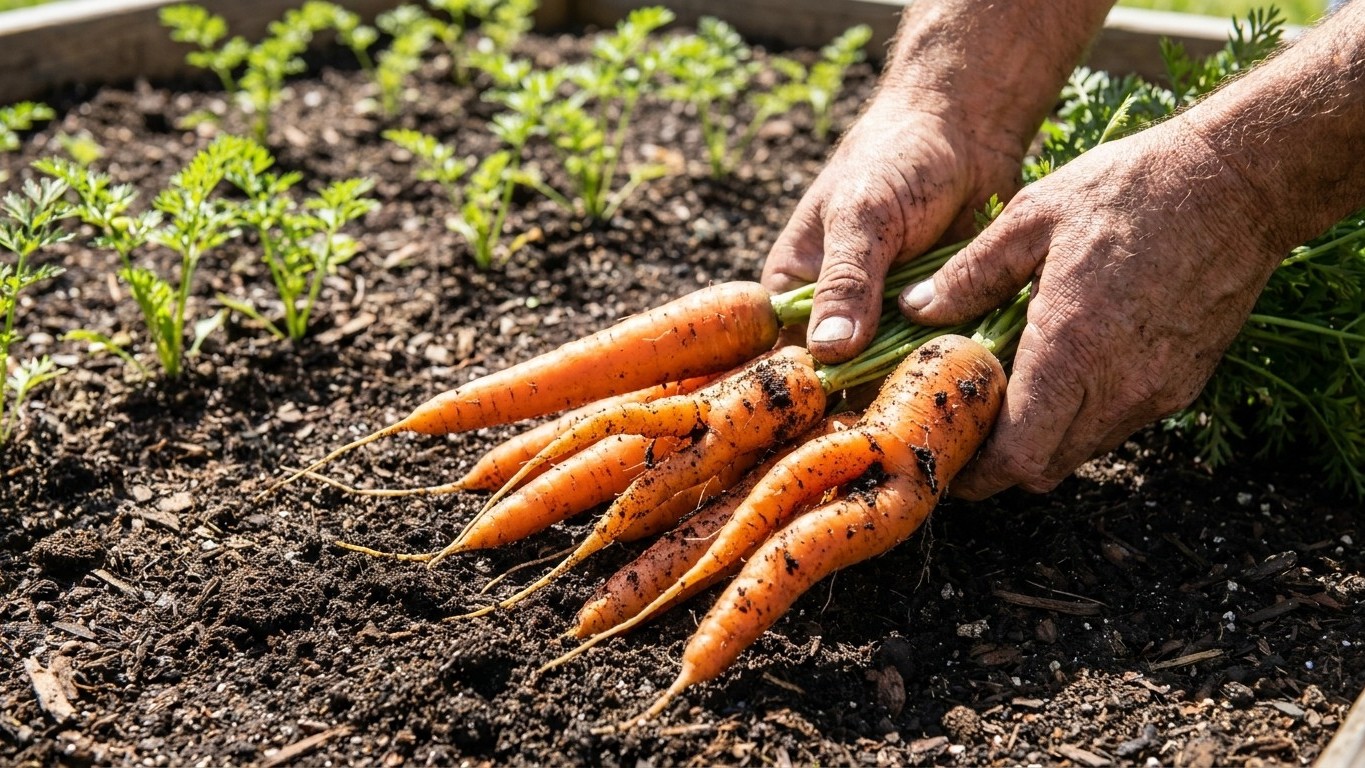

Carrots go into Nebraska ground as seed, straight into the row where they’ll stay, so gardeners typically start once the soil can be worked and count on roots being ready somewhere between 70 and 100 days later. But the frost date isn’t really what decides success here. What’s under your boots does. Nebraska’s official state soil, a deep prairie loam, shows what the ground in this region tends to do, and that tendency can turn a straight, tapered carrot into a forked, stubby one if nobody checks it first.
The short answer
Nebraska’s state soil, chosen by state law and studied under the USDA’s State Soils program, is the Holdrege series, a Mollisol, the dark, deep prairie soil that built the Corn Belt. Surface samples from the major components of this series run slightly acid, with a pH around 6.2, and the texture sits in loam-to-silt territory: about 11 percent sand, 22 percent clay, and 67 percent silt. Organic matter averages around 2.0 percent, and drainage is classified as well drained.
That combination is, on paper, closer to what a carrot wants than a lot of soils east or west of Nebraska. Carrots need deep, loose ground rich in organic matter, and they punish heavy or rocky soil by forking, splitting into two or three legs as the taproot hits resistance and swerves around it. A well-drained silt loam with modest clay, like the Holdrege profile, doesn’t automatically doom a carrot bed the way a dense clay pan or a gravel-choked subsoil would. The 22 percent clay figure is enough to matter, though, especially where a garden bed has been compacted by foot traffic, construction fill, or years of tilling wet. Clay at that level can crust after rain and resist a young taproot pushing down through it.
The organic matter number, close to 2.0 percent, is on the modest side for a vegetable bed that needs to stay loose and moisture-retentive all season. Compost is the fix, worked in generously before sowing, along with double digging if the bed has any history of compaction. Where the ground still feels tight and stubborn after that treatment, a raised bed filled with a loose, sifted mix solves the forking problem outright, because the carrot never has to fight native soil at all.
None of this is a diagnosis of your particular garden. Nebraska spans hundreds of mapped soil series, and the Holdrege profile represents the state in an official, symbolic sense, not a survey of every backyard in it. A lot fixed on a river bottom, a lot on a hillside, or a lot behind a new subdivision built on scraped and regraded fill can carry soil that has nothing in common with these numbers. Treat the state soil as a starting point for what the region tends toward, then find out what you’re actually growing in.
The test that settles it in your own garden
The only soil report that matters for your carrots is the one you take yourself, with a shovel, in the actual bed. It doesn’t require a lab, just a few minutes of digging and paying attention.
- Dig a hole where the carrots will grow. Go as deep as you can manage with a shovel or digging fork, and note whether you hit a hard, compacted layer, rock, or heavy clay before you’d expect the root to stop growing on its own.
- Look at what comes out of the hole. Loose, crumbly soil that breaks apart easily is a good sign. Soil that comes out in dense, sticky clods, or that’s full of stones and gravel, points toward forking trouble.
- Feel the texture between your fingers. Gritty soil that won’t hold a shape is sandy. Soil that rolls into a smooth ribbon and stays sticky when wet is high in clay. Something in between that feels silky and holds a loose shape is closer to a loam or silt.
- Run a drainage check. Fill the hole with water and watch how it behaves. Water that disappears steadily suggests decent drainage. Water that sits for a long stretch without moving down means the bed will stay soggy, and carrots planted there are more likely to rot or fork around waterlogged pockets.
- Repeat in more than one spot. Soil can change dramatically across a single yard, especially where a house, driveway, or old outbuilding has disturbed the ground. One good hole doesn’t confirm the whole bed.
None of these steps replace a lab soil test if you want an actual pH or nutrient reading, but for the specific question of whether your ground will let a carrot grow straight, this hands-on check tells you more than any state-level figure can.
What goes wrong here
Most carrot failures trace back to one of a small handful of causes, and nearly all of them are preventable once you know what to look for.
- Forking in heavy or compacted ground. Utah State University Extension is direct about this: heavy or rocky soil makes the root fork, and the fix is loosening the ground with compost and double digging before you sow, not switching to a different variety. Where the bed stays stubborn even after that work, build a raised bed with a loose fill instead of fighting the native soil year after year.
- Poor germination during a hot, dry stretch. Carrot seed is small and sits close to the surface, and it dries out fast in warm weather. Keeping the top inch of soil consistently damp until seedlings show, with light, frequent watering or a thin mulch layer, keeps a hot spell from wiping out a whole row before it even starts.
- Splitting from uneven watering. A carrot that grows through a dry spell and then gets a heavy soak can split along the root as it swells too fast. Steady, even moisture through the growing season, rather than long dry stretches followed by a flood, keeps the root growing at a consistent pace.
All three problems share a root cause, so to speak. Carrots are unforgiving of inconsistency, whether that’s inconsistent soil texture underground or inconsistent water on top. A bed that’s been loosened, amended with compost, and watered on a predictable schedule solves most of what goes wrong before it starts.
Common questions
Does Nebraska’s state soil tell me what’s in my own garden?
No. It represents the surface horizon of the Holdrege series as mapped across the state, not a measurement of any single cultivated bed. Your yard could sit on a completely different series, especially if it’s near a river, on a hillside, or on ground that’s been graded or filled during construction.
Do carrots need to be transplanted after starting indoors?
No. Carrots are sown directly into the row where they’ll grow to maturity. There’s no transplanting step, and the 70- to 100-day timeline to harvest is counted from the day you sow the seed, not from any later date.
What’s the actual fix for forked carrots?
Loosen the soil deeply with a digging fork or shovel, work in a generous amount of compost, and remove stones as you find them. If the bed stays heavy and compacted despite that effort, a raised bed filled with a loose growing mix avoids the problem entirely.
Is a pH of 6.2 automatically my soil’s pH?
No. That figure describes the representative surface horizon of the Holdrege series as recorded by USDA soil survey data, not a reading from your particular garden. A home soil test is the only way to know your actual pH.