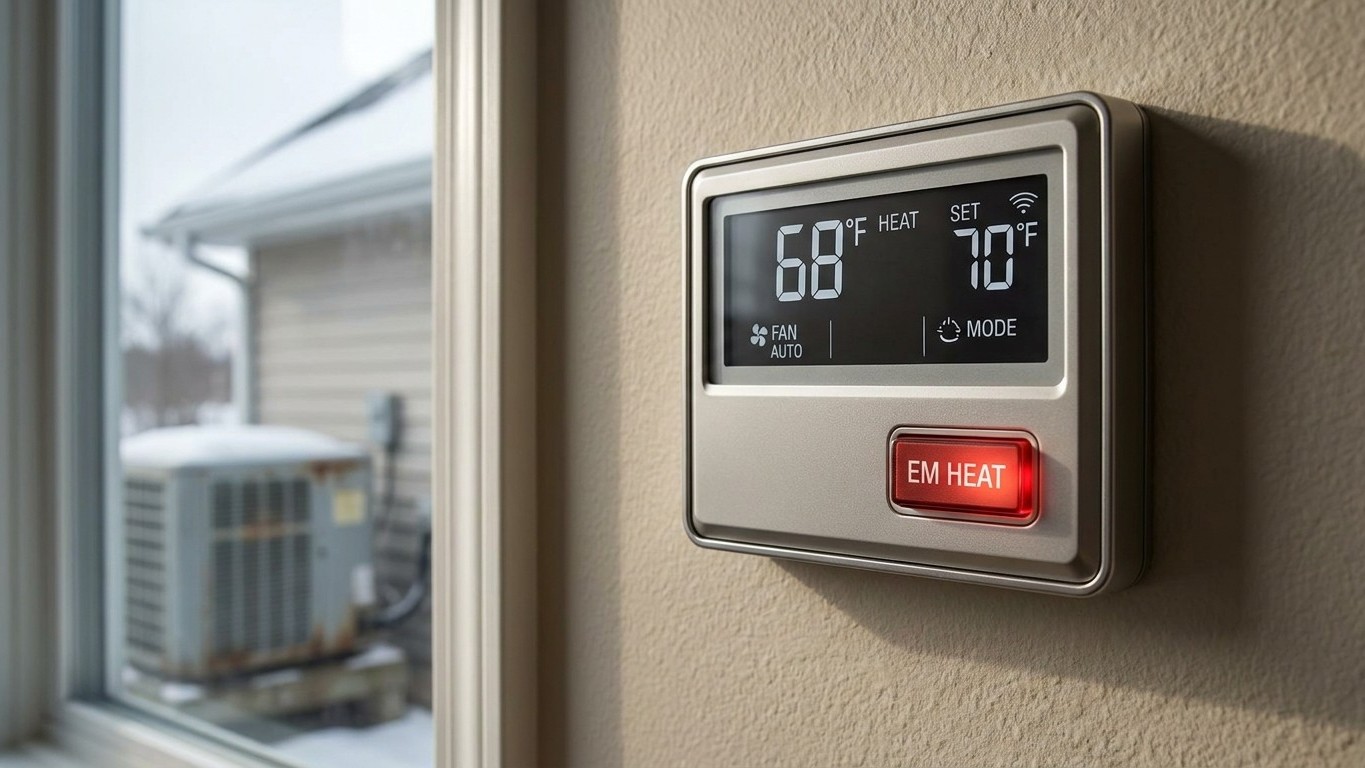

The EM HEAT button tells your heat pump’s outdoor unit to shut off completely and hand all the work to the backup heater, usually electric resistance coils. It exists for one reason: a broken outdoor unit. Flip it on for a cold night or a slow-to-warm house, and you’re paying for the most expensive way to heat your home when the efficient half of the system was working fine all along.
Two labels people confuse, and it costs money

Auxiliary heat and emergency heat sound like variations on the same idea. They aren’t. One is a decision your system makes on its own, constantly, without you noticing. The other is a decision you make, manually, that overrides the system entirely. Mixing them up is where a lot of unnecessary heating costs start.
Auxiliary heat kicks in when the Thermostat calls for more heat than the heat pump alone can currently deliver, maybe during a sharp cold spell or right after a big setback recovery. The heat pump keeps running in the background, and the backup coils add supplemental warmth on top of it. Nobody touches a button. The system’s control board handles the whole thing and shuts the backup off again once the gap closes.
Emergency heat is different in almost every respect. You select it yourself, usually with a switch or a Thermostat menu labeled EM HEAT. Once it’s on, the outdoor unit stops entirely. The compressor doesn’t run. The whole heating load shifts to the backup system by itself, and it stays that way until you switch it back off.
| Setting | What it is | Who decides | What runs | Manual selection? |
|---|---|---|---|---|
| Auxiliary heat | Automatic supplemental heat during high demand | The system’s control board | Heat pump + backup together | No, never selected by hand |
| Emergency heat | Manual override that disables the heat pump | The occupant | Backup heater alone | Yes, and only when the heat pump has failed |
That last column is the one worth sitting with. Auxiliary heat isn’t a setting you manage at all, it’s just part of how the system behaves under load, and you can read more about what that looks like in practice in our guide on how auxiliary heat works. Emergency heat, on the other hand, is a switch that should sit untouched for years at a stretch. If you’ve never needed it, that’s not a sign you’re missing out on some winter feature. It’s a sign your heat pump has been doing its job.
The one situation that justifies it
Emergency heat exists for exactly one scenario: the outdoor unit is broken and can’t run. Maybe the compressor has failed. Maybe the unit is encased in ice that a normal defrost cycle isn’t clearing. Maybe a storm knocked a branch into the fan or wiring got damaged. In any of those cases, the outdoor half of your system is out of commission, and emergency heat is the bridge that keeps the house livable until a technician gets there.
That’s the whole use case. It is not for a cold snap that’s pushing the heat pump harder than usual. It is not for a house that seems to take its time warming up on a frigid morning. It is not for the one night you’d like things a few degrees warmer, faster. In all of those situations the heat pump is working exactly as designed, and auxiliary heat, not emergency heat, is the feature built to help it along automatically.
The reason this distinction matters comes down to one sentence: on emergency heat, the entire house is heated the expensive way, with the efficient part of the system switched off on purpose. A heat pump moves existing heat from outdoor air into your home rather than generating it from scratch, which is what makes it efficient in the first place. Backup resistance heat generates heat directly, and it’s designed as a supplement or a stopgap, not as a full-time replacement. Running the whole house on it, night after night, isn’t a performance boost. It’s the compressor sitting idle while the coils do all the work alone.
How cold it has to get before a given heat pump genuinely struggles depends on the specific model and the specific house, and this brief won’t hand you a number that doesn’t apply to your equipment. The mechanism is simple enough on its own: colder outdoor air holds less transferable heat, so capacity drops as temperatures fall. Where that drop actually matters is a question your unit’s own specification sheet answers, not a general rule of thumb. If you’re unsure whether your system is underperforming or just working through genuinely difficult conditions, that spec sheet, along with a service call if the unit seems iced over or unresponsive, is the right next step, not the EM HEAT switch.
Why people switch it on anyway
None of this is about anyone being careless. The three reasons people reach for emergency heat all make sense on the surface, and all three are misreadings of a heat pump behaving normally.
The first is the air itself. Vent air from a heat pump runs noticeably cooler than what a furnace puts out, even when the system is heating the house correctly, because it’s moving a larger volume of moderately warm air rather than a smaller volume of very hot air. Feeling that air and assuming something’s wrong is common, and it’s covered in more detail in our piece on why heat pump air feels cool even when it’s working.
The second is runtime. Heat pumps are built to run in long, steady cycles rather than short bursts, especially in cold weather, and that constant hum can read as the system struggling when it’s actually just operating efficiently at low, sustained output. If that’s what’s driving the concern, it’s worth checking our guide on why heat pumps run continuously in winter before touching any switch.
The third is advice passed along secondhand, the idea that emergency heat is simply “the winter setting” and should be flipped on once the weather turns. It isn’t, and no manufacturer designs it that way. It’s a repair bridge, not a seasonal mode.
Say this plainly: leave emergency heat on through a full winter, thinking of it as extra warmth or added reliability, and the bill that arrives is one people remember. This is one of the most common and most avoidable mistakes made on heat pump systems, precisely because the switch is easy to find and the consequence doesn’t show up until the next statement lands. If the house feels off, the fix is almost never that switch. It’s confirming the outdoor unit is actually running, checking for ice that hasn’t cleared on schedule, and calling a technician if either one looks wrong.
And the setback question, since it lands here too
Thermostat setbacks come up in the same breath as emergency heat because they can trigger the exact same backup heat you were trying to avoid, just from a different direction.
The U.S. Department of Energy states it this way: “You can save as much as 10% a year on heating and cooling by simply turning your thermostat back 7-10 F for 8 hours a day from its normal setting.” That figure is well established and it’s a genuine yearly savings estimate, based on a combined heating and cooling picture, for a specific setback depth and duration. It’s not a rate that scales with every extra degree, and it’s not a promise tied to any one type of heating system.
That’s exactly where the caveat for a heat pump belongs. The DOE figure describes typical heating and cooling equipment broadly. A deep overnight setback on a heat pump creates a recovery problem in the morning: the thermostat wants the house back up to temperature quickly, and the heat pump’s steady, moderate output isn’t built for a fast catch-up. So the backup heater switches on, the same auxiliary heat covered earlier, and it runs until the gap closes. The savings from the setback get spent right back, sometimes more than spent, in that recovery period.
None of that makes the DOE’s number wrong. It’s a general figure for a general case, and a heat pump recovering from a large setback is simply the case it wasn’t built to describe. The practical takeaway is smaller, gentler adjustments rather than one dramatic overnight drop, and a programmable or smart thermostat that eases the temperature back up gradually instead of demanding it all at once. Our guides on thermostat settings for heat pumps and on programmable thermostat schedules walk through how to set that up without waking up to a backup heater that’s been running for an hour.
Common questions
Is it bad to leave the thermostat on EM HEAT by accident?
For a short stretch, no lasting harm is done, but the heating cost climbs immediately because the backup heater is carrying the entire load instead of the heat pump. Check the setting any time the house feels off or the bill looks unusually high.
Will EM HEAT damage my heat pump?
No. Selecting it simply idles the outdoor unit; it doesn’t run and can’t be damaged by sitting off. The cost is financial, from running backup heat full-time, not mechanical.
How do I know if my outdoor unit has actually failed versus just working hard in the cold?
A unit that’s iced over well beyond a normal defrost cycle, silent when it should be running, or visibly damaged points to failure. A unit that’s running constantly but the house is still warm is very likely just working normally in cold weather. When in doubt, a technician can check it faster than guessing.
Does emergency heat use gas or electricity?
That depends entirely on what backup system is installed. Many heat pumps pair with electric resistance coils, in which case emergency heat runs on electricity. Systems paired with a gas furnace as backup are a different setup, sometimes called dual-fuel, where that half of the system uses combustion instead.