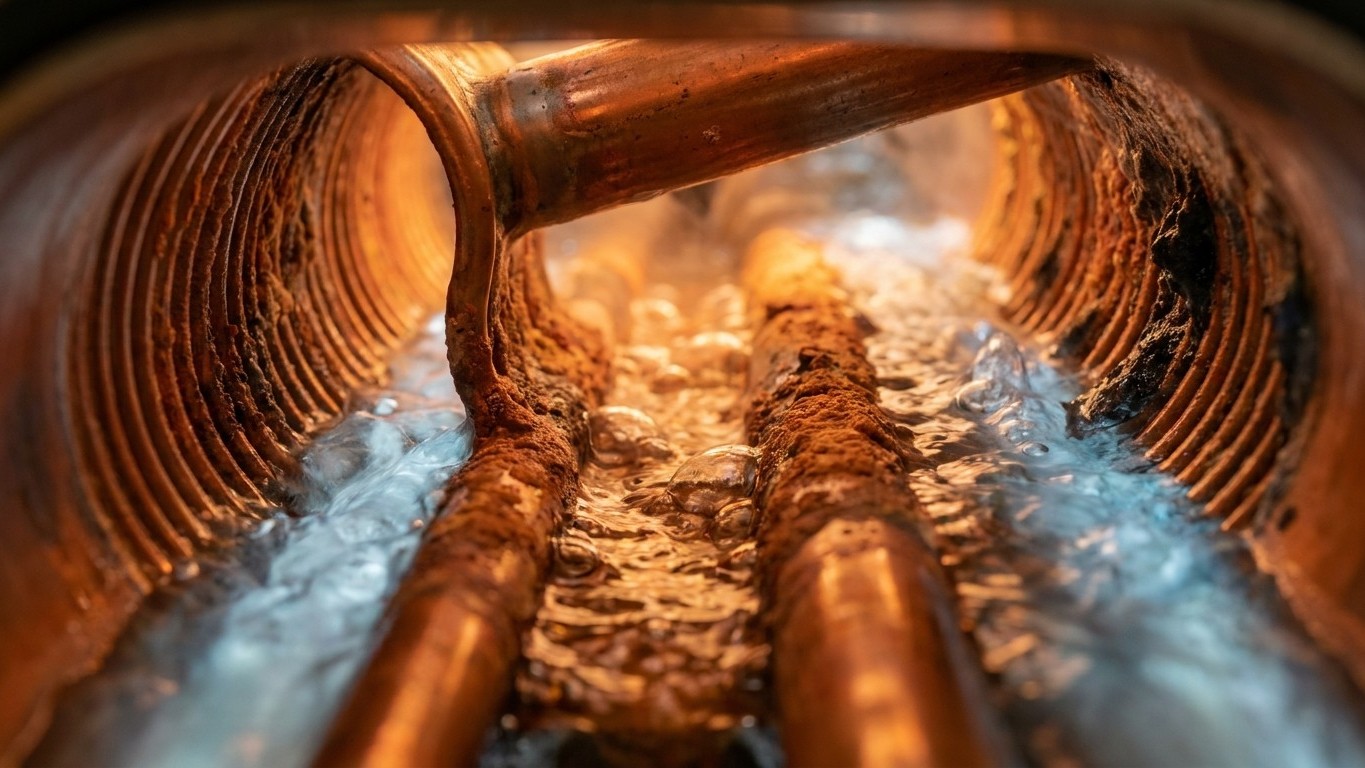

That rumbling or gurgling sound coming from a boiler is water boiling inside a part of the system that was never designed to let it reach that point. It signals restricted flow around the heat exchanger, usually from scale or sludge buildup, and it’s a sign the appliance needs professional attention before the heat exchanger itself takes damage.
The sound of water boiling where it should not

The name gives away the mechanism. Kettling happens because water sitting against the hot metal surface of the heat exchanger reaches boiling temperature locally, even though the water throughout the rest of the system stays well below that point. In a healthy boiler, water circulates fast enough to carry heat away from the exchanger surface as quickly as the burner adds it. Nothing gets the chance to overheat.
When circulation slows down or a layer of Insulating buildup coats the exchanger walls, a thin film of water gets trapped against the metal for too long. That film superheats, forms steam bubbles, and those bubbles collapse violently the instant they touch cooler water flowing past. Each collapse sends a small shockwave through the exchanger. Multiply that by hundreds of tiny implosions a second and you get the rumbling, popping, kettle-like noise that gives the fault its name.
Not the same as banging pipes
It’s worth separating this clearly from banging or hammering pipework, which is a different problem covered on this site’s radiator pages. Water hammer in the distribution pipes usually comes from trapped air, a sudden valve closure, or a loose pipe knocking against a joist. That noise travels through the house’s plumbing runs, often loudest near radiators or shutoff valves. Kettling, by contrast, originates inside the boiler itself, right at the heat exchanger, and it tends to sound more like a low grumble or a kettle just before it whistles. One is a plumbing noise. The other is a heat exchanger under thermal stress. Both deserve attention, but they call for different fixes, and mixing them up wastes time diagnosing the wrong part of the system.
A technician can usually confirm kettling just by listening near the boiler casing while it fires, then checking whether the noise fades as the unit reaches its running temperature or persists throughout the cycle. Persistent, escalating rumbling almost always points back to the exchanger surface itself.
Scale, sludge, or too little flow
Three distinct culprits produce the same symptom, and a technician has to narrow down which one is at work before recommending a fix.
- Limescale. In hard-water regions, calcium carbonate deposits build up on the heat exchanger’s internal surfaces over time. That layer acts like insulation, forcing the flame side to run hotter to push the same amount of heat through the scaled surface. Water trapped against that rough, coated surface boils locally well before the bulk system water gets anywhere close.
- Magnetite sludge. This is a black iron oxide byproduct of corrosion inside radiators and steel pipework, unrelated to water hardness. It circulates through the system and settles wherever flow slows down, often right inside the heat exchanger. Older systems without a working inhibitor or filter are especially prone to it, and it produces the same Insulating, overheating effect as scale.
- Restricted flow rate. Sometimes the exchanger itself is clean, but a failing circulator pump or a partially closed or stuck valve cuts the volume of water moving through it each minute. Less water passing means less heat carried away, and the same localized boiling shows up even without any scale or sludge present.
How a technician tells them apart
Diagnosis usually starts with draining a sample and inspecting the color and texture of the water, since dark, gritty sludge points to magnetite while a chalky residue points to scale. A technician will also check the local water hardness, inspect any magnetic filter already installed for what it has trapped, test the pump’s output against its rated flow, and check whether a zone valve or diverter valve is opening fully. Chemical test kits for inhibitor concentration can also flag a system that’s been running unprotected for years, which raises the odds that both scale and sludge are contributing at once.
What it costs to ignore
Kettling means the heat exchanger is running hotter than it was engineered to run. That’s the core problem, and it doesn’t resolve on its own. The insulating layer of scale or sludge keeps building, the flame side keeps compensating with more heat, and the metal experiences repeated cycles of localized overheating and cooling. That kind of thermal stress leads to fatigue, hairline cracks, and eventually leaks in the exchanger itself, which is one of the most expensive components in the entire appliance to replace. A boiler running with kettling is also almost certainly delivering less of its fuel energy as usable heat. AFUE, the ratio of a boiler’s annual heat output to the total annual fuel energy it consumes, reflects how much of that energy actually reaches the home versus how much leaves up the flue. A unit fighting scale or sludge buildup is working against its own design efficiency every time it fires.
The remedies match the three causes above, and none of them are do-it-yourself jobs. A system flush, sometimes called a power flush, forces water at higher velocity through the pipework and heat exchanger to dislodge sludge and loosen scale deposits. A chemical inhibitor gets added afterward to slow future corrosion and mineral buildup, and it needs periodic testing to confirm it’s still at the right concentration. A magnetic filter installed in the return pipe captures magnetite before it can recirculate back into the exchanger, and it needs to be opened and cleaned out on a schedule, not left untouched indefinitely. All three are standard parts of a professional annual boiler service, which is also the point at which a technician checks the heat exchanger, flue, and combustion safety together rather than one at a time.
Because a boiler is a fuel-burning appliance, a heat exchanger under stress is also a combustion safety issue, not just an efficiency one. Carbon monoxide is colorless and odorless, and a working CO alarm in the home is required regardless of how minor the kettling might seem. An electric boiler doesn’t carry this particular risk since it burns no fuel, but any gas, oil, or propane unit does. The U.S. Fire Administration puts the standard plainly: “Maintain heating equipment and chimneys by having them cleaned and inspected each year by a professional.”
Common questions
Is boiler kettling dangerous?
On its own, the noise isn’t an immediate safety emergency, but it signals a heat exchanger under abnormal thermal stress that can crack or leak over time. Because the appliance burns fuel, any change in its behavior is worth having checked promptly, and a working carbon monoxide alarm should already be installed near the appliance regardless.
Can I fix boiler kettling myself?
No. Diagnosing whether the cause is scale, sludge, or a failing pump requires draining and inspecting the system, and the fixes, a power flush, inhibitor dosing, or a magnetic filter install, involve working directly on a pressurized, fuel-burning appliance. This is service work for a licensed technician.
Does kettling always mean I need a new boiler?
Not usually. Most cases resolve with a flush, inhibitor treatment, and a magnetic filter, especially when caught early. A full replacement only becomes necessary if the heat exchanger has already cracked or if repeated overheating has damaged other components beyond repair.
How is kettling different from banging pipes?
Kettling originates inside the heat exchanger from localized boiling, and it sounds like a low rumble or grumble tied to the burner cycle. Banging pipes, covered separately on this site’s radiator pages, come from trapped air or water hammer in the distribution pipework, and the noise tends to travel through the walls or floor rather than staying near the boiler itself.