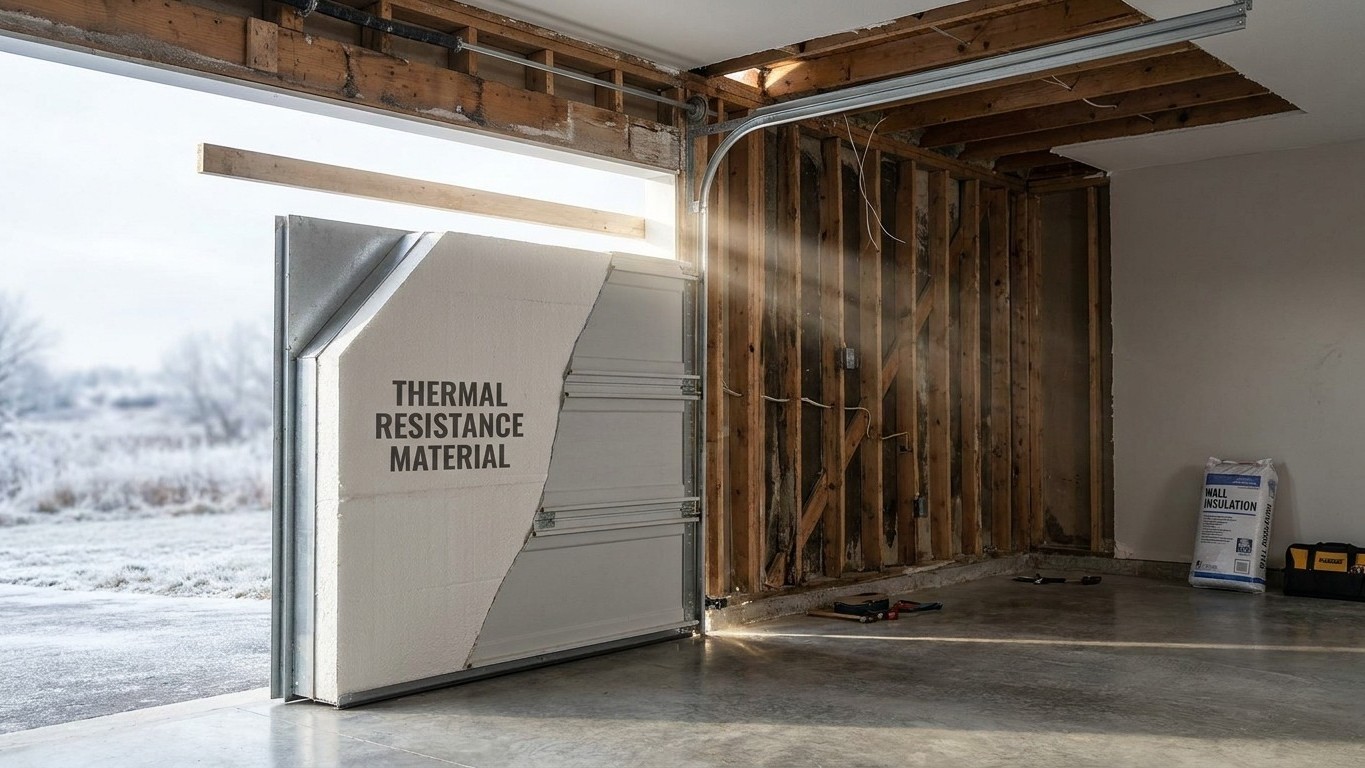

An insulated garage door changes very little if the rest of the garage stays outside your home’s thermal envelope. The door is one panel in a much bigger boundary, walls, ceiling, and the gaps around all of it. It’s worth doing when the garage itself is heated or cooled, or when a living space sits directly above it. Otherwise, the Insulation mostly keeps the garage’s own air a bit steadier, not your utility bill.
What is actually going on

Here’s the part most people skip past: a garage is usually built outside the thermal envelope of the house. The envelope is the continuous boundary of Insulation and air sealing that separates conditioned space from everything else, attic, crawl space, and yes, the garage. The wall between the garage and the house is part of that boundary. The garage door is not, unless the garage itself is meant to be conditioned.
That distinction changes what an insulated door actually does. Heat moves through the door by conduction, and an insulated panel slows that down. But if the garage’s side walls, the ceiling, and the gaps around the door frame are still uninsulated and unsealed, the garage keeps swinging with the outdoor temperature almost as much as before. You’ve reduced one path for heat flow while leaving several others wide open. The door gets a little warmer to the touch. Your thermostat doesn’t notice.
This is where it helps to look at what the U.S. Environmental Protection Agency’s ENERGY STAR program has actually measured. Its modeling finds that “homeowners can save an average of 15% on heating and cooling costs (or an average of 11% on total energy costs) by air sealing their homes and adding Insulation in attics, floors over crawl spaces, and accessible basement rim joists.” Read that sentence closely. It names three specific locations: attics, floors over crawl spaces, and accessible rim joists. Garage doors and garage walls aren’t on that list, and the percentages don’t stretch to cover them. That’s not a knock on garage work, it just means the well-documented savings figure belongs to a different part of the house, and nobody should borrow it to justify a garage door purchase.
What the door Insulation does buy you is more modest and more local: less temperature swing inside the garage, a warmer surface on cold mornings, and, if the garage shares a wall with living space, a smaller temperature difference across that shared wall. Whether that’s worth doing depends entirely on what’s on the other side of the door, and what’s happening in the rest of the garage’s shell. That’s the actual decision, and it’s the subject of the next section.
Where it belongs, and where it does not
The honest answer is that garage door insulation is a good fit for a short list of situations, and a poor use of effort in the rest. Laid out plainly, it looks like this:
| Situation | Does the door matter? | What goes wrong if it’s used in the wrong place |
|---|---|---|
| Heated or cooled workshop garage | Yes, the door is now part of the conditioned envelope, same as any exterior wall | Skipping the walls and ceiling while insulating only the door leaves the bigger heat losses untouched |
| Room built directly above the garage | Yes, but the floor between them matters more than the door | Insulating the door while leaving that floor cavity empty does little for the room upstairs |
| Attached garage, uninsulated, used for storage/parking only | Marginal, the door reduces swing inside the garage itself | Treating it as a home energy upgrade overstates what it delivers |
| Detached garage with no conditioning | Low priority | Money and effort spent here don’t touch the house’s energy use at all |
| Garage housing a furnace, water heater, or other combustion appliance | Insulate and seal only after the appliance’s combustion air needs are evaluated | Tightening the space without that check can starve the appliance of air it needs to vent safely |
The room-above-garage case deserves a closer look, because it’s the one where a real number applies. ENERGY STAR’s retrofit guidance for existing wood-framed buildings gives floor insulation targets by climate zone, and that floor value is exactly the assembly separating a garage from a room above it:
| Climate zone | Attic if currently uninsulated | Attic if you already have 3–4 inches | Floor |
|---|---|---|---|
| Zone 1 | R30 | R25 | R13 |
| Zone 2 | R49 | R38 | R13 |
| Zone 3 | R49 | R38 | R19 |
| Zones 4A and 4B | R60 | R49 | R19 |
| Zones 6, 5, and 4C | R60 | R49 | R30 |
| Zones 7 and 8 | R60 | R49 | R38 |
Those attic columns aren’t three versions of the same number, two describe attic insulation depending on what’s already up there, and the third is the floor value, which is the one that applies over a garage. Which row applies to your address isn’t something this page can tell you: ENERGY STAR publishes climate zones as a map, not a state-by-state list, and the boundaries don’t follow state lines. Check the map before buying material to that number, not a guess based on where you live.
Notice, too, that a fire-rated ceiling assembly between garage and living space is doing a job that has nothing to do with energy: it’s the barrier that slows a garage fire from reaching the house. Adding insulation there doesn’t replace that fire separation, and any work on that ceiling should leave it intact.
The moisture side of the decision
Every insulation decision is also a moisture decision, whether anyone thinks of it that way or not. An empty cavity dries in whatever direction moisture happens to push it. Add insulation, and you slow that drying down, sometimes on purpose, sometimes by accident. Garage assemblies are no exception, and they come with their own quirks: a garage often isn’t heated the way the house is, humidity swings more with the weather, and a car pulling in wet or salted brings moisture inside that a living room never sees.
The core question for any wall or ceiling cavity is which direction it’s supposed to dry, and what would stop that from happening. A vapor retarder placed on the wrong face of an assembly can trap moisture inside a wall instead of keeping it out, and that’s a slower, quieter kind of damage than a leak, it shows up as rot or mold months or years later, not the day it happens.
This is exactly where a national page has to stop and say so plainly: vapor control is climate-dependent, and there is no single rule that applies from Minnesota to Florida. The model energy code does not require an interior vapor retarder at all in the three warmest climate zones, where the drying direction and the risk profile are simply different from a cold northern climate. Anyone insulating a garage wall, ceiling, or the wall shared with the house should work from the vapor barrier guidance for their own climate, not a blanket rule repeated for the whole country.
One more distinction worth keeping straight: a vapor retarder and an air barrier are not the same thing, even though people use the words loosely. A vapor retarder slows the diffusion of water vapor through a material. An air barrier stops bulk air movement, which carries far more moisture, far faster, than diffusion ever does. Sealing air leaks around a garage door frame, wall penetrations, and the top and bottom plates of garage walls is an air-barrier job, separate from whatever vapor retarder decision applies to the climate. Skipping air sealing and hoping a vapor retarder covers for it is a common way this goes wrong.
None of this is a reason to avoid insulating a garage where it makes sense. It’s a reason to get the sequence and the direction right before buying material, because the fix for a mistake made inside a closed wall cavity is a lot more involved than the original job.
What to settle before you buy anything
Air sealing comes before insulating, not after, and not alongside it as an afterthought. ENERGY STAR treats the two as one project with sealing first, because insulation slows conduction but does nothing to stop air leaking straight through gaps, and a well-sealed cavity is what lets any added insulation actually perform the way its rating suggests. That 15%/11% figure quoted earlier belongs to sealing and insulating together, not to insulation installed on top of leaks nobody closed.
Before buying anything, three checks settle most of the decision:
- What’s already in the cavity. Pulling back a section of drywall or reaching into an attic access to feel for existing insulation tells you whether you’re starting from zero or adding to a partial depth, and the table above shows those are two different target numbers.
- Whether the cavity is even accessible. A finished garage ceiling, a wall with no access panel, or a floor assembly with no way to reach it from below all change what’s realistic without opening things up.
- What else is sharing that space. A furnace, water heater, or any other combustion appliance in the garage means air sealing work needs an evaluation of combustion air supply first, tightening a space that appliance depends on for makeup air is not a step to take without that check.
A few safety points apply whenever this work is underway. Walk on joists, never on the material between them, in any attic or floor cavity. Material that looks loose-fill and grayish or that resembles vermiculite should not be disturbed or handled until it’s been assessed, some vermiculite insulation installed decades ago contains asbestos. Recessed lighting and flue pipes both have clearance requirements set by the fixture or appliance manufacturer, and insulation piled against either one is a fire hazard, not a savings opportunity.
Federal tax credit for residential energy efficiency work closed at the end of 2025 and isn’t part of the current picture. State energy offices and local utilities still run their own rebate programs for insulation and air sealing, and eligibility and paperwork vary by state, checking your own state’s energy office before buying material is worth the ten minutes it takes.
Common questions
Does an insulated garage door lower my house’s heating bill?
Only if the garage is part of the conditioned space or shares a wall or ceiling with living space that’s also being sealed and insulated. On its own, in an otherwise uninsulated garage, the effect stays mostly inside the garage.
What R-value should a garage door have?
There’s no single national figure to quote here, and the door’s R-value only matters relative to the rest of the garage’s shell. A well-insulated door paired with uninsulated walls and ceiling is an unbalanced assembly.
Is it worth insulating a detached garage?
Rarely for home energy savings, since a detached structure isn’t touching the house’s thermal envelope at all. It can still be worth it for comfort inside the garage itself, which is a different goal.
Should I insulate the garage ceiling myself?
Only after checking what the ceiling is doing structurally and as a fire separation between garage and house. If a combustion appliance sits in that garage, get its air supply evaluated before sealing anything around it.