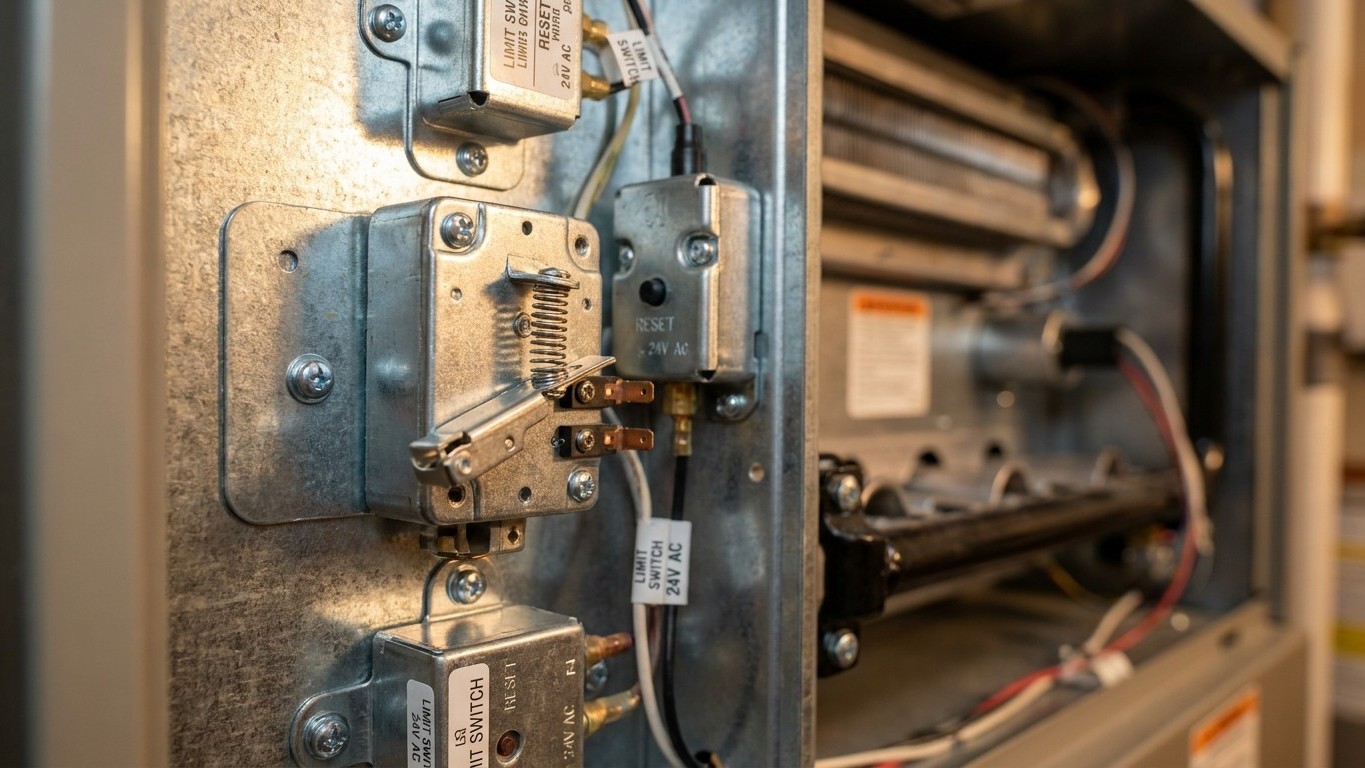

A furnace limit switch is a safety control that shuts the burner or blower down when it senses a condition outside its safe range, most often too much heat building up inside the cabinet. It is not a defect and not something to disable. It is the furnace telling you, in the only language it has, that something upstream needs attention before it runs again.
A furnace full of reasons to stop

Open the cabinet of a modern furnace and you will find more than one switch standing guard. Each one watches a single condition, and each one has the authority to cut power to the burner, the blower, or both, independent of what any thermostat is asking for. A furnace that shuts down mid-cycle has not necessarily failed. In a real sense, it has done its job: it refused to keep running under a condition it was built to reject.
That distinction matters more than it sounds like it should. Homeowners tend to treat a shutdown as the problem itself, something to make stop happening. But the switch is a messenger, not the message. It trips because a heat exchanger got hotter than its rating allows, or because flame found its way somewhere it should never be, or because a draft the burner depends on failed to develop, or because a panel was left loose. None of those are caused by the switch. The switch is simply the part built to notice.
This is true whether the furnace burns natural gas, propane, or fuel oil, and it is true in states where oil heat still dominates the housing stock as much as it does in parts of the Northeast. The fuel changes how combustion happens and which switches are present, since an electric furnace has no flame and no rollout risk. But the underlying logic of every fuel-burning furnace is identical: a set of independent switches, each tied to one measurable condition, each able to stop the machine on its own.
So the question worth asking after a shutdown is never how to make the tripping stop. It is what condition the switch saw. Answer that, and the tripping stops on its own because the thing causing it is gone. Chase the symptom instead, and you are left guessing at a machine that was, from the start, trying to tell you something specific.
The next section breaks down the switches homeowners run into most often, what each one is actually watching, and how to tell a comfort inconvenience from something that needs a technician today rather than this weekend.
The four you are most likely to meet
Most furnace shutdowns trace back to one of four switches. They look similar and do similar work in the sense that all four break an electrical circuit, but the condition behind each one is different, and so is the level of concern it should raise.
| Switch | What it senses | What it usually means | Type of problem |
|---|---|---|---|
| High-limit switch | Air temperature inside the heat exchanger is above its safe ceiling | Not enough air is moving across the exchanger to carry the heat away | Almost always an airflow issue, a comfort problem until ignored too long |
| Rollout switch | Flame is present outside the burner box, where it should never be | A venting or combustion problem is pushing flame backward | Serious. Treat every trip as a signal to stop using the furnace and call a technician |
| Pressure switch | Whether the draft the burner needs to operate safely has actually developed | Venting is blocked, restricted, or the inducer motor isn’t performing | Safety-related; the furnace will not fire without it |
| Door or panel switch | Whether the blower access panel is fully seated in place | Panel left off, loose, or not latched after a filter change or service visit | Simple mechanical fix, no diagnosis needed |
The high-limit switch is the one most households meet repeatedly, because it responds to something that changes month to month: how easily air moves through the system. The pressure switch belongs to fuel-burning furnaces specifically, since it exists to confirm that combustion gases have somewhere safe to go before the burner is allowed to light. The door switch is the least dramatic of the four and the easiest to resolve, usually solved by reseating a panel that did not click all the way into place.
The rollout switch deserves its own sentence, said plainly and only once: it is watching for flame in a place flame should never reach, and a trip means the combustion process is not behaving the way the furnace was designed for. That is not a switch to reset repeatedly and move on from. It is a switch that earns a service call before the furnace runs again.
Most of them come back to airflow
Here is the pattern that ties most nuisance shutdowns together: the high-limit switch trips because too little air is passing across the heat exchanger, so heat that should be carried into the ductwork instead builds up right where the switch is watching. The fix is rarely the switch itself. It is whatever is standing between the blower and the rooms it is supposed to heat.
According to ENERGY STAR, “Airflow problems can reduce your system’s efficiency by up to 15 percent.” That is not a small margin in a furnace working through a New England winter, and it is exactly the kind of restriction that pushes a high-limit switch toward its ceiling. ENERGY STAR also recommends a habit most households let slide: “Inspect, clean, or change air filters once a month in your central air conditioner, furnace, and/or heat pump.” Monthly, across all three types of equipment, not once a season.
Where to check, cheapest first
The order below is deliberate. Start with what costs nothing and takes two minutes, and only move down the list if the problem persists.
- Check the air filter first. A clogged filter is the single most common cause of a high-limit trip, and it is the cheapest thing in the entire system to fix.
- Walk the house and make sure supply registers and return grilles are open, not blocked by furniture, rugs, or curtains pushed in front of them.
- Confirm interior doors aren’t closing off return airflow to rooms that need it, which can starve the system even with a clean filter.
- If airflow still feels weak, have a technician inspect the duct system itself. Undersized, crushed, or leaking ducts can’t carry what the blower is trying to move, and no filter change fixes that.
Follow that order and most high-limit trips resolve without ever touching the switch. It was never broken. It was reporting exactly what it was built to report.
The one thing never to do
None of these switches gets bypassed, jumpered, or taped shut, and a switch that keeps tripping is never replaced simply to make the tripping stop. Every one of them exists to report a real condition inside the furnace, and the condition is what gets fixed, not the messenger.
The stakes are not theoretical. According to the U.S. Consumer Product Safety Commission, “Each year, more than 200 people die from unintentional non-fire related carbon monoxide poisoning associated with consumer products. Heating equipment and portable generators are among the top contributors to CO deaths.” That figure covers consumer products broadly, not furnaces alone, but heating equipment sits among the leading contributors, and a defeated rollout switch is precisely the failure path that lets combustion products escape into a living space instead of venting outside where they belong.
This is a fuel-burning furnace concern specifically, tied to natural gas, propane, and oil systems that produce combustion byproducts. Electric furnaces don’t carry the same risk, since there’s no flame and no rollout switch involved. But in any home with a fuel-burning furnace, an annual inspection by a qualified technician and a functioning carbon monoxide alarm are the backstop that a safety switch alone cannot replace. The CPSC is direct about this: “Install battery-operated CO alarms or CO alarms with battery backup on every level of the home and outside sleeping areas. Interconnected CO alarms are best; when one sounds, they all sound.”
A CO alarm is not a substitute for a propane leak detector, and the two should never be treated as interchangeable. One watches for combustion byproducts after fuel has already burned; the other watches for unburned fuel escaping before it reaches a flame. A furnace that keeps tripping a safety switch is asking for a diagnosis, not a workaround, and that distinction is the whole point of every switch described on this page.
Common questions
Can a furnace limit switch be reset?
Some are equipped with a manual reset button, but resetting it without addressing whatever caused the trip usually just delays the next shutdown. If it trips again shortly after, the underlying condition, not the switch, needs attention from a technician.
Is a high-limit switch trip dangerous?
Not immediately, in most cases. It’s typically an airflow problem rather than a combustion problem, which makes it more of a comfort and efficiency issue. A rollout switch trip is the one that deserves urgent attention.
Why does my furnace shut off after running for a while?
This is the classic high-limit pattern: the system runs fine until the heat exchanger builds up enough temperature to trip the switch, which points toward restricted airflow somewhere between the blower and the ductwork.
Do electric furnaces have the same switches as gas or oil furnaces?
Electric furnaces typically include a high-limit switch and a door switch, since airflow and panel safety matter regardless of fuel type. Rollout and pressure switches are specific to fuel-burning furnaces, since they relate to combustion and venting that an electric furnace does not have.