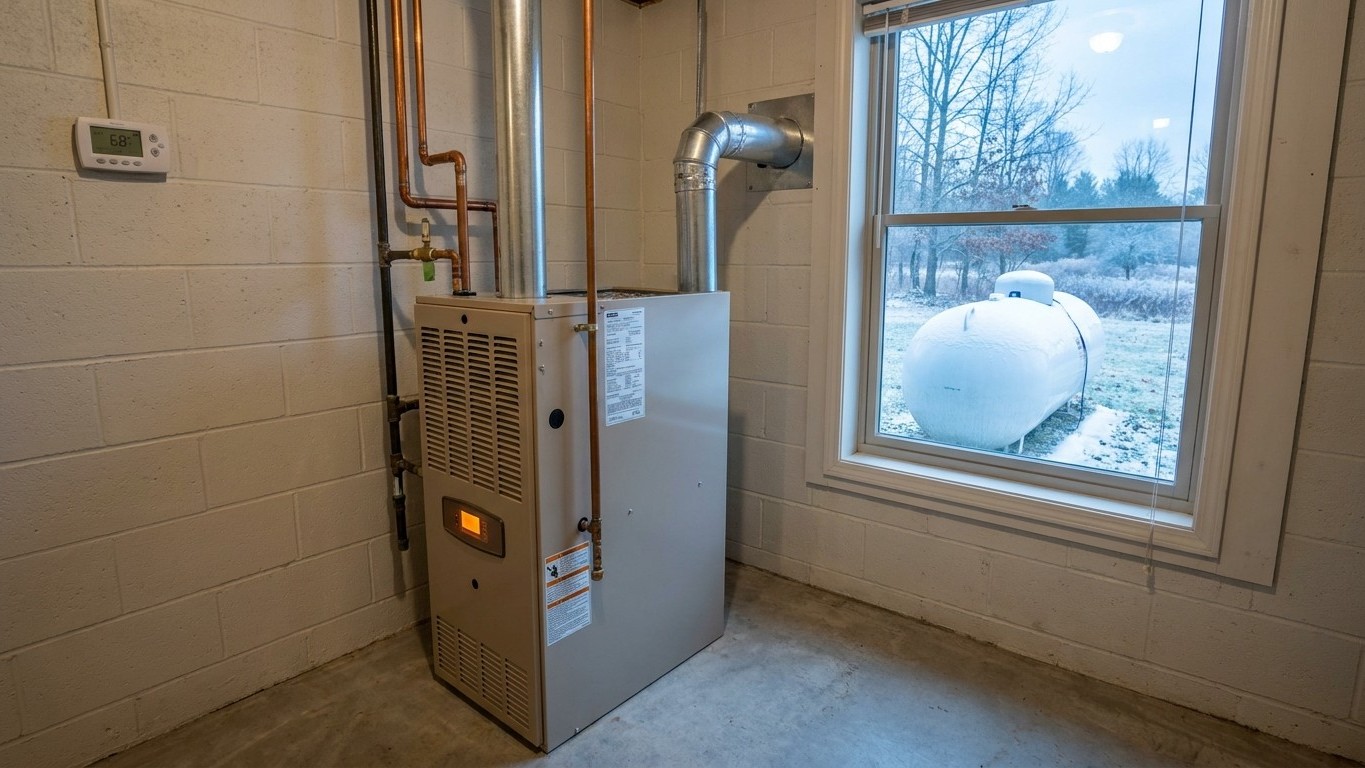

A propane furnace runs almost exactly like a natural gas furnace: same burner concept, same blower, same thermostat control, same basic troubleshooting logic. What actually sets the two apart comes down to three things: propane is heavier than air, it’s stored on the property instead of arriving through a utility pipe, and the furnace itself is built specifically for propane’s delivery, not gas pulled from a main. None of that makes propane heat unusual or inherently riskier. It just means a few habits, and a few details printed on the appliance’s rating plate, deserve attention that a natural gas household never has to think about.
Where propane heats homes

Propane heat clusters where two conditions line up: no natural gas main runs anywhere nearby, and winters are cold enough that all-electric heat gets expensive fast. That pattern shows up in the U.S. Energy Information Administration’s 2020 Residential Energy Consumption Survey (RECS), which tracks two separate things about a home’s heating setup: the type of equipment installed, and the fuel that equipment actually burns. A furnace can run on natural gas, fuel oil, or propane, or it can be an electric unit entirely. Those are two different columns in the same survey, and mixing them up misreads the data.
| State | Furnace (equipment) | Steam/hot-water boiler | Main fuel: natural gas | Main fuel: electricity | Main fuel: fuel oil/kerosene | Main fuel: propane |
|---|---|---|---|---|---|---|
| Maine | 46% | 31% | not a leading share | not a leading share | 49% | 16% |
| Maryland | 64% | not a leading share | 49% | 41% | not a leading share | not a leading share |
| Washington | 47% | not a leading share | 37% | 55% | not a leading share | not a leading share |
Maine is the state where propane’s role stands out most clearly. Furnaces heat 46% of Maine homes and steam or hot-water boilers cover another 31%, but the fuel behind those systems tells the sharper story: fuel oil or kerosene is the main heating fuel in 49% of Maine homes, and propane sits at 16%. That’s a state where neither natural gas nor electricity leads, because the gas main simply doesn’t reach much of rural Maine.
Maryland and Washington look different. Maryland runs 64% furnaces, with natural gas as the main fuel in 49% of homes and electricity in 41%. Washington leans electric, with 55% of homes primarily electric-heated, 47% running furnaces, and natural gas covering 37%. Propane doesn’t appear as a leading fuel in either state’s headline figures. That doesn’t mean zero propane furnaces exist in Maryland or Washington. RECS regularly marks smaller categories as not reported or suppresses an estimate the sample size can’t support reliably. Not reported is not the same as zero; it means the survey lacked enough responses in that slice to publish a trustworthy number.
A rural fuel by nature
Line the numbers up and the pattern is hard to miss: propane fills the gap left by absent gas infrastructure. It arrives by truck instead of pipe, so it can heat a house at the end of a gravel road just as easily as one two blocks from downtown, something a gas utility can’t do without a very expensive line extension. That’s also why a propane furnace and a natural gas furnace are close mechanical cousins rather than distant relatives. What separates them is short, but it changes how the fuel behaves in the home and how the system gets managed day to day.
The three that matter
The differences between propane and natural gas furnaces aren’t about how the appliance heats the house. They’re about how the fuel gets there, how it behaves if it escapes, and how the burner is calibrated to use it.
| Difference | Natural gas | Propane |
|---|---|---|
| Weight relative to air | Lighter than air; disperses upward | Heavier than air; settles and pools low |
| Supply | Continuous, piped from a utility main | Delivered and stored in a tank on the property |
| Appliance setup | Built and calibrated for natural gas | Built and calibrated specifically for propane |
Start with weight, because it’s the one detail that changes how a leak actually presents itself. Natural gas is lighter than air, so a leak tends to drift upward and disperse. Propane is heavier than air. If it escapes, it doesn’t rise and dissipate the same way; it settles toward the floor, into basements, crawlspaces, and other low spots before spreading further. That’s not a reason for alarm about propane appliances generally, but it does mean a leak in a propane system can behave differently from one in a natural gas system, and it’s worth knowing that plainly rather than discovering it by accident.
The second difference is supply. Natural gas comes through a buried pipe connected to a utility network that, barring an emergency, doesn’t run dry. Propane comes from a tank on the property, refilled on a schedule by a delivery truck. That tank has a finite amount of fuel in it at any given time, which introduces a situation natural gas customers never face: running out.
The third difference sits inside the furnace itself. A propane furnace is manufactured, or converted by a qualified technician, to burn propane specifically. The internal components that control how fuel and air mix are matched to propane’s characteristics, not natural gas’s. That’s why a furnace built for one fuel can’t simply be swapped to the other without the appropriate parts and a professional conversion; the exact specifications for a given unit live on its rating plate and in its manual, not in a general article, because they vary by model and manufacturer.
Running out, and what happens next
This is the situation with genuinely no equivalent on natural gas, and it’s the one that catches propane households off guard most often. A natural gas line doesn’t run empty. A propane tank does, and when it does, the furnace simply stops. No heat, no hot water if the home’s water heater also runs on propane, no warning beyond whatever the tank gauge was already showing.
Refilling isn’t as simple as topping the tank back up and flipping the furnace back on. Once a system has run dry, air can enter the lines, and that changes the safety picture. In many places, restoring service after an empty tank requires a supplier to check the system, verify there’s no leak, and relight the appliances before gas flows again. That check, and often a required leak test before service resumes, is the supplier’s job and in many jurisdictions a legal requirement, not something to attempt as a homeowner.
Avoiding the situation in the first place comes down to a short list of habits:
- Check the tank gauge regularly through the heating season, not just when the house starts feeling cold.
- Know the delivery schedule with the supplier, whether that’s automatic refills based on estimated usage or a will-call arrangement that depends on the homeowner requesting a delivery.
- In a cold snap, when usage climbs faster than normal, call the supplier ahead of time rather than waiting for the gauge to hit empty, since demand surges during extreme cold can slow delivery routes across an entire service area.
None of that is complicated, but it does require a different kind of attention than a natural gas household ever needs to give its heating fuel. A gas furnace owner never checks a gauge. A propane furnace owner does, or risks a cold house and a multi-step process to get heat flowing again.
The smell, and the yearly visit
A smell of gas is handled the same way regardless of which fuel is behind it: leave the area, don’t touch light switches or anything electrical, and call for help from outside the home rather than from a phone inside it. The specific odors to know, and what each one can mean, are covered in the gas smell guide on this site rather than repeated here.
What propane and natural gas furnaces share completely is the case for routine professional attention. The U.S. Consumer Product Safety Commission puts it directly: “CPSC urges consumers to schedule a yearly professional inspection of all fuel-burning home heating systems, including furnaces, boilers, fireplaces, wood stoves, water heaters, chimneys, flues and vents.” That guidance applies to fuel-burning equipment specifically; it doesn’t reach an all-electric furnace or a heat pump, because there’s no combustion happening to inspect.
The U.S. Environmental Protection Agency has said something similar for decades. In its October 1997 guidance (EPA 402-K-97-002), the agency states: “EPA does, however, recommend that if you have a fuel burning furnace, stove, or fireplace, they be inspected for proper functioning and serviced before each heating season to protect against carbon monoxide poisoning.” Two federal agencies, decades apart, landing on the same point: before winter starts, a fuel-burning furnace gets looked at by someone qualified to catch what a homeowner can’t see.
The stakes behind that recommendation are real. CPSC reports that “each year, more than 200 people die from unintentional non-fire related carbon monoxide poisoning associated with consumer products. Heating equipment and portable generators are among the top contributors to CO deaths.” That figure covers consumer products broadly, not furnaces alone, but heating equipment is named specifically among the leading contributors.
CPSC’s follow-up advice is about detection, not prevention: “Install battery-operated CO alarms or CO alarms with battery backup on every level of the home and outside sleeping areas. Interconnected CO alarms are best; when one sounds, they all sound.” That’s carbon monoxide guidance, worth taking seriously on its own terms. But a CO alarm is not a propane leak detector, and it doesn’t do the job of one. CO alarms watch for a byproduct of incomplete combustion; a propane leak is a different hazard entirely, and treating one device as coverage for both risks a false sense of security.
Common questions
Can a natural gas furnace be converted to run on propane?
Some furnace models can be converted between fuels, but only with the manufacturer-approved parts and a qualified technician making the change. The internal components that meter fuel and air are matched to one fuel type, and swapping fuels without the correct conversion kit and setup isn’t a do-it-yourself adjustment.
Does a propane furnace need different maintenance than a natural gas one?
The maintenance philosophy is the same: a yearly professional inspection of the fuel-burning system, as both CPSC and EPA recommend. The propane-specific items an inspection covers include the tank, the regulator, and the delivery lines running to the house, none of which a natural gas system has in the same form.
Why does a propane tank need a delivery schedule instead of just refilling when it’s low?
Because there’s no pipeline backup. Waiting until the gauge reads near empty leaves no margin if a cold snap slows delivery routes or a supplier’s schedule gets backed up, which is common in the coldest weeks of winter when everyone’s usage climbs at once.
Is it normal for a propane tank to run out even with regular deliveries?
It shouldn’t happen with an accurate delivery schedule matched to actual usage, but unusually cold stretches, an appliance running longer than expected, or a missed check of the gauge can all outpace a standing delivery plan. Checking the gauge periodically, rather than assuming the delivery schedule alone covers it, catches that gap before the furnace does.