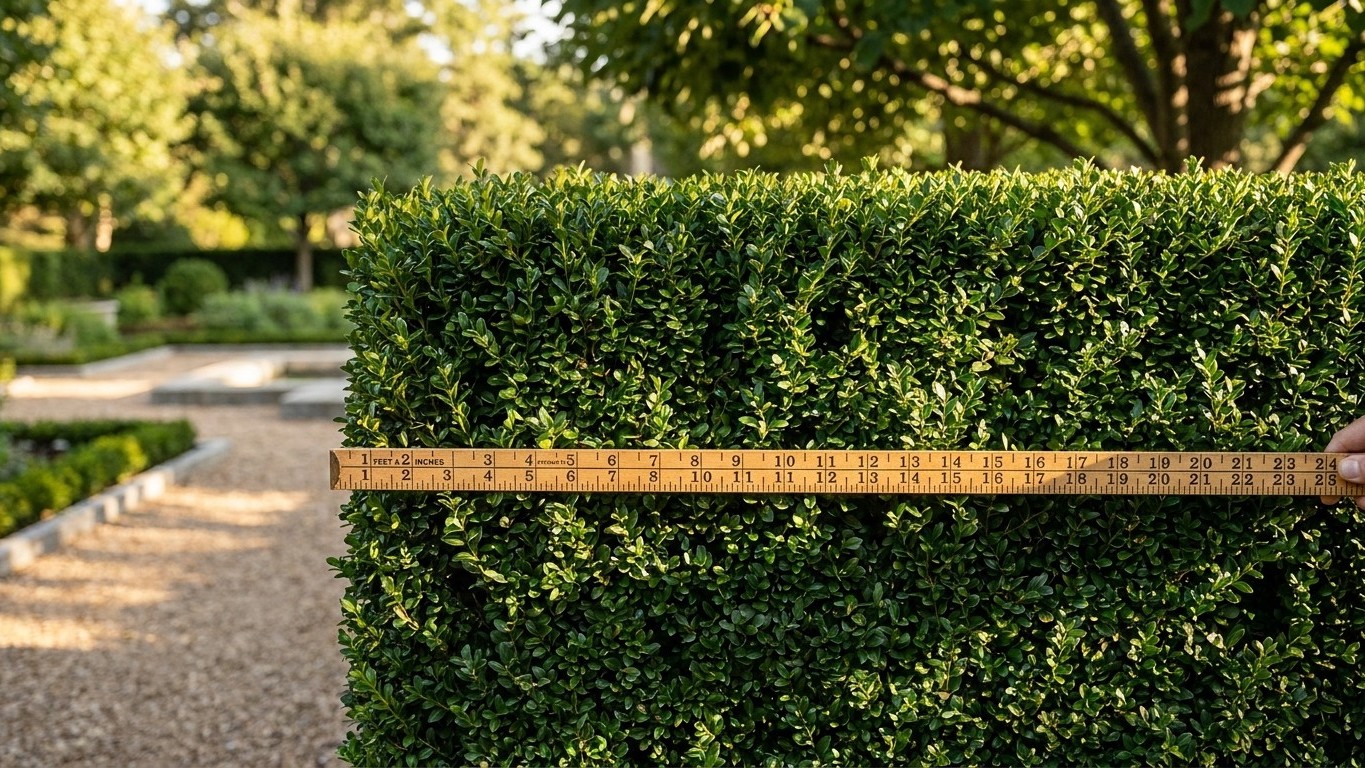

Buxus sempervirens, commonly sold as boxwood, common box, common boxwood or European box, survives across USDA hardiness zones 5a-8b, tolerates full sun to partial shade, and needs the most attention paid to its mature width, 6 to 12 feet as a specimen or 12 to 24 feet in some settings, since spacing mistakes are harder to fix than a bad pruning cut. It flowers in spring, but that bloom is minor next to the pruning question it raises.
Where it will and will not survive

The USDA hardiness range for Buxus sempervirens runs 5a-8b. The range is worth using the way it’s actually useful: not as a list of places where the shrub might do well, but as a line past which it simply won’t make it through winter, or won’t hold up to summer heat and humidity at the other end.
Below the bottom of this range, cold will kill the plant outright, or damage it badly enough in most winters that it never establishes as the dense, year-round screen people plant it for. Above the top of it, the stress runs the other way: heat, humidity and the kind of summer nights that never cool down put a strain on a shrub bred for temperate conditions, and even where it technically survives, it may never look like the tight, glossy hedge shown in catalog photos.
A range means survival, not comfort
That distinction matters more than it sounds like it should. A shrub rated hardy to zone 8b is not necessarily happy in zone 8b, it’s simply not guaranteed to die there. Gardeners at the warm edge of the range often see slower growth, more disease pressure or foliage that never gets as thick as the same plant three zones cooler. The range tells you where the plant can persist. It doesn’t tell you where it will thrive, and those are two different questions with two different answers.
None of this is useful, though, until you know your own zone, and that’s not something to guess at from a regional map glanced at online. Zone boundaries shift block by block in hilly or coastal terrain, and a property a few hundred feet higher in elevation than its neighbor can sit in a colder zone entirely. Rather than assume, check your exact zone against this site’s hardiness zone guide, which breaks the country down by state and county rather than by broad, unreliable bands. Once you know where you land relative to 5a-8b, the survival question above answers itself.
Light, soil and where it belongs
The North Carolina Extension Gardener Plant Toolbox lists a range of conditions this shrub tolerates rather than a single ideal setup, and reading the list that way avoids the common mistake of thinking every box needs the same corner of the yard.
| Condition | What it tolerates |
|---|---|
| Light | Full sun (6+ hours direct) or partial shade (2-6 hours direct) |
| Soil texture | Clay, high organic matter, loam (silt), sand |
| Soil pH | Neutral (6.0-8.0) |
| Drainage | Good drainage, or occasionally wet |
That spread of tolerances explains why boxwood shows up in so many different kinds of yards, from sandy coastal lots to heavier clay soils further inland. What it doesn’t tolerate well is standing water for extended stretches, which is where “occasionally wet” stops and root rot starts.
What it looks like from the window
Its habit is dense, multi-stemmed and rounded, which is exactly why it’s used as a screen rather than a plant you look through. Set along a property line or under a window, it reads as a solid green wall for most of the year thanks to its broadleaf evergreen foliage, holding its shape and color through winter when deciduous neighbors have gone bare. Set against a fence or a wall, it fills the gap between hardscape and lawn without needing a trellis or support, since it holds its own structure.
The mature size the source gives, 6 feet to 12 feet in one context and 12 feet to 24 feet in another, is really two different planning numbers depending on the use. For a clipped hedge, plants are typically set close enough that neighboring shrubs merge into a single line, so the lower figure guides spacing between plants, roughly a third to half of the mature spread. For a standalone specimen left to reach its full rounded form, the wider figure is the one to measure from the house, the walkway or the property line, since a shrub that eventually spreads 20 feet across planted 5 feet from a foundation becomes a maintenance problem for decades rather than one bad pruning season.
When it flowers, and what that decides
Bloom happens in spring, though the flowers themselves are inconspicuous compared to the shrub’s evergreen foliage; most gardeners notice the small, dry seed capsules that follow, described as globose, about 1/3 inch, dehiscent, and maturing to brown, more than they notice the bloom itself.
The timing matters less for the display than for what it decides about pruning. Shrubs generally fall into one of two camps: those that set flower buds on the previous year’s wood, which need pruning right after they finish blooming so next year’s buds aren’t cut away, and those that flower on new growth put on during the current season, which can be pruned in late winter or early spring before that growth starts without sacrificing bloom.
The source data here doesn’t settle which category this shrub falls into, and rather than guess, the honest answer is to watch one full season. Prune lightly at a time you’d normally expect to shape a hedge, then note whether flowering the following spring is noticeably reduced compared to an unpruned section of the same planting. If bloom holds up regardless of when you cut, timing is flexible. If it drops off after a particular pruning window, that tells you which wood carries the flower buds, and you can adjust the following year. Since boxwood is grown almost entirely for foliage and form rather than for its flowers, most maintenance schedules are built around shaping and size control rather than around protecting bloom, which gives more flexibility than a shrub grown specifically for its flowers would allow.
Planting and the first two years
Getting a boxwood established follows the same sequence as most woody shrubs, and skipping a step tends to show up as stalled growth a year or two later rather than immediately.
- Plant in spring or fall, when temperatures are moderate and the plant isn’t fighting summer heat or winter cold while it’s trying to root.
- Dig the hole wider than it is deep, at least twice the width of the root ball, since roots spread laterally far more than they grow downward in the first seasons.
- Set the root flare, the point where the trunk widens into roots, right at or slightly above grade. Buried too deep, the stem base stays wet and invites rot.
- Tease out any roots that are circling the root ball from container growth; left alone, they keep circling underground and can eventually girdle the plant.
- Backfill with the native soil dug from the hole rather than amending heavily, so roots don’t stay confined to a rich pocket and instead push out into the surrounding ground.
- Water deeply right after planting, soaking the full root zone rather than a quick surface sprinkle.
- Mulch two to three inches deep in a ring around the plant, keeping it pulled back from direct contact with the stems.
The drought resistance often associated with mature boxwood applies to an established plant with a root system that’s had time to spread. A shrub in its first two summers hasn’t built that system yet, and needs regular deep watering regardless of how the species is generally described. It’s also worth setting expectations before year one: many shrubs, this one included, put energy into roots rather than visible growth the first season, look noticeably fuller by the second, and only really perform, filling out and holding a consistent shape, by the third year. A boxwood that looks stalled in its first summer is usually normal, not failing, and digging it up to check the roots does more harm than waiting it out.
What it resists, and what it does not
Resistance in a plant description means a tendency to be less bothered by a given pressure, not immunity from it. A shrub listed as resistant to deer can still be browsed, especially when hungry animals have few other options in late winter, and drought resistance describes how a plant behaves once its root system is fully established, not how it handles its first dry spell in the ground.
The source lists deer, drought and rabbits among the categories tracked for this species but does not specify the degree of resistance in each case, only that the categories are noted. That’s worth taking at face value rather than assuming a strong rating: treat it as a plant that may be less appealing to deer and rabbits than some alternatives, and that may tolerate dry spells once mature, without counting on either as a guarantee.
| Category | What the listing means | What to expect in practice |
|---|---|---|
| Deer | Tracked, degree unspecified | May be browsed less than preferred species, but not deer-proof |
| Rabbits | Tracked, degree unspecified | Same caution applies, especially to young plants |
| Drought | Tracked, degree unspecified, applies once established | New plantings still need regular water for the first two years |
Growth rate is listed as slow, and maintenance as medium. Together those two facts shape how the shrub fits into a maintenance schedule: slow growth means a clipped hedge holds its shape longer between trims than a fast-growing alternative would, but medium maintenance signals it still isn’t a plant-it-and-forget-it choice, since shaping, occasional feeding and watching for the space it needs as it fills toward that 6 to 24 foot mature range all require some ongoing attention rather than none.
Common questions
Is Buxus sempervirens the same as common boxwood?
Yes, common box, common boxwood, European box and boxwood are all names used for the same species, Buxus sempervirens. None of those common names is more “official” than another, they’re simply different labels used in different regions and by different growers for the identical plant.
How far apart should I space boxwood for a hedge?
Spacing depends on which mature size figure applies to your planting style. For a tight, clipped hedge using the lower end of the mature spread, plants are typically set close enough that they merge into a continuous line. Left as individual rounded specimens at the wider mature spread, they need considerably more room per plant to avoid crowding as they fill in over the years.
When is the right time to prune boxwood?
The source data doesn’t specify which pruning group this shrub belongs to, so the safest approach is to test it: prune lightly one season and watch whether spring bloom the following year is affected compared to an unpruned section. That observation tells you whether to time future pruning before or after flowering.
Does boxwood need full sun to thrive?
No. It tolerates full sun, six or more hours of direct light a day, as well as partial shade, two to six hours. Both are listed as acceptable conditions rather than one being described as ideal, so placement can be flexible depending on what the rest of the yard allows.