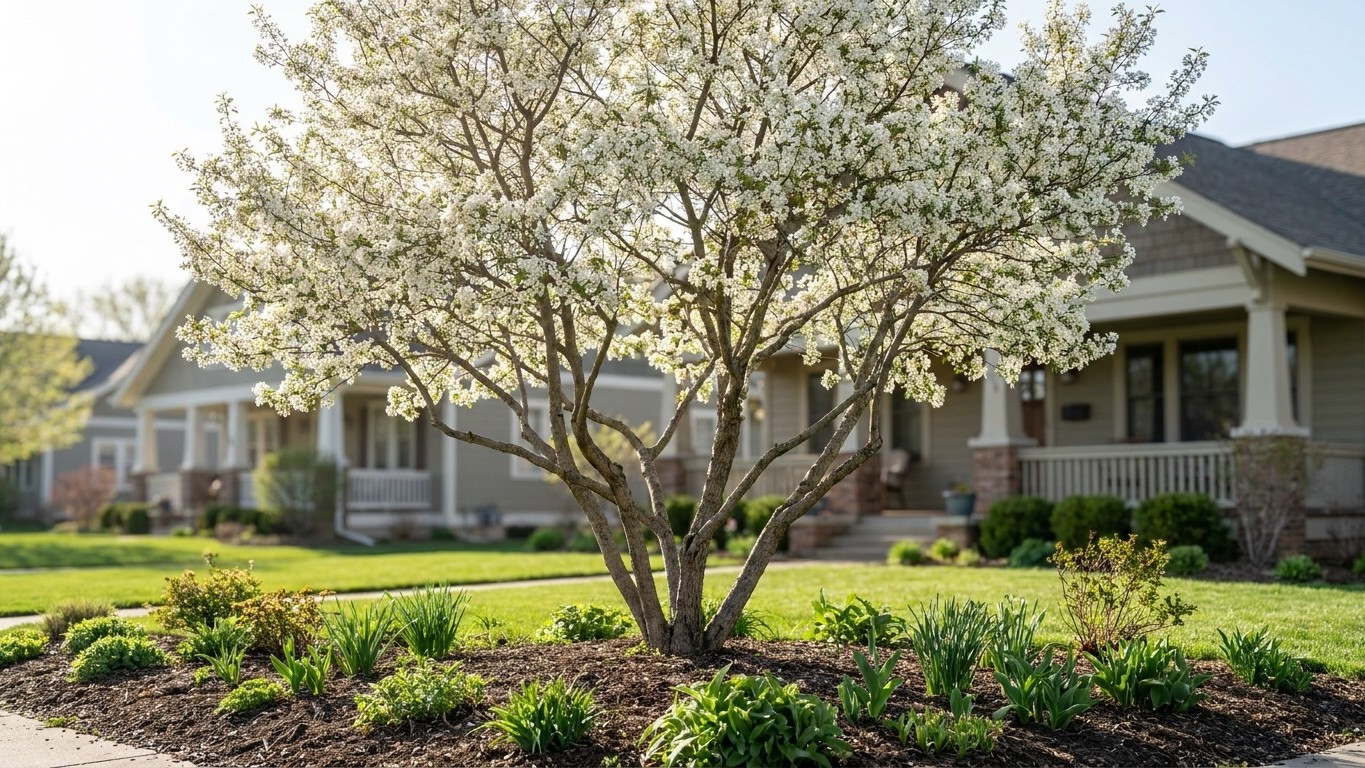

Amelanchier canadensis, sold under names including Canadian Serviceberry, Eastern Serviceberry, Juneberry, Serviceberry, Shadblow serviceberry, and Shadbush Serviceberry, survives across USDA hardiness zones 3a-8a. The size matters just as much: this tree or large shrub spreads 12 to 24 feet at maturity, grows erect and irregular, often with multiple stems, and needs room a lot of buyers don’t budget for when they picture a small ornamental near the front steps.
Where it will and will not survive

The USDA hardiness range for Amelanchier canadensis is 3a-8a. That’s not a suggestion, it’s a survival boundary. Below the bottom of that range, winter cold will kill the plant outright, or cut it back hard enough each year that it never develops into the tree the size figures describe. Above the top of the range, summer heat works against it differently: the plant may live, but it won’t perform the way the same specimen would in the cooler half of its range.
A range means the plant can survive there, not that it’s comfortable there. A serviceberry rated to zone 8a can be planted in an 8a landscape and come through winter fine, but it’s at the warm edge of what it tolerates. The same logic runs in reverse at zone 3a.
Zone maps shift block by block in some parts of the country and hold steady for hundreds of miles in others, and guessing based on a neighboring county or nearby state is exactly how the wrong tree ends up in the wrong yard. Hardiness zone maps break down by state and county, and that’s the number to check before anything else.
“Native” in that listing means native to the southeastern United States specifically, not to every region where the hardiness range says it can survive. Any regional planting advice tied to a Piedmont, Coastal, or Mountain designation from that same source is specific to North Carolina growing conditions and shouldn’t be applied elsewhere, even inside the same hardiness zone.
The mistake that costs the most: space
Space at maturity for Amelanchier canadensis is 12 to 24 feet. That’s the figure most people skip past when they’re standing in front of a four-foot nursery specimen, and it’s the figure that causes the most expensive regret ten or fifteen years later. A plant that starts out modest can, at full size, reach a spread wider than most driveways, and no pruning schedule shrinks a mature canopy back down to fit a space it was never meant to fill.
This mistake costs more than a wrong hardiness guess, because a cold-killed sapling dies in its first winter and gets replaced cheaply. A mature tree planted too close to a wall, foundation, driveway, septic field, or overhead wires doesn’t announce the problem for years. By the time the canopy is pressing against siding or lifting a walkway, the only real fix left is removal, not a trim.
Before digging, a short set of checks does most of the work:
- Look up: note any overhead wires, eaves, or power lines within roughly 15 to 20 feet of the planting spot, since a mature spread of up to 24 feet reaches that far in every direction from the trunk.
- Look down: identify septic lines, drain fields, buried utilities, and irrigation lines that fall inside that same radius.
- Measure the actual distance to the nearest wall, fence, or driveway edge, and compare it against half the mature spread.
- Check which way the canopy will fall across the yard as it fills in, and think through what it will shade in ten years.
- Confirm there’s room for the mature multi-stemmed, irregular habit this species tends toward, rather than a tidy single-trunk column.
A tree given this room from the start rarely needs corrective removal later. One planted too close to a structure almost always does.
The site it actually wants
Rather than a single ideal setup, the source data for Amelanchier canadensis reads as a list of tolerated conditions, wider than a lot of planting guides suggest.
| Condition | What it tolerates |
|---|---|
| Light | Dappled sunlight, full sun (6+ hours direct), or partial shade (2-6 hours direct) |
| Soil texture | Clay, loam (silt), or sand |
| Drainage | Good drainage, moist soil, or occasionally wet soil |
That’s a plant that accepts clay on one end and sand on the other, full sun on one end and dappled shade on the other. Flattening that into a single recommendation like “plant it in rich loam” loses the point: this species has real flexibility across soil texture and light, making it workable for a site that doesn’t offer perfect loam or a full-sun clearing.
The source data does not specify a soil pH preference for this species, so nothing here should be treated as a pH recommendation. A local extension office can test a soil sample directly if that matters to a broader planting plan.
Checking your own site without equipment
Drainage is easy to test without buying anything. Dig a hole about a foot deep, fill it with water, let it drain once, then fill it again and time how long the second fill takes to disappear. Water gone within a few hours points to good drainage. Water still standing after half a day or more points to the kind of occasionally wet ground this species can tolerate, rather than a swamp no tree will handle. A spot that drains far too fast, holding almost no moisture, matches the sandy soils this species accepts, but will need attention while a young plant establishes.
When a site doesn’t match any of these tolerances well, the more reliable move is choosing a different spot on the property rather than trying to amend heavy clay or fast-draining sand into something else. This species already accepts a wide band of conditions; the goal is finding where that band overlaps with reality.
Planting it so it establishes
Getting a young Amelanchier canadensis into the ground correctly matters more than almost anything that happens afterward. The steps below run in the order that gets a tree established with the least stress:
- Choose the planting season using the frost timing for your area, on the frost date guide on this site, rather than picking a calendar month that works somewhere else.
- Dig the planting hole wide, at least two to three times the width of the root ball, rather than deep, so roots spread outward instead of circling.
- Locate the root flare, where the trunk widens before the roots begin, and keep it at or slightly above grade once backfilled.
- Loosen and tease apart any roots circling the root ball from nursery-pot growth.
- Backfill with the same native soil that came out of the hole, rather than a different soil type, so roots don’t stall at the boundary between two textures.
- Water deeply right after planting, then continue with deep, infrequent watering through the first growing season rather than frequent shallow sprinkles.
- Mulch in a ring around the tree, two to three inches deep, keeping it pulled back from direct contact with the trunk.
Two mistakes account for most young tree deaths, and both show up in that list. Planting too deep, burying the root flare below grade, suffocates roots and invites trunk-base rot over time. Piling mulch against the bark holds moisture against the trunk and creates the same rot risk from the other direction. Both are easy to avoid and both are permanent once they’ve done their damage.
This species carries no particular reputation for needing water once established, but that tolerance applies to a mature plant with a developed root system, not a tree in its first season. A newly planted specimen needs consistent, deep watering regardless of how the plant is generally described, because its roots haven’t spread far enough yet to find moisture on their own.
What it resists, and what it does not
Resistance is worth defining before listing it. A plant described as resistant to a given challenge is browsed, damaged, or affected less often than a plant without that trait, not immune to it. A hard winter with little other forage can push deer to eat plants they’d normally pass over.
| Challenge | What resistance means here | What a reader would actually see |
|---|---|---|
| Deer | Browsed less frequently than many landscape plants | Some browsing is still possible, especially on young growth or in a hard winter |
| Fire | Better tolerance of fire exposure than more flammable landscape species | Reduced but not eliminated damage risk in a fire-prone setting |
| Wet soil | Tolerates soil that stays occasionally wet, consistent with the drainage range covered earlier | Roots that don’t decline in a low spot that holds water after rain |
Growth rate and maintenance level for this species are both listed as medium. That combination points to a tree that fills in steadily rather than shooting up in a couple of seasons, giving a homeowner more time to notice a spacing problem, but it still isn’t plant-it-and-forget-it. Medium maintenance means ongoing attention, whether shaping a multi-stemmed habit, managing suckering, or watching how close branches creep toward a structure over the years. It also attracts bees, butterflies, small mammals, and songbirds, a feature for most homeowners, though worth knowing if fruit drop near a patio or walkway is a concern.
Common questions
Is Amelanchier canadensis the same as a serviceberry bought under a different name?
The common names in use for this species, including Serviceberry, Juneberry, Shadblow serviceberry, and Shadbush, all refer to the same plant according to the source data. Nurseries use these names inconsistently, so it’s worth confirming the botanical name, Amelanchier canadensis, on a plant tag before assuming two differently labeled plants are identical.
Can I eat the berries?
The source describes the fruit as edible, similar to blueberries, and used in jams, jellies, and pies. The fruit is a berry-like pome that starts green, turns red, and matures to dark purplish-black between May and June. That description covers appearance and timing, not sweetness or flavor, and the blueberry comparison is one of appearance and use, not a nutritional claim.
Does it need full sun to bloom well?
The listed growing conditions include full sun, partial shade, and dappled sunlight, so a spot with less than a full day of direct sun is not automatically disqualified. Spring bloom timing shifts with latitude and elevation rather than a fixed calendar date.
How far should it be from my house?
Base the distance on the mature spread of 12 to 24 feet rather than the size of the plant at purchase. Half that spread, measured out from where the trunk will sit, is the minimum clearance from a wall, driveway, or foundation that avoids a removal decision down the road.