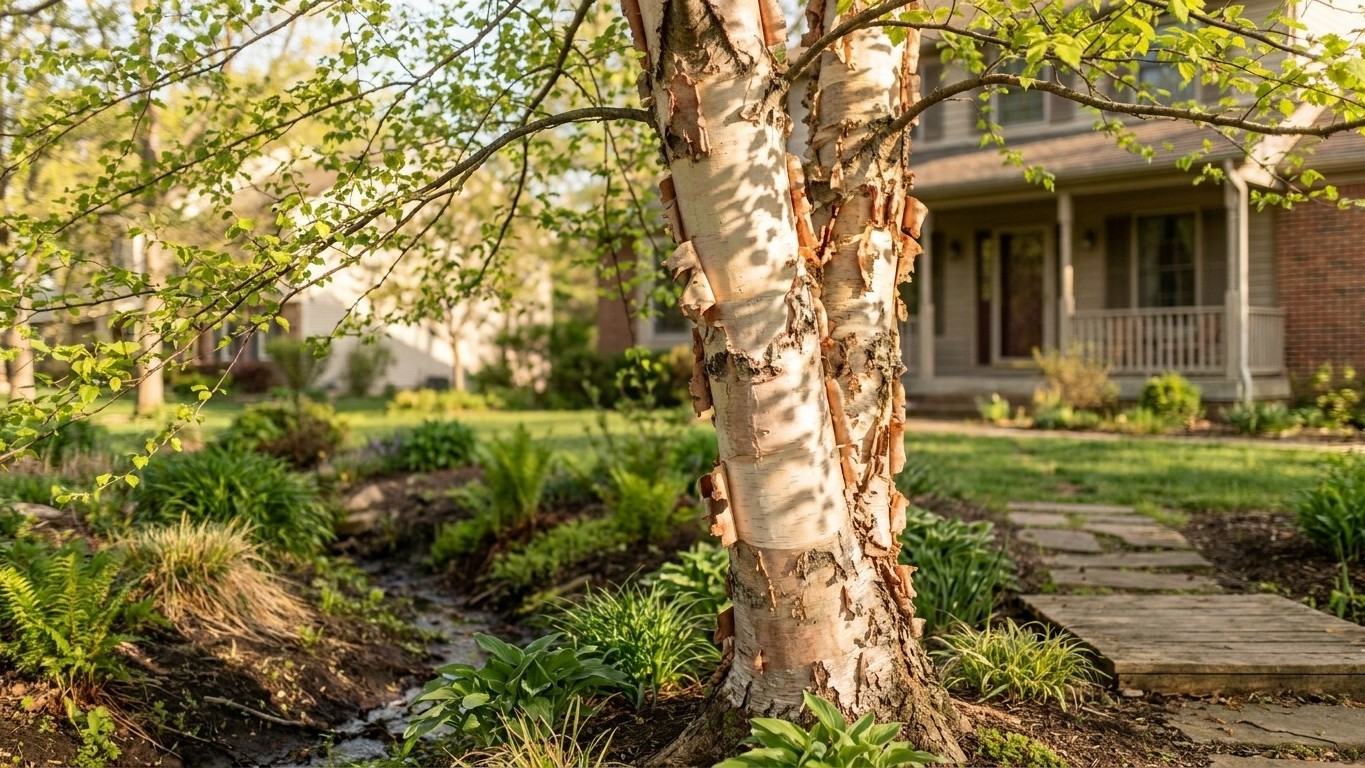

River Birch, Black Birch, Red Birch, Water Birch — Betula nigra goes by several names, none more official than the others. The USDA lists it hardy from zone 4a to 9b. North Carolina Extension classifies it as a Native Plant, Perennial, and Tree: deciduous, blooming in spring, growing fast, asking for medium upkeep. It tolerates wet soil about as well as dry stretches, which is why it shows up along creek banks and ordinary front yards alike. Where it actually belongs on a given property is a narrower question than the zone map answers.
Where it will and will not survive

The USDA hardiness range for Betula nigra runs from zone 4a to zone 9b. Below that range, the tree has no track record of surviving winter; the cold kills wood the plant needs to leaf out again in spring. Above 9b, the plant simply isn’t rated to hold up.
A range like this describes survival, not comfort. A tree rated hardy to 9b isn’t necessarily happy in a 9b summer, and one rated hardy to 4a isn’t thriving at the cold edge of its range. Hardiness zones measure the coldest temperature a plant is expected to tolerate, not where it grows best. Species at the far ends of their listed range often perform at half strength, blooming late or dropping leaves early under stress they can technically withstand but don’t relish.
The source matters too. The growing data comes from North Carolina Extension’s Gardener Plant Toolbox. The USDA hardiness range is a national standard, but any regional notes about coastal, piedmont, or mountain conditions are local to North Carolina and don’t transfer to a yard in another state, even one sharing the same zone number.
One more wrinkle: “Water Birch” also names a different species, Betula occidentalis, native to the western US. Shopping by common name alone can send you home with the wrong tree. The botanical name is the only one that reliably points to a single species.
None of this tells you what zone your own address sits in, and guessing is how the wrong tree ends up in the wrong yard. Check your specific hardiness zone before planting anything long-lived; this site’s hardiness zone guide breaks it down county by county rather than leaving it to a rough regional guess.
The mistake that costs the most: space
North Carolina Extension lists the space this tree needs at maturity as 6 feet to 12 feet. That figure is the one most home landscapers get wrong, because the consequence doesn’t show up on planting day. It shows up ten or fifteen years later, when a tree that looked like a reasonable fit as a two-gallon sapling has grown into a space that was never big enough for it, and the only real fix left is removal rather than pruning.
Six to twelve feet of mature spread means the root system and canopy will occupy that entire footprint, not just the trunk. Planted too close to a foundation, driveway, septic field, or fence line, the tree and the structure will eventually compete for the same ground, and the structure loses first, cracked pavement, lifted footings, roots working into a drain line. Overhead, that same spread can put branches into siding, gutters, or a low utility line.
The reason this mistake is expensive rather than just inconvenient is timing. Pruning solves a young tree’s minor overreach; it does not solve a mature root system undermining a slab or a canopy grown into service wires. By the time the conflict is obvious, the tree is too large to move and too integrated into the yard’s drainage and shade pattern to cut back hard without disfiguring it. Removal is usually the real option left.
Before digging, run through these checks:
- Look up: note any overhead wires, eaves, or roof lines within reach of the tree’s mature spread.
- Look down: call for a utility locate before digging, and note any septic lines, drain fields, or buried cable in the area.
- Measure out the full mature spread from the trunk location in every direction, not just toward open lawn.
- Track the sun path across that spot and decide whether the mature canopy will shade a garden bed, a window, or a neighbor’s yard once it fills in.
A tree this size doesn’t demand a huge lawn to be practical, but it does demand that someone walk off that 6-to-12-foot footprint against real fixed structures before the shovel goes in.
The site it actually wants
North Carolina Extension’s data for Betula nigra reads less like a single ideal site and more like a list of what the tree will put up with, a more useful distinction than the usual “rich, well-drained soil” advice.
| Condition | What the source lists it accepting |
|---|---|
| Light | Full sun (6+ hours direct) or partial shade (2–6 hours direct) |
| Soil texture | Clay, loam (silt), or sand |
| Soil pH | Acid (below 6.0) or neutral (6.0–8.0) |
| Drainage | Good drainage, moist, occasionally dry, or occasionally wet |
Read across that table and the pattern is tolerance, not a narrow sweet spot. Clay and sand both make the list, unusual since most trees prefer one over the other. The drainage line is just as wide, which is part of why this tree is a common choice near low spots and drainage swales that stay soggy after rain but aren’t permanently underwater.
Checking your own site without lab equipment
You don’t need a soil lab to get a rough read. For drainage, dig a hole about a foot deep, fill it with water, and time how long it takes to drain; water gone within a few hours suggests good to moderate drainage, while water still standing after most of a day points to a site that stays wet, which this tree tolerates but many others can’t. For pH, a home soil test kit or a sample sent to your state’s extension soil lab will give you an actual number rather than a guess.
If your site doesn’t match the table, decide whether it’s close enough. A yard with acidic, occasionally wet clay is well inside what this tree accepts. A yard with alkaline soil that drains almost instantly and sits in deep, constant shade is pushing past what the source lists, and it’s worth weighing a different species rather than fighting the site for years.
Planting it so it establishes
Getting a tree into the ground correctly matters more than almost anything you’ll do for it afterward. Follow these steps in order:
- Pick the planting season using your local frost timing rather than a calendar month, this site’s frost date guide gives that window by location, and it shifts by hundreds of miles across zones 4a to 9b.
- Dig the planting hole wide, two to three times the width of the root ball, rather than deep, so roots spread outward instead of circling.
- Locate the root flare, the point where trunk widens into roots, before setting the tree in the hole.
- Set the tree so that root flare sits right at, or very slightly above, the surrounding soil grade, never buried.
- Tease out any roots circling the root ball from nursery pot growth, gently loosening or cutting them.
- Backfill with the same native soil that came out of the hole, without amending it, so roots don’t stay confined to a “better” pocket of soil.
- Water deeply and infrequently right after planting, soaking the root zone rather than sprinkling the surface daily.
- Apply mulch in a wide, shallow ring, keeping it several inches clear of the trunk itself.
Two mistakes account for most young tree deaths. Planting too deep, so the root flare ends up buried, suffocates roots and invites rot. Piling mulch against the trunk in a “volcano” traps moisture against bark not built to handle it, inviting decay right where the tree can least afford it.
It’s also worth being clear that “drought resistant” describes an established plant, one that’s had a full season or more to grow roots into the surrounding soil. A tree in its first year still depends on regular deep watering from you, regardless of the species’ mature reputation for handling dry spells.
What it resists, and what it does not
North Carolina Extension’s resistance data for Betula nigra lists several categories: deer, fire, heat, wind, drought, diseases, wet soil, pollution, compaction, and black walnut, but marks each as unspecified rather than confirmed or rated. That’s worth noting, because “resistant” gets used loosely in gardening writing. Resistance is a tendency, not immunity. “Deer resistant” means a plant gets browsed less often than a preferred one nearby, not that it’s off the menu entirely, a hard winter can change that. “Drought resistant” applies to an established root system, not a first-year sapling.
| Category | What resistance means | What a reader would actually see |
|---|---|---|
| Deer | Tendency, not guarantee, of reduced browsing | Some browsing is still possible, especially on young growth in a lean winter |
| Drought | Applies once established, not to a new planting | A mature tree handling dry spells; a first-year tree still needs supplemental water |
| Wet soil | Tolerance for soil that stays moist or occasionally wet | The tree holding up in a low spot or near a drainage swale |
| Diseases | Not specified in the source data | No confirmed claim either way; don’t assume immunity |
Since the source marks these categories as unspecified, the honest read is that no strong claim is made either way for this tree on deer, fire, heat, wind, pollution, compaction, or black walnut sensitivity. That’s different from a source actively rating a plant as resistant or susceptible, and it shouldn’t be stretched in either direction.
What the source does specify plainly is growth rate and maintenance: rapid growth, medium maintenance. Rapid growth cuts both ways. A modest sapling fills out into shade and structure faster than a slow-growing species, but it also reaches toward gutters, eaves, and overhead lines faster than expected if it wasn’t sited with that 6-to-12-foot mature spread in mind from the start. Medium maintenance suggests routine seasonal cleanup and occasional pruning rather than either a hands-off tree or a high-upkeep one.
Common questions
Is Betula nigra the same as River Birch?
Yes. River Birch is one of the common names used for Betula nigra, along with Black Birch and Red Birch. Water Birch is also listed as a common name for this species, but that same name is used elsewhere for Betula occidentalis, a different western US tree, so it’s not a reliable name to shop by.
How fast does it grow?
North Carolina Extension rates its growth rate as rapid. Combined with the modest 6-to-12-foot mature space listed for it, that means it fills its footprint quickly, worth factoring in when deciding how close to plant it to structures, drives, or overhead lines.
Does it need full sun?
No. The source lists it accepting either full sun, at least six hours of direct light daily, or partial shade, roughly two to six hours. It isn’t restricted to one lighting condition.
Will it grow in wet or clay soil?
It can. The source lists clay, loam, and sand among tolerated soil textures, and moist, occasionally dry, and occasionally wet among tolerated drainage conditions, alongside good drainage, a wider range than many trees can handle.