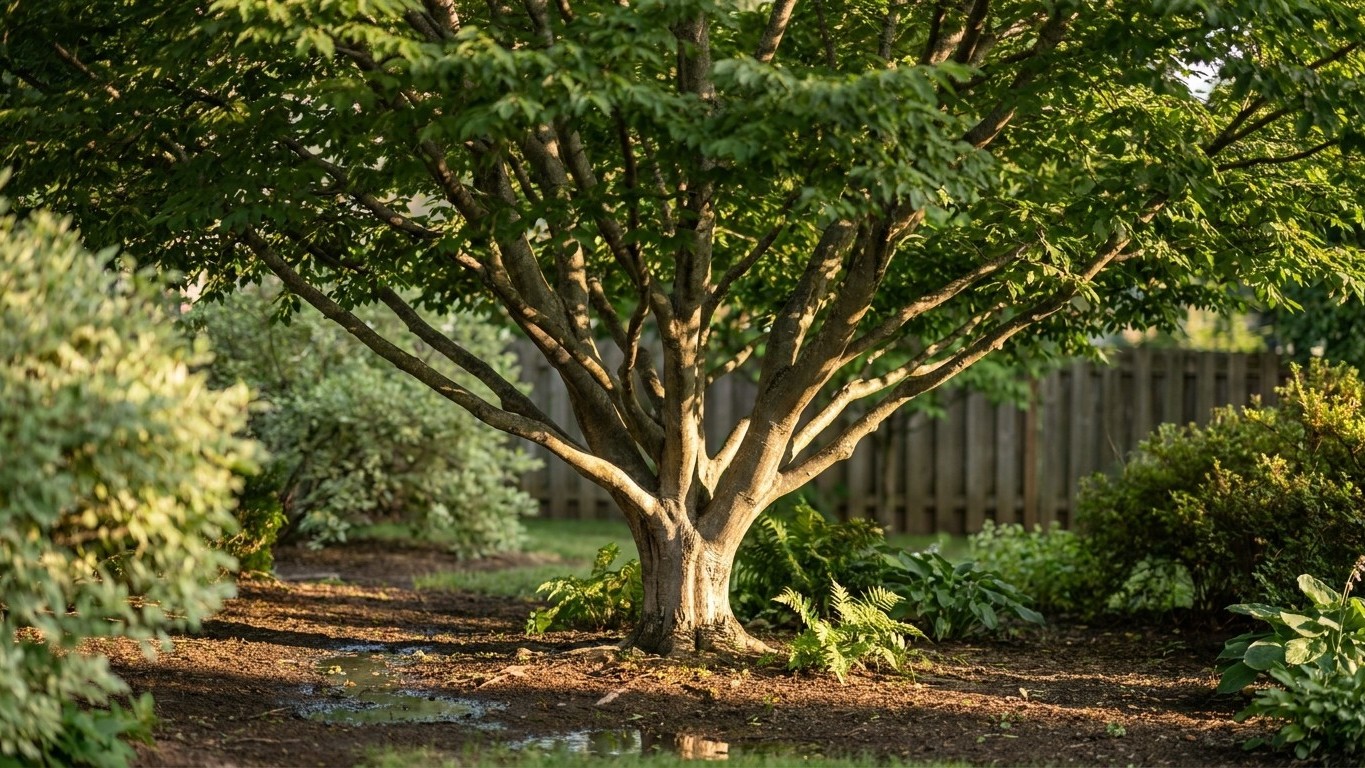

American Hornbeam. Blue Beech. Ironwood. Musclewood. Water Beech. Carpinus caroliniana answers to all of these, and the botanical name is the only one that reliably points to one tree, since two of those common names also drift onto other species in casual use. It’s hardy across USDA zones 3a-9b, tops out at a modest 12 to 24 feet wide at maturity, and tolerates deep shade, wet soil, and clay about as well as any small tree sold in the United States. Where it struggles is space: this is a wide, spreading tree people plant like a narrow one.
Where it will and will not survive

The USDA hardiness range for Carpinus caroliniana is zones 3a-9b. A useful way to read that range is backwards: it tells you where the tree will not survive at all. Below zone 3a, cold kills wood, not just leaves, and a tree pushed past its cold limit doesn’t come back in spring. Above zone 9b, the concern flips to heat and the length of the warm season rather than frost. Either edge is a real boundary, not a suggestion.
A hardiness zone number only tells you the coldest a place typically gets, not whether a tree is comfortable there. A hornbeam rated to survive in zone 9b is not necessarily thriving there the way it would closer to the middle of its range, in zone 6 or 7. Survival and vigor are different questions, and the USDA number only answers the first one.
Zone assignments vary by county and shift with elevation and local microclimate even within the same state, so check your specific zone on this site’s hardiness zone guide before deciding whether Carpinus caroliniana is even in play for your yard.
It’s also worth flagging where the underlying plant data for this page comes from: the North Carolina Extension Gardener Plant Toolbox. The USDA hardiness range is a national standard and travels anywhere. Anything region-specific that a state extension service says about its own coastal plain, piedmont, or mountain conditions does not travel the same way, and shouldn’t be read as advice for a yard outside that state.
The mistake that costs the most: space
American Hornbeam reaches 12 to 24 feet of space at maturity. That’s the number that gets ignored most often, and it’s the one that eventually costs money, because a tree that outgrows its spot doesn’t shrink back down. The fix at that point is removal, not a trim.
Picture the widest point of that range, 24 feet, as a circle centered on the trunk. Anything inside that circle in fifteen years, a wall, a driveway, a septic field, power lines, is either pruned hard every year forever or removed. Neither is cheap, and neither was necessary if the tree had gone in ten feet farther out to begin with.
This is also a multi-stemmed, clumping, spreading tree by habit, according to the source data, so the canopy grows out and low rather than up and away in one clean trunk. That changes how close it can sit to a walkway or patio without eventually brushing shoulders with foot traffic.
The mistake is expensive rather than just annoying because of timing. A hornbeam is a slow grower, so crowding doesn’t show up in year two or three, when a homeowner still remembers exactly why the tree went where it did. It shows up ten or fifteen years out, against a foundation or fence line the tree was never measured against, at a point where cutting it back hard would ruin its shape and cutting it down is the only clean option left.
Before digging, run through a short list rather than trusting a guess about how much room there is:
- Look up: note anything overhead within 24 feet, especially power lines, since a spreading canopy will eventually reach for that space too.
- Look down: know what’s buried nearby, including septic lines, water service, or a foundation drain, before a root system that size has a chance to interfere with it.
- Measure the mature canopy radius, not the diameter, out from the planting hole in every direction, and check what falls inside it.
- Consider which way the canopy will fall across the yard as it fills in, and whether that shade lands on a garden bed, a patio, or a neighbor’s property line.
The site it actually wants
The source data for Carpinus caroliniana reads less like an ideal recipe and more like a list of what the tree will put up with, and that list is unusually broad, especially its tolerance for both clay and sand.
| Condition | What it accepts |
|---|---|
| Light | Deep shade (less than 2 hours of direct sun) or partial shade (2 to 6 hours) |
| Soil texture | Clay, high organic matter, loam (silt), or sand |
| Soil pH | Acid (below 6.0) or neutral (6.0 to 8.0) |
| Drainage | Good drainage, consistently moist, occasional flooding, or occasionally wet |
There’s no full-sun listing at all here; this is a tree suited by its own biology for shade or partial shade, making it one of the few small trees genuinely suited to the north side of a house or the understory beneath taller trees. Planting it in blazing, all-day sun isn’t covered by the source’s tolerance list.
The drainage line reads almost contradictory at first (good drainage and occasional flooding), but that’s the honest range of an adaptable native tree. It handles a low spot that floods for a day after heavy rain about as well as a well-drained slope, which is useful if the site is neither perfectly dry nor a permanent wetland.
Checking your own site without equipment
Soil texture is a hand test: squeeze a damp handful, and clay stays balled up and slick, sand falls apart immediately, and loam holds a loose shape and crumbles with a light poke. For drainage, dig a hole about a foot deep, fill it with water, and see how long it takes to drain; standing water after several hours signals the “occasionally wet” end of this tree’s tolerance rather than “good drainage.” Soil pH is harder to eyeball, but a basic home test kit or a sample sent to a local extension office answers it directly. When a yard doesn’t match any row in that table, that’s the point to reconsider the spot rather than force the tree into it.
Planting it so it establishes
Getting a young Carpinus caroliniana through its first year or two comes down to a handful of steps done in the right order.
- Pick the planting season using the frost timing for your specific zone (check this site’s hardiness zone guide) rather than a calendar month.
- Dig the hole wide, roughly two to three times the width of the root ball, but no deeper than the root ball itself.
- Find the root flare, the point where the trunk widens into roots, and set the tree so that flare sits right at, or very slightly above, the surrounding soil grade.
- Tease out any roots that are circling the root ball before backfilling, so they grow outward instead of strangling the trunk later.
- Backfill with the same native soil that came out of the hole rather than swapping in amended soil, so roots don’t stall at the edge of a “better” pocket.
- Water deeply right after planting, soaking the full root zone rather than sprinkling the surface.
- Mulch two to three inches deep in a wide ring, keeping the mulch pulled back from direct contact with the trunk.
- Water deeply but infrequently through the first growing season, letting the soil dry somewhat between waterings.
The two mistakes that kill more young trees than anything else are planting too deep and piling mulch against the bark in a “volcano” shape. Both trap moisture against the trunk and invite rot, and both are avoidable at planting time.
The tolerance for occasional flooding or drier soil listed above applies to an established tree with a developed root system, not a tree in its first season, which still needs regular, deep watering through that first year.
What it resists, and what it does not
Resistance in a plant listing is a tendency, not a guarantee. “Resistant” to a given stress means the tree handles it noticeably better than a typical species, not that the stress never touches it, a distinction that matters most in an unusually hard year.
| Challenge | What “resistant” means here | What you’d actually see |
|---|---|---|
| Dry soil | Handles short dry spells better than most trees its size | Little visible stress in a normal dry stretch; wilting still possible in a severe, prolonged drought |
| Wet soil | Tolerates standing water and poor drainage for periods | No dieback after a heavy-rain event that would stress less tolerant species |
| Heavy shade | Grows and holds its shape under low light | A full, even canopy even in a spot with very little direct sun |
| Wind | Multi-stemmed, low structure resists breakage | Fewer snapped limbs after a windstorm compared to tall, single-trunk trees nearby |
| Fire, storm damage, urban conditions, black walnut | Listed tolerances for additional environmental stress | Generally steady performance under these specific pressures relative to more sensitive species |
None of that adds up to an immunity guarantee, just a tree that shrugs off more than most in the categories above. The growth rate, listed as slow, and the maintenance level, listed as medium, are the more predictive numbers for planning. A slow grower won’t crowd a nearby structure overnight, but it also takes years to fill in and provide real shade or screening. Medium maintenance suggests occasional pruning and cleanup rather than a hands-off tree, worth factoring in alongside the space-at-maturity number from earlier.
Common questions
Is Carpinus caroliniana the same tree as Ironwood?
Ironwood is one of the common names listed for Carpinus caroliniana, but that name is also widely used for a different tree, Eastern Hophornbeam. Confirm the botanical name before assuming which tree is meant.
Does American Hornbeam need full sun to grow well?
No. The growing conditions on record list only deep shade and partial shade as accepted light levels, with no full-sun tolerance noted, making it a genuine option for shaded yards where many other small trees struggle.
How much space does American Hornbeam actually need?
It reaches 12 to 24 feet of spread at maturity, and that spread should be measured out from the trunk in every direction before planting near a wall, driveway, or property line.
Is the fruit of Carpinus caroliniana edible?
The source describes the fruit only in physical terms: a nutlet about ⅓ inch long attached to a leaf-like, three-lobed green scale that helps it travel on the wind. That’s a description of appearance and dispersal, not a statement about edibility, and nothing here supports treating it as a food source.