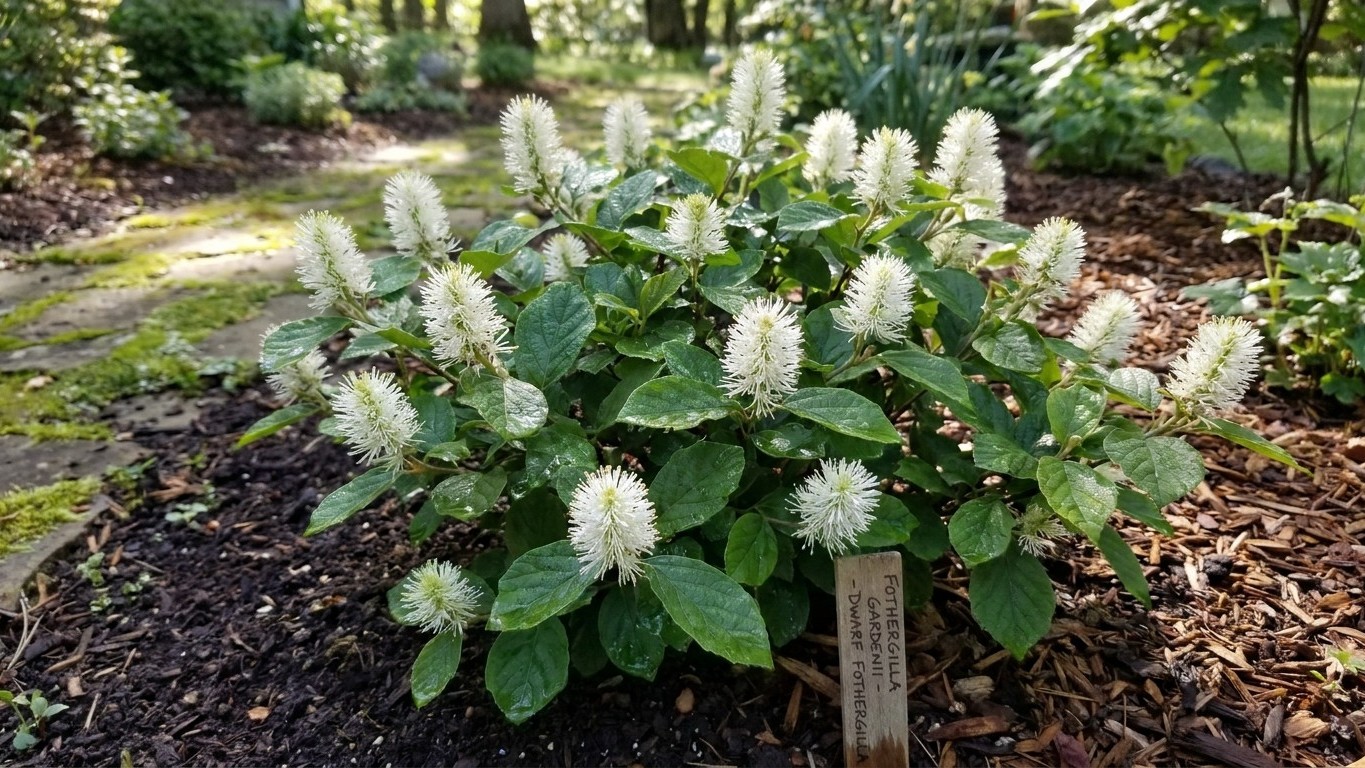

Fothergilla gardenii, also sold as Coastal Witch-alder or Dwarf Fothergilla, is a compact deciduous shrub hardy in USDA zones 5a-8b. It wants full sun to partial shade, acidic soil, and good drainage, though it also tolerates occasional wet spots. It flowers in spring on a low, spreading form, and pruning timing depends on watching your own plant rather than following a calendar date.
Where it will and will not survive

The USDA hardiness range for Fothergilla gardenii runs 5a to 8b. That’s a wide band, but the more useful reading of it isn’t where the shrub thrives, it’s where it simply won’t make it through the year. Below the bottom of that range, in colder zones than 5a, winter temperatures drop past what the plant’s roots and stems can recover from, and a shrub planted there is gambling on a mild year rather than counting on the species’ normal behavior. Above the top of it, past 8b, the issue flips: heat and humidity stress replace cold as the limiting factor, and the plant that survives may not perform the way it does closer to the middle of its range.
A hardiness range describes survival, not comfort. A shrub rated to zone 8b will likely live there, but “will live” and “will look good” aren’t the same claim. Plants pushed to the warm edge of their tolerance often show smaller flowers, thinner foliage, or slower recovery from stress compared with the same species growing mid-range. The reverse holds at the cold edge too: a plant that barely survives a 5a winter isn’t necessarily one that fills out and blooms reliably every spring.
Find your zone before you plant
None of this is useful without knowing your own zone first, and guessing is exactly how gardeners end up disappointed two winters in. Rather than assuming a state or region falls inside or outside this range, check a hardiness zone guide for your area on this site, since zone boundaries shift by county and even by elevation within a single state. That’s the number to compare against 5a-8b, not a regional label or a neighbor’s experience three towns over.
Worth remembering too: the 5a-8b figure is the universal USDA rating, which is different from region-specific planting advice you might find from a state extension service. A recommendation written for coastal, piedmont, or mountain conditions in one particular state doesn’t necessarily transfer to a similar-sounding climate elsewhere, even within the same hardiness zone. The zone number travels. Regional planting notes usually don’t.
Light, soil and where it belongs
Fothergilla gardenii isn’t fussy about one ideal condition so much as it tolerates a range of them. The source data lists several acceptable options for light, soil texture, and drainage rather than a single best-case scenario, and it’s worth reading the list that way: as tolerances, not as an instruction to replicate one specific setup.
| Condition | What it tolerates |
|---|---|
| Light | Dappled sunlight, full sun (6+ hours direct), partial shade (2-6 hours direct) |
| Soil texture | High organic matter, loam (silt), sand |
| Soil pH | Acid (below 6.0) |
| Drainage | Good drainage, occasional flooding, occasionally wet |
That drainage tolerance is worth pausing on. A shrub that handles occasional flooding and occasionally wet soil isn’t a plant for a bone-dry, sandy bank, but it’s also not one that demands a raised bed with perfect drainage. It has room to work in a low spot that stays damp after storms, provided the soil isn’t compacted or permanently waterlogged.
What it looks like from the window
The growth habit is described as rounded and spreading, and being deciduous, it won’t hold a screen year-round the way an evergreen would. Expect a full, rounded form filling out during the growing season and an open, twiggy silhouette once the leaves drop. Against a wall or fence it reads as a soft, low mass rather than a hard vertical line, which suits foundation plantings and border edges better than a spot meant to block a view in January.
The source data doesn’t specify an exact mature height and spread for this shrub, so don’t assume a number that isn’t on the plant’s own tag or nursery listing. What the rounded, spreading habit does tell you is the shape of the growth: it fills out sideways about as readily as it grows upward. That has a direct spacing consequence. Planted as a hedge, plants need to sit close enough that their spreading habit closes the gaps between them, tighter than you’d space the same shrub as a standalone specimen, where it needs open room on every side to keep its rounded form rather than growing lopsided toward the light.
When it flowers, and what that decides
Fothergilla gardenii blooms in spring. That’s given as a season rather than a calendar date on purpose, since bloom timing shifts with latitude and elevation, a plant at a lower, warmer elevation flowers noticeably earlier than the same species a few hundred miles north or a few thousand feet higher.
The bloom season matters for more than the display itself. It sets the pruning calendar. Shrubs generally fall into one of two camps: those that flower on wood grown the previous year, and those that flower on new growth produced the same season. The first group needs pruning right after the flowers fade, since cutting in late winter or early spring removes the buds that were already set the year before and the plant simply won’t flower that year. The second group can be pruned before growth starts in late winter, since the flower buds haven’t formed yet on wood that doesn’t exist.
Which case applies here
The source data doesn’t specify which category Fothergilla gardenii falls into, so this isn’t a case to guess at. The reliable way to settle it is to watch one full season on your own plant. Note when flowers appear relative to new leaf growth, and check whether the flower buds are visible and swollen on stems before the plant resumes active growth in late winter. If buds are already formed and waiting before growth starts, treat it as a plant that flowers on last year’s wood and prune only right after it blooms. If flowers appear on stems that grew that same spring, pruning before growth resumes won’t cost you the display. One season of watching beats a guess either way, and it’s the only way to be certain rather than assuming based on how a related shrub behaves.
Planting and the first two years
Getting a new shrub established has more to do with the first two seasons than with anything the plant tag promises about its mature toughness. A basic planting sequence holds for Fothergilla gardenii as it does for most container-grown woody shrubs:
- Plant in spring or fall, avoiding the stress of summer heat or hard winter freezes on a newly disturbed root system.
- Dig the hole wider than it is deep, roughly two to three times the width of the root ball, so roots can spread into loosened soil rather than fighting a narrow shaft.
- Set the root flare, where the trunk widens into the roots, at or slightly above grade rather than burying it under soil or mulch.
- Tease out any roots that are circling the root ball before planting, so they grow outward instead of continuing to spiral and eventually girdle the stem.
- Backfill with the native soil that came out of the hole rather than amending it heavily, so roots don’t stay confined to a small pocket of rich soil.
- Water deeply right after planting to settle the soil around the roots and eliminate air pockets.
- Mulch two to three inches deep in a wide ring, keeping mulch pulled back from direct contact with the stems.
The source notes this shrub tolerates occasional flooding and occasionally wet soil once established, but that tolerance describes a plant with a developed root system, not one still settling in. A newly planted shrub needs consistent, attentive watering through its first two summers regardless of how forgiving it will eventually be about moisture swings.
It also helps to expect little in year one. Many shrubs put energy into root establishment before top growth, so a plant that looks stalled its first season, fills in visibly by year two, and finally performs the way the tag promised by year three is following a completely normal pattern, not failing. Digging up a shrub that’s simply still building its root system usually undoes more progress than it fixes.
What it resists, and what it does not
Resistance to a pest, disease, or stress means a plant tends to shrug off a particular pressure more than average, not that it’s immune to it under every condition. That distinction matters because a resistant plant can still struggle if conditions push hard enough in the wrong direction.
The source data for this particular shrub doesn’t specify individual pest or disease resistances, so nothing here should be read as a claim about deer, insects, or fungal problems the source hasn’t actually documented. What the data does specify is growth rate, maintenance level, and what the plant attracts.
| Characteristic | What the source states | What that means for the reader |
|---|---|---|
| Growth rate | Slow | Expect gradual filling in rather than a fast-growing hedge; patience matters more than pruning to control size |
| Maintenance | Low | Minimal routine intervention needed once established; no heavy annual shaping required |
| Attracts | Bees, pollinators | Spring flowers draw pollinator activity, useful near vegetable gardens or fruiting plants nearby |
A slow grower with low maintenance needs is one that rarely demands corrective pruning to control size, since it isn’t racing to outgrow its space the way a fast-growing shrub might. That also means it takes longer to reach whatever size it will eventually settle into, so patience during the early years matters more than intervention. Combined with the rounded, spreading habit discussed earlier, the practical takeaway is a shrub that asks for the right spot up front rather than ongoing correction afterward.
Common questions
Is Fothergilla gardenii the same as regular Fothergilla?
The genus Fothergilla includes more than one species, and gardenii specifically refers to the dwarf form sold under names like Coastal Witch-alder or Dwarf Fothergilla. If a listing uses a different species name, don’t assume identical hardiness, size, or bloom behavior.
Does “native plant” mean it’s native to my region?
Not necessarily. The source classification lists this as a native plant in the sense of native to the southeastern United States, which is a specific regional claim, not a guarantee of native status everywhere it’s sold or planted.
Can I prune Fothergilla gardenii in late winter to control its size?
Only once you know how it flowers on your own plant. Since the source doesn’t specify whether it blooms on old wood or new wood, watch one full season first, then time pruning accordingly rather than cutting on a fixed winter schedule.
Will it survive in a container in a colder zone than its rating?
Containers expose roots to colder temperatures than the same soil in the ground, since there’s no surrounding earth to buffer the cold. A shrub rated to zone 5a in the ground may not survive an unprotected winter in a container in that same zone.