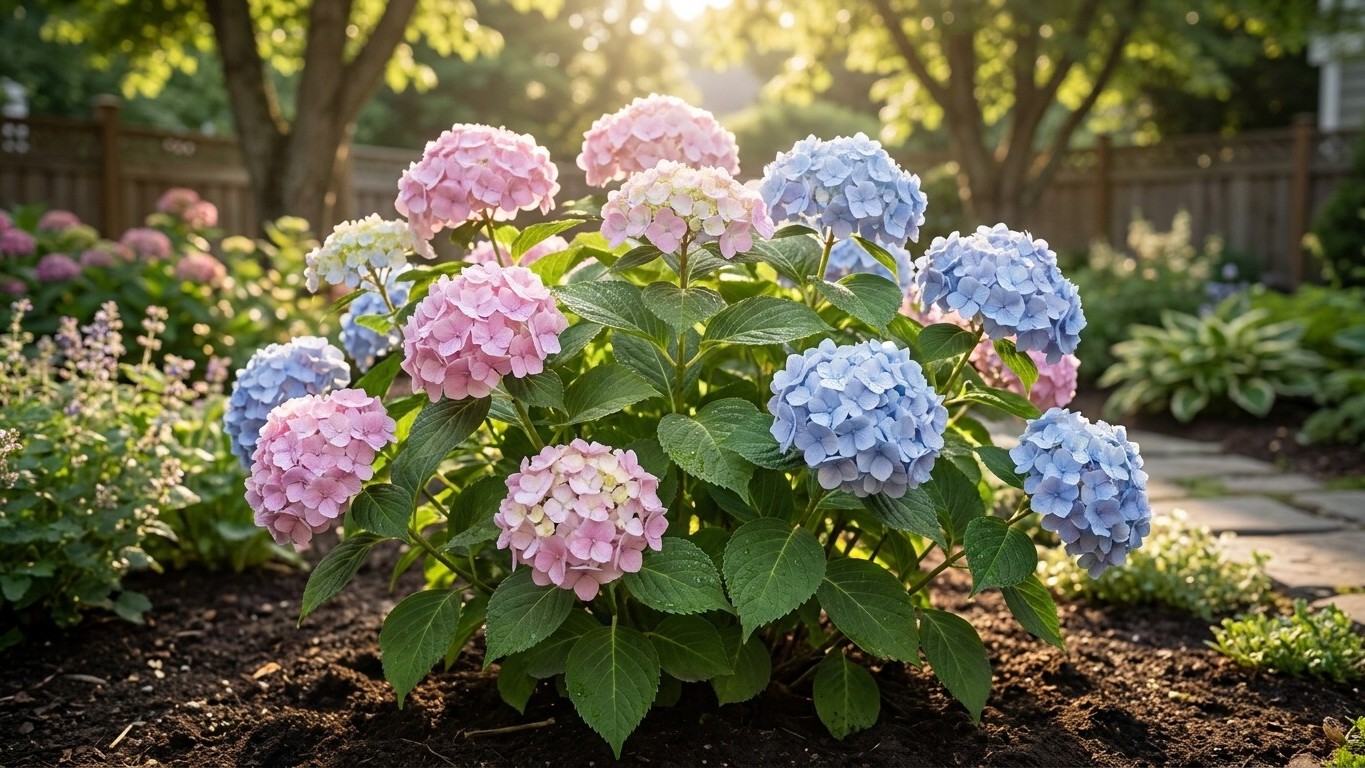

Bigleaf hydrangea, also sold as French hydrangea, hortensia, lacecap hydrangea, mophead hydrangea or snowball plant, survives USDA hardiness zones 6a through 9b, according to the North Carolina Extension Gardener Plant Toolbox. It wants partial shade to dappled light, soil that drains but doesn’t dry out, and pruning timed to when it actually blooms rather than a date on a calendar. Get those three things right and the shrub does most of the work itself.
Where it will and will not survive

The USDA range for this shrub runs 6a to 9b. That’s the number to work from, and the more useful way to read it is backward: this is where the plant survives, and everything colder than 6a or hotter than 9b is where it doesn’t. A winter that drops below the threshold at the bottom of that range can kill the shrub outright, or kill it back to the ground even if the roots survive, which matters a lot for a plant whose flower buds form on wood that has to overwinter intact.
At the warm end, above 9b, the limiting factor flips. It isn’t cold that fails the plant there, it’s heat and the length of the growing season working against a shrub that evolved for milder summers. Being hardy to 9b means the plant can technically survive there, not that it will look happy doing it. A shrub rated to the top of its range often needs more shade, more water, and more patience through the hottest stretch of summer than the same plant grown in the middle of its zone.
Find your zone before you plant
Nothing here should be read as a list of states or regions where this shrub does or doesn’t belong. Hardiness zones don’t line up neatly with state borders, coastlines, or even counties in some cases, and elevation changes the answer within a few miles. The only reliable step is to look up the hardiness zone for the specific property where the shrub will go, not the nearest big city, and that’s what a dedicated hardiness zone guide is for. Check the zone for your address before you buy, and treat a plant tag or catalog listing as a starting point, not the final word.
One more distinction worth keeping straight: hardiness zones measure winter cold, not summer heat, drought, or humidity. A shrub can sit comfortably inside 6a-9b on the cold side and still struggle in a particular summer because of dry air, poor drainage, or too much afternoon sun. That’s a site problem, not a zone problem, and it’s the subject of the next section.
Light, soil and where it belongs
The extension data lists a range of conditions this shrub tolerates rather than a single ideal setup. That distinction matters, because a plant that tolerates deep shade and also tolerates partial shade isn’t necessarily happiest at either extreme. It’s giving a reader the outer edges of what will work, not a formula.
| Condition | What’s tolerated |
|---|---|
| Light | Dappled sunlight, deep shade, partial shade (2-6 hours of direct sun) |
| Soil texture | Clay, high organic matter, loam/silt, sand |
| Soil pH | Acid (below 6.0), neutral (6.0-8.0), alkaline (above 8.0) |
| Drainage | Good drainage, occasionally wet |
That soil pH range is worth a pause, since it’s the reason bigleaf hydrangea flowers are famous for changing color: acidic soil tends to push blue tones, alkaline soil tends to push pink, and the plant itself doesn’t care either way about which color it produces. Tolerance of both ends of the pH scale means the plant will grow in almost any garden soil; it just won’t necessarily bloom the color a label promised.
What it looks like from the window
This is a rounded, multi-stemmed, erect shrub, which means it reads as a soft mound rather than a see-through screen. Planted along a fence or foundation, it fills in as a solid mass rather than something you look through to the yard beyond. That makes it a reasonable pick for softening a blank wall or blocking a sightline at eye level, less useful if the goal is a tall privacy screen, since it stays shrub-height rather than climbing a fence line.
Space at maturity runs 3 feet to 6 feet, and that single figure implies two different spacing decisions depending on the job. Planted as a hedge, centers spaced toward the lower end of that range, roughly 3 feet apart, let the shrubs merge into a continuous mass sooner, though they’ll need thinning as they mature into each other. Planted as a single specimen, the full 6-foot spread should be given room on all sides, which means keeping it that same distance from a wall, a walkway, or the next shrub over. Crowding it at specimen spacing just guarantees pruning battles for years to come.
When it flowers, and what that decides
Bigleaf hydrangea blooms in summer. That’s given as a season rather than a month on purpose, since bloom timing shifts with latitude, elevation, and the particular spring a given year delivers. A gardener at the cooler edge of the hardiness range will typically see flowers later in summer than one at the warmer edge, and a late frost can push the whole show back regardless of zone.
The more consequential fact hiding behind bloom time is what it means for pruning. Shrubs generally fall into one of two camps: those that set flower buds on the current season’s new growth, and those that set buds on wood grown the previous year, sometimes called old wood. A shrub that blooms on new growth can be cut back hard in late winter or early spring before growth starts, because the wood that will carry flowers hasn’t grown yet. A shrub that blooms on old wood has to keep that wood intact through winter, which means pruning right after it finishes flowering, before next year’s buds start forming, rather than in spring.
The extension data for this shrub doesn’t settle which camp it falls into, and rather than guess, the honest answer is to watch one full season before reaching for pruning shears. If a hard spring pruning is followed by a summer with few or no flowers, that’s the plant telling you it blooms on old wood and needs to be cut back right after flowering instead. If it flowers reliably regardless of how it was pruned in late winter, it’s working off new growth. One season of observation costs nothing; a wrong guess can cost an entire year’s flower display.
Planting and the first two years
- Plant in spring or fall, avoiding the hottest stretch of summer when new roots have to fight heat stress on top of transplant stress.
- Dig the hole wider than it is deep, roughly two to three times the width of the root ball, so roots can spread into loosened soil rather than hitting a hard-sided pit.
- Set the root flare, the point where the trunk widens into roots, right at or slightly above grade. Buried too deep, the stem base can rot over time.
- Tease out any roots that are circling the root ball before planting, so they grow outward instead of continuing to spiral and eventually strangling the plant.
- Backfill with the same native soil that came out of the hole rather than amending heavily, so roots don’t stay confined to a pocket of rich soil and refuse to spread.
- Water deeply right after planting, soaking the whole root zone rather than a quick surface sprinkle.
- Mulch two to three inches deep in a wide ring, keeping mulch pulled back from direct contact with the stems.
The extension listing notes this shrub tolerates occasionally wet soil and grows in conditions ranging from deep shade to partial sun, but none of that tolerance is automatic for a plant that’s only been in the ground a few months. Any mention of drought tolerance applies to an established shrub with a root system that’s had time to spread; a first-year or second-year planting still needs regular deep watering through dry spells, full stop.
What to expect in the meantime: many shrubs, this one included, spend their first year mostly sulking, putting energy into roots rather than visible growth above ground. Year two usually brings noticeably more foliage and a fuller shape. Year three is typically when the plant starts performing the way the label promised, flowering fully and filling its allotted space. Digging up a shrub after one disappointing summer usually means giving up right before it was about to take off.
What it resists, and what it does not
Resistance on a plant label means a tendency to shrug off a particular stress most of the time, not a guarantee against it. The extension source lists only one resistance for this shrub: salt, with the degree left unspecified. That’s worth noting rather than skipping over, since an unspecified rating means the source confirms some tolerance without quantifying how much salt exposure the plant can handle before showing damage.
| Challenge | What resistance means here | What a reader would see |
|---|---|---|
| Salt | Some tolerance noted, degree not specified by the source | Likely better performance than a salt-sensitive shrub near a treated walkway or coastal spray, but damage is still possible under heavier exposure |
No other pest or disease resistance is listed for this shrub in the source data, and none should be assumed. That’s different from saying it has no problems; it just means the reference used here doesn’t make a claim either way, and inventing one wouldn’t be honest.
Growth rate is listed as rapid, with low maintenance and an erect, multi-stemmed, rounded habit. Rapid growth paired with low maintenance suggests a shrub that fills its space quickly with relatively little routine care, but it also means the pruning question from earlier can’t be ignored for long. A fast grower that’s pruned at the wrong time, or not pruned at all, will crowd its 3-to-6-foot mature spread faster than a slower shrub would, pushing into walkways or neighboring plants sooner than a gardener might expect from a “low maintenance” label alone.
Common questions
Is bigleaf hydrangea poisonous?
The extension classification lists this plant as poisonous, alongside its classification as a perennial and a shrub. That classification should be taken seriously around pets and small children, and it’s worth keeping in mind when deciding where on the property to plant it.
Does bigleaf hydrangea need full sun?
No. The tolerated light range runs from deep shade through dappled sunlight to partial shade, meaning as little as two hours of direct sun can work. Full, all-day sun isn’t listed among its tolerances at all.
Why didn’t my hydrangea bloom this year?
The most common cause is pruning at the wrong time relative to how the shrub sets its buds. Since bloom timing here is old-wood or new-wood dependent and not settled by the source data, a missed bloom season after hard pruning is a strong clue the shrub needed to be cut back right after flowering rather than before spring growth.
How far apart should I plant them for a hedge versus a single specimen?
Mature spread runs 3 feet to 6 feet. For a hedge, spacing toward the 3-foot end lets shrubs merge into a continuous mass sooner. For a standalone specimen, give it the full 6-foot spread on all sides so it isn’t crowded against a wall, path, or neighboring plant once mature.