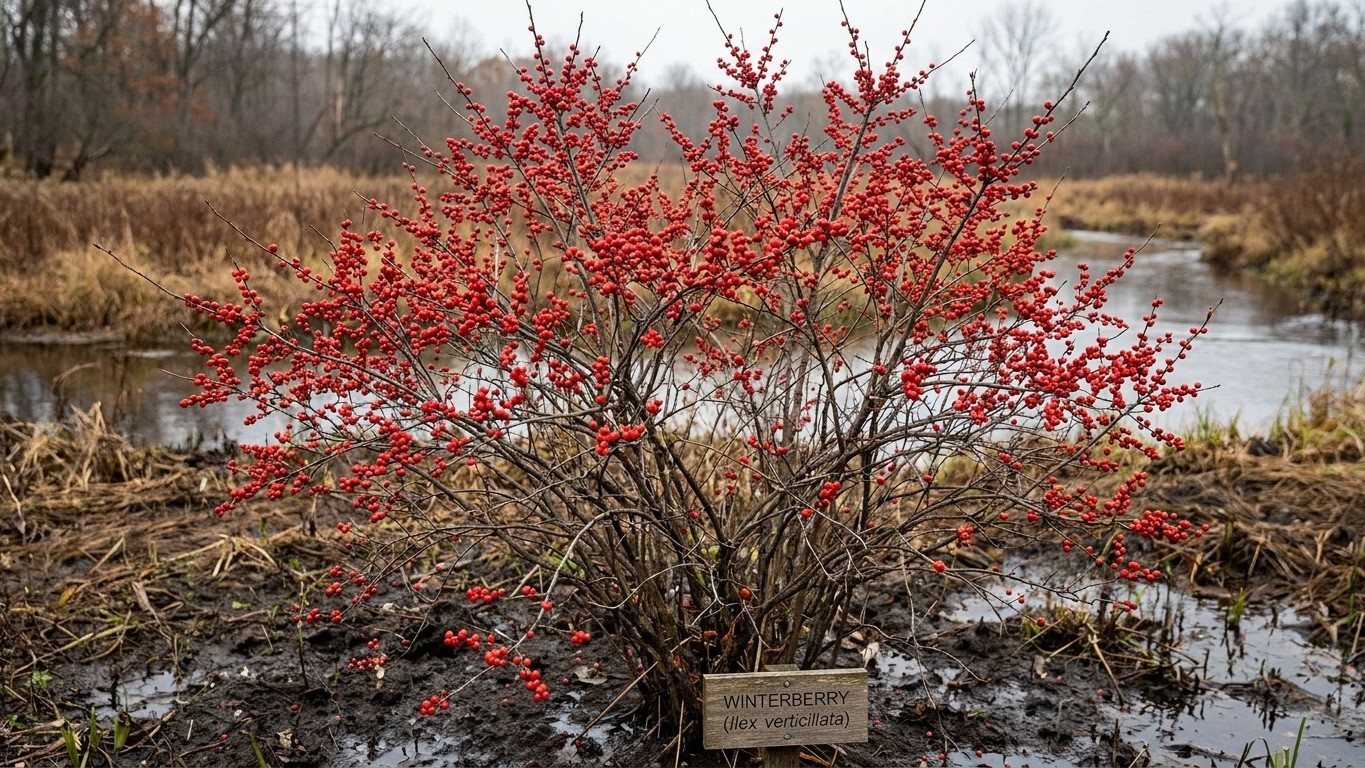

Winterberry holly survives across USDA hardiness zones 3a through 9b, one of the widest ranges of any shrub covered on this site. That spread means the plant itself is rarely the limiting factor where you live. What matters more is matching the site: the wet, acidic soil this species evolved to tolerate, the light it can take without sulking, and the pruning timing that depends on when it flowers rather than a fixed date on the calendar.
Where it will and will not survive

Zones 3a through 9b is the range the USDA data gives for Ilex verticillata, and it’s worth reading that number as a boundary rather than an endorsement. Below the bottom of this range, winter cold will kill the plant outright or damage it badly enough that it won’t recover reliably. Above the top of it, the shrub may survive but the stress of a long hot season works against it in ways that show up as thin canopies, early leaf drop, or fruit that never quite develops deep color.
A range like this describes survival, not comfort. A winterberry planted at the very edge of zone 9b is not living the same life as one in the middle of zone 6. It may hang on for years while declining slowly in ways that get blamed on soil or watering when the real cause is simply that the plant is working harder than it should to get through summer. The same logic applies at the cold edge: a shrub rated to zone 3a is not necessarily thriving there, just surviving winters that would kill less hardy species.
Find your zone before you plant
The number 3a-9b only becomes useful once you know where your own property falls inside it, and that’s not something to guess at from memory or from what a neighbor’s shrub happens to be doing. Zone boundaries shift with elevation, proximity to large bodies of water, and microclimates created by buildings, slopes, and windbreaks. Check the hardiness zone guide on this site for your state, which breaks the data down county by county, to know whether you’re planting well inside this shrub’s comfort range or pushing at one edge of it.
None of this means avoid the plant if you’re near an edge of the range. It means pair the planting with a site that compensates. A borderline-cold zone gets some help from a location out of harsh winter wind. A borderline-hot zone gets some help from afternoon shade and consistent soil moisture, both of which this species tolerates well, as the next section covers.
Light, soil and where it belongs
The plant data from the North Carolina Extension lists a set of tolerances for winterberry holly, not one ideal condition to aim for. That distinction matters because it means the shrub can handle a wider band of situations than gardeners often assume for a “wetland” plant, while still having limits worth respecting.
| Condition | Tolerance range |
|---|---|
| Light | Deep shade, partial shade, or full sun |
| Soil texture | Clay, loam (silt), or sand |
| Soil pH | Acid (below 6.0) |
| Drainage | Good drainage, moist, or occasionally wet |
The acid pH requirement is the one number in that table worth flagging on its own. Winterberry is not fussy about texture, and it’s not fussy about how wet the ground stays, but it does want acidic soil to perform well. A neutral or alkaline site, common where old concrete has leached lime into the ground near foundations and walkways, can leave the shrub chlorotic and unproductive even when light and moisture are fine.
What it looks like from the window
Winterberry drops its leaves in fall, which means for roughly half the year it reads as a bare, multi-stemmed thicket rather than a solid screen. That’s the point in a garden built around winter interest: the bright red fruit (or yellow-orange to orange on some cultivars) shows up against bare branches with nothing in the way. Planted where it’s viewed through a window from indoors, that show is the payoff for six months of a fairly plain, oval-to-rounded shrub the rest of the year. It’s not the right choice for a spot that needs year-round privacy screening, since a deciduous, clumping habit won’t block a view in January the way it does in July.
Spacing at maturity
Space at maturity runs 3 feet to 6 feet, and that figure means two different things depending on how the shrub is used. Planted as a hedge, spacing toward the lower end (roughly 3 to 4 feet apart) lets the multi-stemmed habit knit together into a continuous mass within a few seasons. Planted as a specimen meant to be seen as its own clumping form, the full 6-foot allowance on all sides keeps it from crowding a fence, foundation, or neighboring shrub as it fills out. Given a slow growth rate, that fill-in takes patience either way.
When it flowers, and what that decides
Winterberry blooms in spring, a small, unshowy flower that most gardeners barely notice compared to the fall and winter fruit display that follows on female plants. Because bloom timing shifts with latitude and elevation, there’s no single month worth pinning to a calendar.
What that bloom timing decides matters more than the flower itself: when the shrub gets pruned. The general rule for flowering shrubs splits into two groups. A shrub that flowers on last year’s wood, meaning the buds formed the previous growing season, gets pruned right after it finishes blooming, so the plant has a full season to set next year’s buds before winter. A shrub that flowers on new growth, meaning it produces flower buds on the current season’s stems, can be pruned before growth starts in late winter or early spring without sacrificing that year’s bloom.
The available data on winterberry doesn’t specify which group it falls into, so the honest approach is to watch one season on your own plant. Note where flowers appear relative to the wood: if they show up on stems that grew the previous year, treat it as an after-bloom pruner. If they appear near the tips of the current season’s new growth, late-winter pruning is safer. One season of observation settles a question the label alone can’t answer, and it beats pruning off a year of berries by guessing wrong.
Planting and the first two years
Getting a winterberry holly established follows the same sequence that applies to most container-grown shrubs, with a few points specific to this species’ preference for acidic, evenly moist ground.
- Plant in fall or early spring, when cooler temperatures reduce transplant stress and let roots establish before summer heat arrives.
- Dig the hole wider than it is deep, at least twice the width of the root ball, so roots can spread laterally into loosened soil.
- Set the plant so the root flare sits at or slightly above grade; a shrub planted too deep struggles for years in ways that are hard to reverse.
- Tease out any circling or matted roots before backfilling, especially on a plant that’s been in a container long enough to start winding around the pot’s edge.
- Backfill with the native soil dug from the hole rather than amending heavily, since roots need to adapt to the surrounding ground, not a pocket of richer soil they never grow beyond.
- Water deeply at planting and on a regular schedule through the first two growing seasons, since the “drought resistant” reputation of an established winterberry does not apply to a plant that hasn’t built out its root system yet.
- Apply mulch in a wide, shallow ring, keeping it a few inches back from the stems so moisture and rot organisms don’t sit against the bark.
Expect the first year to look underwhelming. Many shrubs, winterberry included, spend that first season establishing roots rather than pushing visible top growth, a pattern sometimes described as sleep, creep, leap: modest change in year one, noticeable fill-in by year two, and full performance by year three. A shrub that looks stalled in its first summer is usually doing exactly what it should be doing below ground.
What it resists, and what it does not
Resistance in a plant description means a tendency to shrug off a particular stress, not a guarantee against it. A deer-resistant shrub can still get browsed when a hard winter leaves deer with fewer options; a salt-resistant plant can still decline if exposed to concentrated de-icing runoff year after year. The source lists winterberry as resistant to deer, fire, salt, and wet soil, without further detail on degree, which is worth keeping in mind as a general tendency rather than a promise.
| Challenge | What resistance means here | What you’d likely see |
|---|---|---|
| Deer | Generally lower browsing pressure than many landscape shrubs | Occasional nibbling possible, especially on young plants or in a hard winter |
| Fire | Some tolerance for fire exposure | Reduced but not eliminated damage compared to more flammable species |
| Salt | Tolerates salt exposure better than salt-sensitive shrubs | Fewer symptoms near roadside de-icing or coastal salt spray |
| Wet soil | Handles occasionally wet or poorly drained ground | No decline in a low spot or seasonally soggy bed |
Growth rate is listed as slow, and maintenance as low, a combination that tells you what to expect once the shrub is established. Slow growth means pruning needs are infrequent, mostly limited to removing dead or crossing wood and shaping after bloom or before growth depending on what a season of observation confirms. Low maintenance means it’s not a shrub that demands regular feeding or spraying to look its best, but it does still need the space the mature size calls for; a slow grower crowded too tightly at planting takes years longer to show the problem.
Common questions
Does winterberry holly need a male plant nearby to produce berries?
The plant data notes that fruit appears on female plants, which is standard for hollies as a group; they’re typically dioecious, meaning individual plants are either male or female. A female winterberry planted alone, with no male of a compatible bloom time nearby, generally won’t set the fruit display the species is known for.
Why didn’t my winterberry fruit its first year?
A shrub still establishing its root system in year one often skips a strong fruit set, consistent with the general pattern of modest first-year growth followed by fuller performance in year two and year three.
Can winterberry holly grow in full shade?
The tolerance range listed includes deep shade alongside partial shade and full sun, so yes, it can survive there. Whether fruiting and overall vigor match a sunnier planting is a separate question the source data doesn’t quantify.
Is winterberry the same plant as English holly or other evergreen hollies?
No. Winterberry is deciduous, dropping its leaves each fall, which sets it apart from the evergreen hollies most people picture when they hear the word “holly.” The bare-branch fruit display described in the source is a direct result of that deciduous habit.