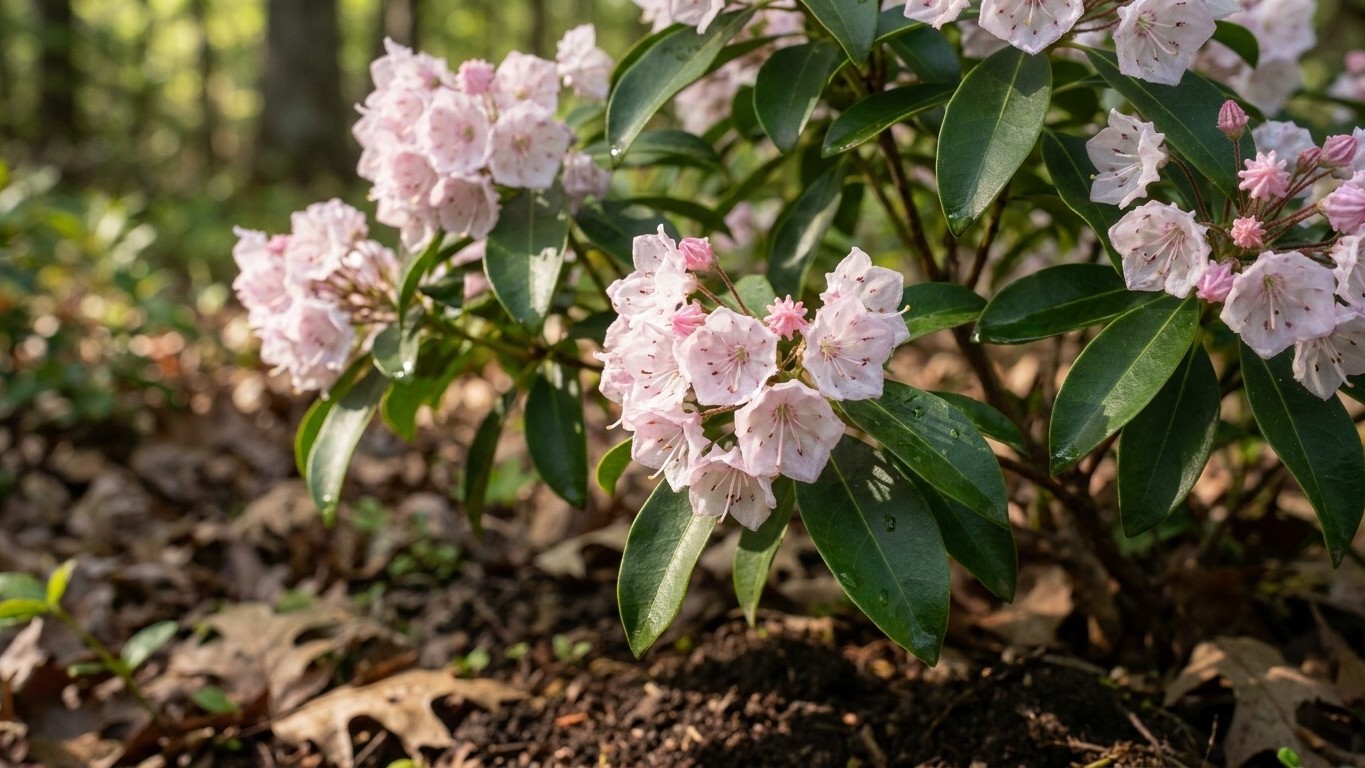

Mountain laurel, also called Calico Bush, Ivy Bush, Laurel, Mountain Ivy, Sheepkill or Spoonwood depending on who you ask, survives across USDA hardiness zones 4a through 9b. It’s a broadleaf evergreen shrub, classified by the North Carolina Extension as a native plant (to the southeastern United States), a perennial, and poisonous. It flowers in spring and summer, tolerates shade to full sun, and needs acidic, well-drained soil. Its mature spread, 6 to 24 feet depending on habit, is the single detail most likely to get it planted in the wrong spot.
Where it will and will not survive

The USDA range for Kalmia latifolia is 4a-9b. That’s a wide band, but treat it as a survival threshold, not an invitation. Below the bottom of this range, in zones colder than 4a, the shrub is not reliably hardy: winter cold will damage or kill it outright, regardless of how it’s sited or mulched. Above the top of it, in zones warmer than 9b, the plant is pushed past what it can tolerate, generally from heat and humidity stress rather than cold.
Inside 4a-9b, survival is not the same as comfort. A mountain laurel planted at the cold edge of its range, zone 4a, is hanging on rather than thriving, and the same is true at the hot edge in 9b. The shrub’s broadleaf evergreen foliage, which stays on the plant through winter, makes it more exposed to winter burn and desiccation at the cold end than a deciduous shrub would be, and more prone to heat stress at the warm end where evergreen leaves keep transpiring through long summers.
The number on the tag or in a planting guide is only useful once you know your own zone, and that number varies block to block in hilly or coastal terrain far more than most gardeners expect. Rather than assume where you fall, check your specific zone against a current map. This site’s hardiness zone guide breaks the country down by state and county, which matters here because zone boundaries shift with elevation and local microclimate in ways a national map glosses over.
Why the North Carolina source doesn’t map your region
The USDA hardiness range, 4a-9b, is a national standard and applies wherever you garden. But that same extension service also gives regional notes, Coastal, Piedmont, Mountains, that describe conditions specific to North Carolina. Those regional notes don’t travel. A Piedmont recommendation means nothing in a different state’s coastal plain, so regional siting is best left to your own local extension office or the zone guide above.
Light, soil and where it belongs
The source lists a range of conditions mountain laurel will tolerate rather than a single ideal setup. Read the table below as tolerances, meaning the shrub can survive across that spread, not that every point on it produces the same result.
| Factor | Tolerances |
|---|---|
| Light | Dappled sunlight (shade through upper canopy all day), full sun (6+ hours direct), partial shade (2-6 hours direct) |
| Soil texture | High organic matter, loam/silt, sand, shallow rocky soil |
| Soil pH | Acid (below 6.0) |
| Drainage | Good drainage, moist, occasionally dry |
The pH line is the one to take seriously: acid soil, below 6.0, is not negotiable the way the light range is. A mountain laurel dropped into neutral or alkaline soil will struggle regardless of how much sun or shade it gets, which is worth a soil test before you dig if you’re not already gardening under pines or oaks.
What it looks like from the window
Mountain laurel’s habit is described as dense, multi-stemmed, open, and rounded, a combination that reads as a shrub with real body but some visibility through its lower branches rather than a solid wall. It works as a screen once mature but won’t block a view the way a tight-branched hedge plant does; expect a softer, layered look rather than a flat green surface. Against a wall or fence, its rounded form reads as a mass rather than an espalier candidate, and its evergreen foliage means it holds that mass through winter, which matters if you’re using it to anchor a corner that would otherwise look bare from November to March.
Spacing: hedge versus specimen
Space at maturity is given as 6-feet-12 feet for one habit and 12-24 feet for another, and that single figure implies two different plantings. As a hedge, working toward the smaller end of that spread and spacing plants at roughly half their mature width lets branches knit together into a continuous screen. As a specimen, the larger spread, up to 24 feet, means giving it real room: at least 12 feet from a wall, walkway, or another shrub, so it can reach its full rounded form without a decade of corrective pruning. Planting a specimen-grade mountain laurel at hedge spacing is the single most common spacing mistake with this plant.
When it flowers, and what that decides
Mountain laurel blooms in spring and summer, given here as a season rather than a calendar month, because bloom timing shifts with latitude, elevation, and the particular year’s weather. A plant at the southern, low-elevation edge of its range will bloom earlier than the same species at higher elevation or farther north, so treat any specific month you read elsewhere as a local observation, not a rule.
The bloom season matters less for the flower show itself than for what it decides afterward: when you’re allowed to prune. Shrubs that set flower buds on last year’s growth, meaning wood that grew the previous season, need to be pruned right after they finish blooming, because pruning earlier removes the buds before they open, and pruning later removes next year’s flowers along with this year’s growth. Shrubs that flower on new wood, growth made in the current season, can be pruned before growth starts in late winter or early spring without sacrificing bloom, since the flower buds haven’t formed yet.
The facts here don’t settle which category mountain laurel falls into definitively, so the safest approach is to watch one full season before making a pruning decision. Note when flower buds swell and when the flowers open, then note whether new stem growth appears before or after that bloom. If flowers open on wood that clearly grew the prior year, treat it as an after-bloom pruning shrub. Cutting lightly and only for shape in year one, while you observe, costs you almost nothing and saves you from guessing wrong on a slow-growing, long-lived shrub that doesn’t forgive a badly timed hard prune.
Planting and the first two years
Get the planting mechanics right and most of the establishment problems with mountain laurel disappear on their own.
- Plant in spring or fall, when soil temperatures are moderate and the plant isn’t stressed by summer heat or winter freeze.
- Dig the hole at least twice as wide as the root ball but no deeper, so the root flare sits at or slightly above grade rather than sinking over time.
- Set the root flare, the point where roots begin to spread from the trunk, right at soil level, not buried.
- Tease out any circling or matted roots before backfilling, so they grow outward into the native soil rather than continuing to spiral.
- Backfill with the native soil you dug out rather than amending heavily, so roots don’t stay confined to a richer pocket and refuse to spread.
- Water deeply right after planting, soaking the full root zone rather than sprinkling the surface.
- Mulch two to three inches deep in a wide ring, keeping it pulled back from direct contact with the stems to avoid rot.
The source notes mountain laurel tolerates occasionally dry soil once established, but that tolerance doesn’t apply to a plant in its first two summers. A newly planted shrub’s root system hasn’t spread far enough to find water on its own, so it needs consistent deep watering through its first two growing seasons regardless of what the drought tolerance label says down the road.
Expect a slow start. Many shrubs, mountain laurel included, spend their first year mostly settling roots rather than producing visible top growth, fill in noticeably during year two, and don’t show their real performance until year three. A shrub that looks stalled in August of its first summer is usually fine; digging it up to check almost always does more damage than the wait would have.
What it resists, and what it does not
Resistance means a tendency to be less bothered by a given pressure, not immunity from it. A deer-resistant plant can still get browsed, especially by a hungry animal in a lean winter, and a compaction-resistant plant can still decline in badly compacted soil if the compaction is severe enough. The source lists mountain laurel’s resistance to deer and to soil compaction, without specifying the degree.
| Challenge | What resistance means here | What you’d likely see |
|---|---|---|
| Deer browsing | Less preferred than many nearby plants, not avoided outright | Occasional nibbling, especially on young growth, but not the plant stripped bare |
| Soil compaction | Some tolerance for denser, foot-traffic-affected soil | Slower decline than a compaction-sensitive shrub in the same spot, not full immunity |
Growth rate and maintenance level from the source both point toward a low-input shrub: it’s not a fast grower, and it’s rated low maintenance. That combination means pruning demands stay light once you’ve settled on the right timing (see the flowering section above), and the space it needs at maturity, up to 24 feet for a specimen-sized plant, should be budgeted for from the start rather than corrected later with repeated hard cuts. A slow grower given too little room doesn’t outgrow the mistake quickly; it just sits crowded for years while you prune around the problem instead of solving it.
Common questions
Is Kalmia latifolia the same plant as the one called Mountain Laurel elsewhere?
Yes, Mountain Laurel is one of the common names listed for Kalmia latifolia alongside Calico Bush, Ivy Bush, Mountain Ivy, Sheepkill, and Spoonwood. Common names aren’t standardized, so always confirm the botanical name if you’re buying based on a common name alone.
Is mountain laurel actually poisonous?
The North Carolina Extension classifies it as a poisonous plant. That classification alone doesn’t specify which parts or what level of exposure is dangerous, so keep it away from areas where pets or children might chew on foliage, and treat any ingestion as worth a call to a poison control resource.
Does mountain laurel need full sun to bloom well?
It tolerates full sun, partial shade, and dappled sunlight through upper canopy, so no single light level is required for survival. Bloom performance across those light levels isn’t specified in the source data, so it’s worth observing your own plant’s flowering across a season or two in its actual site.
Can I grow mountain laurel in a pot?
The source data doesn’t address container growing. Given its acid-soil requirement and eventual size (up to 24 feet at maturity for larger habits), it’s better suited to in-ground planting where soil pH and root space are easier to manage long-term.