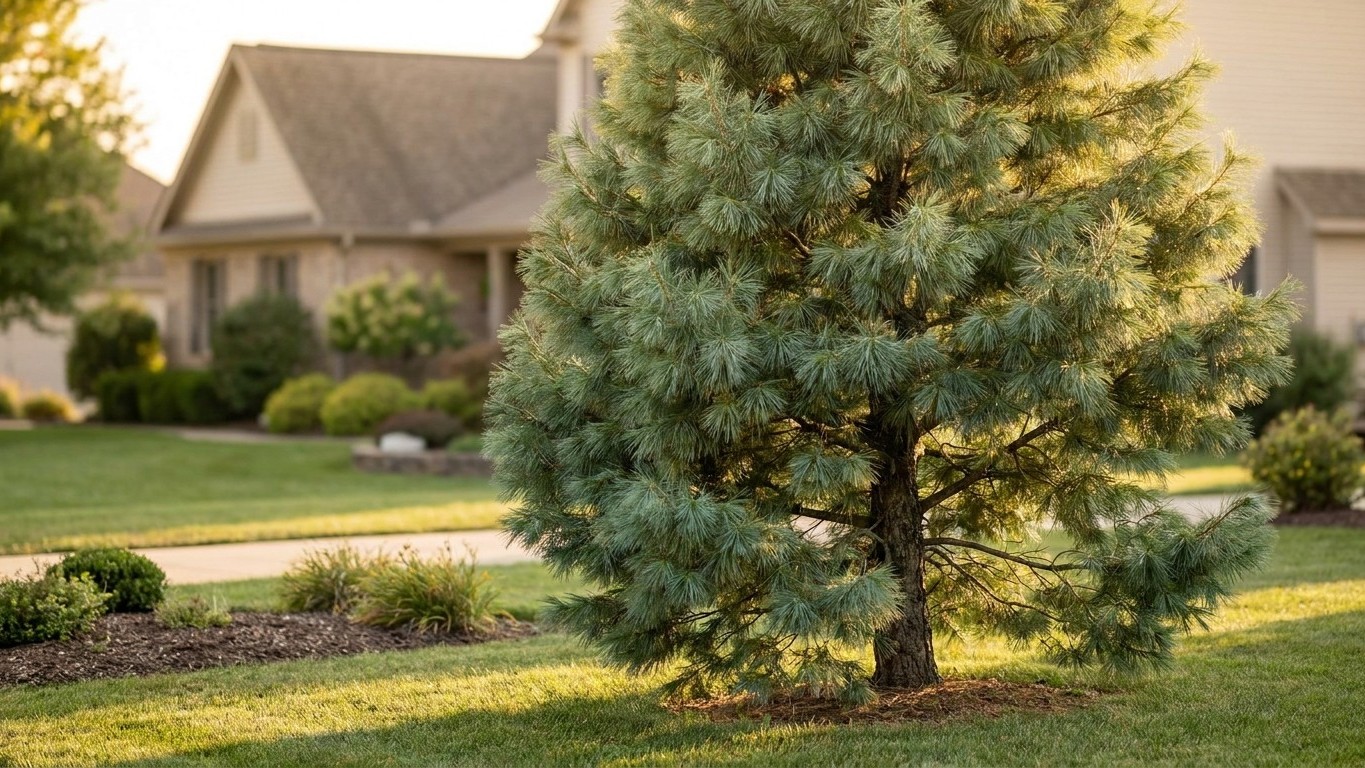

Pinus strobus goes by several common names, including Eastern White Pine, North American White Pine, Northern White Pine, Soft Pine, and White Pine. It’s a needled evergreen tree, classified in the source data as a native plant, perennial, and tree, hardy across USDA zones 3a to 8b. Growth rate is rated rapid and maintenance low once it’s in the ground. The number that actually determines whether this pine belongs in a home landscape isn’t its hardiness. It’s the space it needs at maturity, listed at 24 to 60 feet, and sometimes more.
Where it will and will not survive

The USDA hardiness range for Pinus strobus is 3a to 8b. That’s the fact to build a planting decision around, and the most useful way to read it is backward: a site colder than the bottom of that range, below 3a, will kill this tree outright in a typical winter. A site warmer than the top, above 8b, pushes it past what it can tolerate on the heat side, whether from insufficient winter chill, prolonged summer stress, or both. Neither end is a judgment call. Both are limits.
Between those two points, though, “hardy” doesn’t mean “thriving.” A range describes survival, not comfort. A pine rated to the warm edge of its range, 8b, can live there without necessarily putting on the vigorous growth or dense form it would show closer to the middle of its range. The same logic runs the other direction at 3a: surviving a brutal winter and looking good after one are different outcomes. Nurseries selling into the outer edges of a hardiness range are selling you survival, not a guarantee of the specimen you picture.
Find your own zone before you decide
None of this is useful without knowing which zone your own property sits in, and hardiness zones don’t follow state lines. Elevation, proximity to large water, and even the slope a tree sits on can shift the effective zone by a full number or more. Rather than guessing, check your county against a hardiness zone map before assuming you fall inside 3a to 8b, or where inside it you land. This site’s hardiness zone guide breaks that down by county rather than by state generalization, which is the level of detail this decision actually needs.
One more note on the common names above: they’re not all interchangeable in the way a shopper might assume. Eastern, North American, and Northern all point to the same geography, while Soft Pine is a reference to the texture of the wood and needles rather than to where the tree grows. None of the five is the “correct” one and none is more official than another; they’re simply what different regions and different nursery catalogs settled on. The plant data source, the North Carolina Extension, also lists this species as a native plant, but that classification reflects native range in the southeastern United States specifically. A tree tagged “native” in a plant database from one region isn’t necessarily native to your own, even when it will grow there without issue.
The mistake that costs the most: space
Set aside the hardiness question for a moment, because the mistake that actually costs money and years isn’t a cold snap. It’s underestimating how much room this tree needs. The source data lists space at maturity for Pinus strobus at 24 to 60 feet, with some individuals exceeding 60 feet. That’s not a typo or a wide margin of error. It’s a tree that, planted as a young whip a few feet tall, can end up with a canopy spread rivaling the footprint of a house.
Here’s why that particular mistake is expensive in a way that, say, a slightly wrong pH isn’t. A tree planted too close to a foundation, a driveway, a septic field, or overhead utility lines doesn’t reveal the problem in year one or two. It reveals it in year ten or fifteen, once the canopy and root system have both grown into the space that was assumed to be safe. At that point the fix isn’t a prune. It’s a removal, often an expensive one given the size involved, sometimes with cabling or a bucket truck required simply because of how tall and wide the tree has become. A pruning mistake is reversible. A siting mistake at this scale generally is not.
Before any digging starts, a short set of checks catches most of the problems that show up later:
- Look up: note any overhead utility lines within what will eventually be the tree’s mature height and spread.
- Look down: call for a utility locate to mark buried lines, pipes, or a septic field before the hole goes in.
- Measure out the distance to the nearest foundation, wall, or driveway edge, and compare it against the mature canopy spread of 24 to 60 feet.
- Walk the site at different times of day and note which direction the mature canopy will eventually shade, since a tree with a spreading or pyramidal habit casts a wide, moving shadow as it matures.
- Confirm there’s room for root spread as well as canopy spread; roots on a rapid-growing tree this size extend well beyond the drip line over time.
None of this requires special equipment, just a tape measure, a phone call to the local utility locate service, and the willingness to plan for the tree this will become rather than the one currently sitting in a nursery pot.
The site it actually wants
Once the space question is settled, matching the site itself is more forgiving than it might seem, mostly because this species tolerates a wider range of conditions than a single “ideal” description would suggest. The source data lists a set of conditions it accepts rather than one narrow requirement, and that distinction matters. A plant that tolerates both loam and sand isn’t fussy about texture in the way a plant needing rich, amended loam specifically would be.
| Condition | What Pinus strobus tolerates |
|---|---|
| Light | Full sun (6+ hours direct) or partial shade (2-6 hours direct) |
| Soil texture | High organic matter, loam (silt), or sand |
| Soil pH | Acid, below 6.0 |
| Drainage | Good drainage, moist, or occasionally dry |
Checking your own site without a lab test
Soil pH below 6.0 is the one condition on that list that’s worth actually confirming rather than assuming, since acidic soil isn’t universal and alkaline soils are common in areas with limestone bedrock or heavily limed lawns. A basic home soil pH test, the kind sold at any garden center, gives a reading close enough to know whether a site is in the acidic range this tree wants or well outside it.
Drainage is easier to check without any kit at all. Dig a hole roughly a foot deep, fill it with water, and time how long it takes to drain. Water gone within a few hours points to good drainage or an occasionally dry site, both of which this tree accepts. Water still standing after eight hours or more signals a wet, slow-draining spot that falls outside what the source lists as tolerated, and that’s a site where this particular pine is a poor match regardless of how appealing the light and space otherwise look.
Planting it so it establishes
Getting a young Pinus strobus through its first year or two comes down to a short list of steps, done in order, more than any single trick.
- Choose a planting window using the frost timing guidance for your area rather than a fixed calendar month, since frost dates shift by hundreds of miles across this tree’s hardiness range.
- Dig the hole wide, roughly two to three times the width of the root ball, rather than deep.
- Locate the root flare, the point where the trunk widens into roots, before setting the tree in the hole.
- Set the root flare level with or very slightly above the surrounding grade, never buried below it.
- Tease out and straighten any roots that are circling the root ball from nursery pot growth, rather than planting them as-is.
- Backfill with the same native soil that came out of the hole, without swapping in amended soil that creates a bathtub effect for water.
- Water deeply and infrequently rather than lightly and often, encouraging roots to grow downward and outward in search of moisture.
- Spread mulch two to three inches deep out to the drip line, keeping it pulled back several inches from the trunk itself.
Two mistakes account for most of the young trees that fail to establish. Planting too deep, so the root flare ends up buried, effectively suffocates the tree slowly over several years. Piling mulch up against the trunk, sometimes called a mulch volcano, holds moisture against the bark and invites rot right at the point most vulnerable to it. Both are easy to avoid and both are common enough to be the default outcome when nobody’s paying attention.
One more point worth being direct about: the “occasionally dry” tolerance and the general reputation for drought resistance this species carries apply to an established tree, one with a root system that’s had at least a full season, often two, to spread out. A tree planted this spring needs regular, deep watering through its first growing season regardless of how drought-tolerant the species is rated once mature. Skipping that step on the assumption the label covers it is how newly planted trees die in their first summer.
What it resists, and what it does not
Resistance, wherever it shows up on a plant label, means a tendency, not a guarantee. A plant listed as deer resistant gets browsed less often than a plant deer actively prefer, not never. A hard winter with little else available to eat changes that calculus fast, and a hungry deer will eat plenty of things labeled resistant when the alternative is starving.
| Challenge | What resistance means | What you’ll actually see |
|---|---|---|
| Deer | Lower browsing preference relative to more palatable species | Occasional nibbling, especially on young trees or in a hard winter, but not the tree of choice |
| Rabbits | Lower feeding preference, not immunity | Some bark or seedling damage possible, worse on young, unprotected trunks |
Both of those apply more to a young tree than an established one simply because young bark and foliage sit within easy reach and offer less of a barrier. A trunk guard through the first few winters is a reasonable hedge against both, particularly in areas with heavy deer pressure.
The growth rate listed for this species is rapid, and maintenance is rated low. Those two facts together predict most of what ownership looks like over the following decade: a tree that fills its allotted space faster than a slow-growing species would, with relatively little pruning, feeding, or pest management demanded along the way. The tradeoff is that rapid growth doesn’t stop being rapid once it becomes inconvenient. A tree sited too close to a roofline or gutter under the assumption there’s time to deal with it later will close that gap faster than a slower species would, which loops back to why the spacing decision at planting time matters more than almost anything done afterward.
Common questions
Is Eastern White Pine native to my area?
The source data classifies it as a native plant, but that classification reflects the southeastern United States specifically, since it comes from the North Carolina Extension. Whether it’s native to your particular region depends on where you live, and “native” on one region’s plant database doesn’t transfer automatically to another.
How tall and wide does it actually get?
The source lists space at maturity at 24 to 60 feet, with some individuals growing beyond 60 feet. That figure should drive placement decisions well before soil or light conditions are considered.
Does it need full sun?
No. It tolerates full sun, six or more hours of direct light daily, as well as partial shade, defined as two to six hours of direct sun. Both are listed as acceptable, not one as ideal and the other as merely survivable.
When does it produce cones?
Cones typically don’t appear until the tree reaches 5 to 10 years old. Once they do, cones mature by the summer of their second season and release seeds in July and August, with cones persisting on the tree through September.