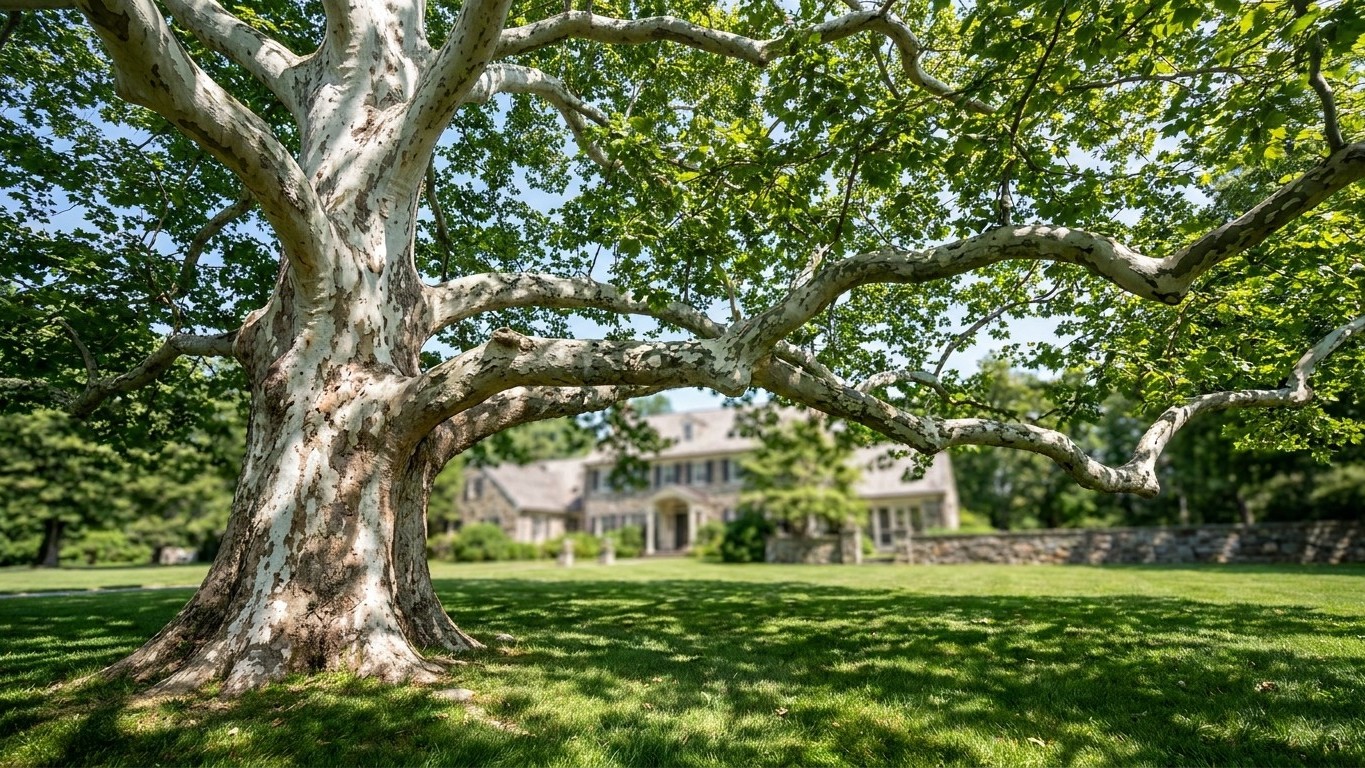

Platanus occidentalis goes by several names: American Plane Tree, American Sycamore, Buttonball Tree, Buttonwood, Eastern Sycamore, Sycamore. It survives in USDA hardiness zones 4a-9b, but the number that decides whether it belongs in your yard isn’t hardiness. It’s the mature spread: more than 60 feet.
Where it will and Will Not Survive
The USDA hardiness range for Platanus occidentalis is 4a-9b. Below the bottom of that range, the tree will not reliably survive winter. Above the top, it runs into heat and humidity stress it isn’t built to handle long-term.
A range like this describes survival, not comfort. A tree rated hardy to 9b can live there without thriving. The cooler edge works in reverse: a specimen planted at the coldest edge may pull through most winters and still get knocked back hard in an unusually severe one. Hardiness ratings are a floor, not a guarantee of vigor.
The USDA zone range applies universally, but that source also classifies the tree as a Native Plant, meaning native to the southeastern United States specifically. Any region-specific planting advice tied to that source is local to North Carolina and shouldn’t be assumed to travel with the tree.
Frost dates and hardiness zones shift by county, sometimes sharply, even within a single state. Rather than assuming you fall inside or outside the 4a-9b range, check your specific zone against a hardiness zone guide that breaks it down county by county. That fifteen-minute check is cheaper than replacing a tree that never had a chance.
The mistake that costs the most: space
Space at maturity for Platanus occidentalis is listed as more than 60 feet. That puts this tree in a different category from most yard trees people plant without a second thought.
Here’s why that number matters more than hardiness. A tree wrong for your zone usually fails within a year or two, cheap and quick to diagnose. A tree wrong for your space doesn’t fail. It succeeds, for a decade or more, until the canopy is shouldering into a roofline, the roots are heaving a driveway, or the crown has grown into overhead lines. At that point the fix isn’t a prune, it’s an expensive removal of a tree that did nothing wrong except grow into the spot it was always going to occupy. Its habit is described as Dense, Horizontal, Irregular, Pyramidal, Rounded, and Spreading depending on the individual tree, so you can’t count on a tidy shape to keep it out of the way either.
Run these checks before the shovel touches soil:
- Look up: note every wire, cable, and low branch of a neighboring tree within the eventual 60-plus-foot spread.
- Look down: call for a utility locate so you know what’s buried before roots find it first.
- Measure the canopy reach in every direction from the planting spot, not just toward the open yard.
- Walk the site at different times of day and picture which way that much shade will fall, onto a garden bed, a neighbor’s window, or a solar panel.
A tree this size isn’t a bad choice. It’s a big one, and big choices deserve a slower first step than most people give them.
The site it actually wants
The growing conditions this species tolerates are broader than most people expect, which is exactly why it gets planted in the wrong spot so often, the plant is forgiving enough to survive it, just not to thrive there.
| Condition | What it tolerates |
|---|---|
| Light | Full sun, 6 or more hours of direct sunlight a day |
| Soil texture | Clay, high organic matter, loam (silt), sand |
| Soil pH | Acid (below 6.0), alkaline (above 8.0), neutral (6.0 to 8.0) |
| Drainage | Good drainage, moist, occasional flooding, occasionally wet |
That’s not a description of an ideal loam bed. It spans clay to sand, acid to alkaline, and dry-ish soil all the way to occasional flooding, the useful information here is exactly how much variation the tree shrugs off.
For drainage, dig a hole about a foot deep, fill it with water, and time how long it takes to empty. Standing water after several hours points to poor drainage; water gone within an hour or two suggests good drainage, and either extreme fits somewhere on this tree’s tolerance list. For pH, a home soil test kit or a sample sent to your local extension office will give you a number without guesswork.
The practical takeaway: this is a tree that adapts to the soil you have rather than demanding you rebuild it. Full sun is the one non-negotiable on the list, everything else is a spectrum it’s already built to handle.
Planting it so it establishes
Growth rate for this species is listed as rapid, and maintenance as high, which makes the establishment window more important than it would be for a slower, easier tree. Get the first season right and the rest mostly takes care of itself.
- Pick the season using frost timing for your area, check a frost date guide for your state and plant after the last frost risk has passed or well before the first one arrives in fall.
- Dig the hole two to three times wider than the root ball, but no deeper. Wide, shallow holes encourage roots to spread outward instead of circling.
- Find the root flare, the point where trunk widens into roots, before setting the tree in the hole.
- Keep that flare at or slightly above grade. Planting too deep is one of two mistakes that kills young trees, and it does so slowly enough that the cause isn’t obvious until years later.
- Tease out any roots circling the root ball rather than leaving them to keep growing in a loop.
- Backfill with the same soil that came out of the hole rather than swapping in something richer, since amended soil can discourage roots from pushing into the native ground around it.
- Water deeply and infrequently rather than a light daily sprinkle, which trains roots to grow downward instead of staying near the surface.
- Mulch two to three inches deep in a ring around the tree, keeping it off the trunk itself. Mulch against bark holds moisture against it and invites rot, the second mistake that kills young trees.
One label detail is worth flagging: drought resistance in the source data describes an established plant, one that’s had a full season or more to build out its root system. A tree in its first year needs regular water regardless of what the species is known for once mature. Skipping first-season watering because “it’s drought resistant” is a common way to lose a tree that would otherwise have earned that reputation.
What it resists, and what it does not
Resistance in a plant listing means a tendency, not a guarantee. “Deer resistant” means deer browse it less often than other options nearby, not that they never touch it, and a hard winter with little else to eat can change that fast.
| Challenge | What resistance means here | What a reader would actually see |
|---|---|---|
| Deer | Browsed less frequently than many alternatives | Occasional nibbling is still possible, especially on young growth |
| Voles | Not a preferred food source | Root and bark damage near the base stays uncommon |
| Drought | Established roots tolerate dry stretches | Wilting or leaf drop mainly shows up in a first-year, unwatered tree |
| Wet soil | Tolerates saturated ground and occasional flooding | No dieback after a heavy rain event that would stress other species |
| Pollution | Handles urban air and roadside conditions | Suitable near streets and parking areas where exhaust and salt spray are common |
| Black walnut | Tolerates juglone, the compound black walnut roots release into soil | Can be planted near a black walnut tree without the dieback that affects sensitive species |
| Urban conditions | General tolerance of compacted soil and reflected heat | Fewer stress symptoms in a paved or hardscaped setting than a woodland species would show |
Growth rate is rated rapid, and maintenance is rated high, and those two facts point in the same direction: this is not a plant-it-and-forget-it tree. Rapid growth into a tight space means rapid growth into gutters, roofs, and power lines too. High maintenance means regular attention: structural pruning while young, monitoring where surface roots are heading, and clearing the debris a large, deciduous canopy drops through fall and into winter as its round seed balls persist on the branches before breaking apart.
Common questions
Can you tap Platanus occidentalis for syrup?
The source data notes that the sap is sweet and is tapped in spring for use as syrup and sugar, the same general practice used with maple, applied here to a different tree entirely.
What does the fruit look like, and is it edible?
The fruit is a showy, fuzzy, long-stalked round ball, roughly half an inch to an inch across, usually one per stalk on a stalk 3 to 6 inches long. It ripens to brown in fall and hangs on into early winter before breaking apart and releasing downy seeds on the wind. That’s a description of appearance and timing, not a claim about taste.
Is this tree native to my area?
The source classifies it as a Native Plant, Perennial, and Tree, but in that source’s own framework, “native” refers specifically to the southeastern United States. Whether it counts as native where you live depends on your region, not on this classification alone.
How much day-to-day work does a mature tree actually require?
With a rapid growth rate and a high maintenance rating, expect regular pruning while young to establish good branch structure, periodic checks on surface roots near hardscaping, and seasonal cleanup of dropped seed balls and leaf litter once the canopy fills in.