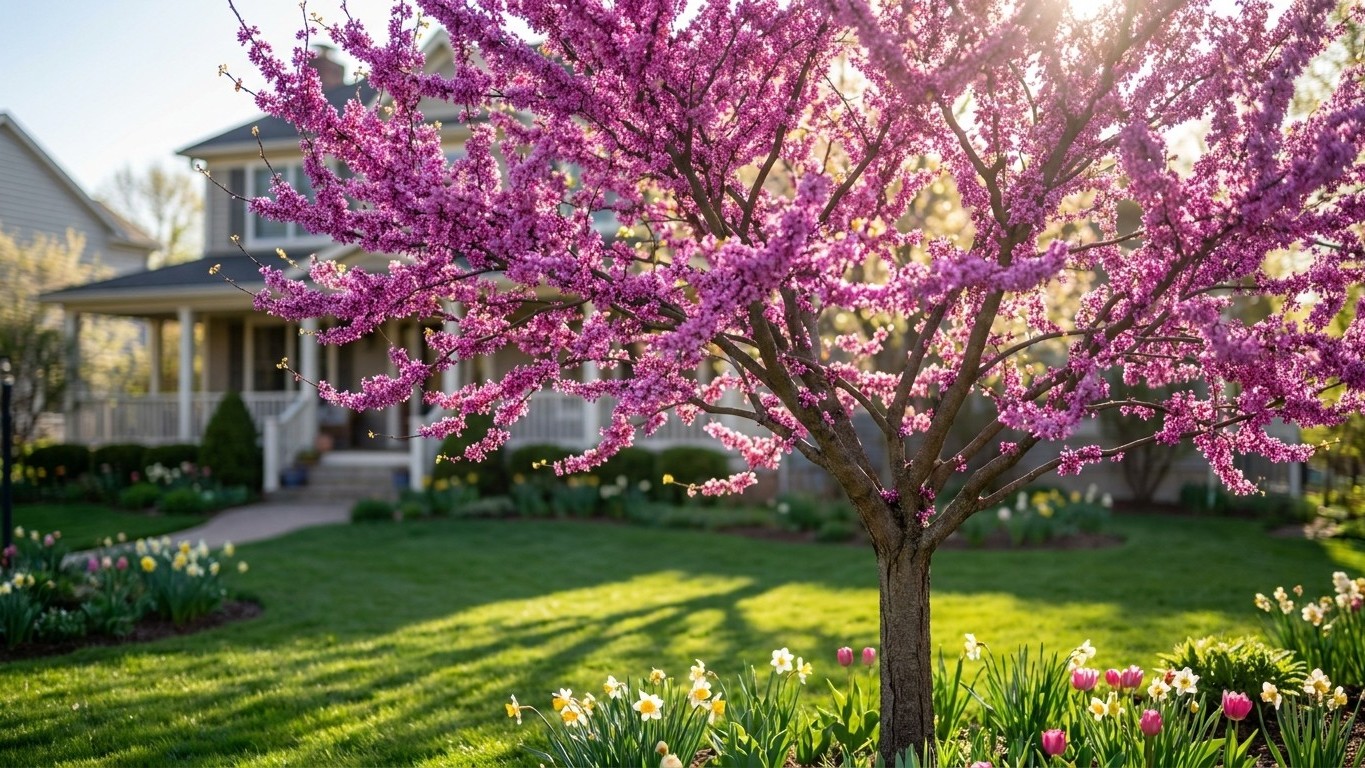

Cercis canadensis, sold under the names eastern redbud, American redbud, American Judas tree, or simply redbud, is a deciduous tree or large shrub that the North Carolina Extension Gardener Plant Toolbox classifies as Edible, Native Plant, Perennial, Shrub, and Tree all at once. It survives USDA hardiness zones 4a through 9b, spreads anywhere from 12 to 60 feet wide depending on habit, and blooms in spring before the leaves emerge. Where it actually belongs on a property depends on more than that headline number.
Where it will and will not survive

The USDA range for Cercis canadensis runs from zone 4a to zone 9b. That is a survival boundary, not a comfort zone, and reading it as one or the other matters. A redbud planted at the coldest edge of 4a is living at the outer limit of what its wood can tolerate through a hard winter, and one planted at the warm end of 9b is enduring summer heat and humidity it merely tolerates rather than thrives in. Neither extreme is where this tree looks its best.
Below the bottom of this range, the plant simply does not have the cold hardiness to survive a normal winter. Above the top of it, the sustained heat and the shortened chill period work against it in ways the species was never built to handle. Neither of those statements tells you anything about your own yard, though, because hardiness zones vary block by block in hilly or coastal terrain, and a house on a north slope can sit a half-zone colder than one three miles away.
That is the reason to check your own zone rather than assume it from a regional label. This site’s hardiness zone guide breaks the USDA map down by state, and it is worth five minutes before you decide whether Cercis canadensis is even a candidate for your address. The plant data behind this page comes from the North Carolina Extension, and while the USDA hardiness figures are universal and safe to use anywhere, the same source also publishes region-specific growing notes for North Carolina’s coastal, piedmont, and mountain zones. Those regional notes are local to that one state and do not transfer to a different state’s climate, so the USDA range is the safer guide.
The mistake that costs the most: space
The Plant Toolbox lists space at maturity for Cercis canadensis as 12 to 24 feet in one habit and 24 to 60 feet in another, reflecting the fact that this species is naturally multi-stemmed, multi-trunked, and rounded rather than a single narrow trunk. That is a wide spread for a tree many people picture as small and ornamental, and it is the single figure homeowners get wrong most often when they plant one.
Wrong here does not show up right away. A redbud planted six feet from a foundation looks perfectly reasonable for its first five or six years, while the canopy is still filling in. The problem arrives a decade later, when a rounded, multi-trunked canopy that was always going to reach 24 to 60 feet wide starts pressing against siding, shading out a vegetable bed, or lifting a walkway with surface roots. At that point the fix is not a pruning job. It is removal, and removing an established tree costs far more, in money and in years lost, than simply putting it somewhere with room to spread in the first place.
Before digging, walk the site and check the following, in order:
- What runs overhead: power lines, low eaves, or a roofline the mature canopy could eventually reach.
- What runs underground: a septic field, a water line, or a sewer lateral within the eventual root zone.
- How far the canopy will reach at 24 to 60 feet wide, measured from the planting hole toward every structure, drive, and property line nearby.
- Which direction the canopy will cast shade once it fills in, and whether that shade will fall on a garden, a solar panel, or a neighbor’s yard.
None of this requires a survey crew. A tape measure and a few minutes standing where the trunk will go is enough to catch the mistake before it becomes a fifteen-year problem.
The site it actually wants
The Plant Toolbox does not describe one ideal soil for this species. It lists a range of conditions the plant tolerates, and treating that list as tolerance rather than a single recipe is the more useful way to read it.
| Condition | What Cercis canadensis accepts |
|---|---|
| Light | Full sun (6+ hours direct) or partial shade (2-6 hours direct) |
| Soil texture | Clay, high organic matter, loam/silt, or sand |
| Soil pH | Acid (below 6.0), neutral (6.0-8.0), or alkaline (above 8.0) |
| Drainage | Good drainage, consistently moist, or occasionally dry |
That spread across texture and pH is unusually wide for a landscape tree, and it means a redbud is rarely disqualified by soil type alone. Checking your own site does not require a lab test. For drainage, dig a hole about a foot deep, fill it with water, and see how long it takes to empty; standing water after several hours points to a heavier, slower-draining spot, which this plant still tolerates according to the source as long as it is not permanently waterlogged. For pH, a simple home soil test kit or a sample sent to a county extension office will tell you where you land on that acid-to-alkaline range, though given how wide the tolerance is here, most home landscapes will not need to amend anything specifically for this species.
Where the site does not match, the fix is usually about drainage rather than pH, since “good drainage,” “moist,” and “occasionally dry” cover most residential yards already. A spot that stays soggy for days after rain, rather than hours, is the one condition worth improving or avoiding before planting.
Planting it so it establishes
Getting a redbud through its first year or two matters more than picking the perfect soil, and the sequence below follows the order that actually protects the roots.
- Choose a planting window using the frost timing for your area rather than a calendar month; this site’s frost date guide gives that by state.
- Dig the hole wide, roughly two to three times the width of the root ball, rather than digging it deep.
- Locate the root flare, the point where the trunk widens into roots, before backfilling anything.
- Set the tree so that root flare sits at or slightly above the surrounding grade, never buried.
- Gently tease apart any roots that are circling the root ball from container growth before it goes in the hole.
- Backfill with the same native soil that came out of the hole, without amending it into something richer than the surrounding yard.
- Water deeply and infrequently rather than with light, frequent sprinkles that only wet the top inch.
- Spread mulch two to three inches deep in a wide ring, keeping it pulled back several inches from the trunk itself.
The two mistakes that kill young trees more than any pest or disease are planting too deep, which suffocates the root flare, and piling mulch against the bark, which keeps that bark constantly damp and invites rot. Both are avoidable, and both are more common than they should be.
It is also worth saying plainly that any tolerance for occasionally dry soil in the source’s growing notes describes an established plant with a developed root system, not a tree in its first season. A newly planted redbud needs regular, deep watering through its first summer regardless of what the mature plant can shrug off later.
What it resists, and what it does not
Resistance, wherever it shows up on a plant label, means a tendency to be bothered less, not an immunity. A “deer resistant” plant still gets browsed in a hard winter when a hungry deer runs out of better options, and that distinction matters more than the label itself.
The Plant Toolbox entry for Cercis canadensis lists four resistance categories, Deer, Fire, Compaction, and Black Walnut, but does not specify a rating for any of them. That is worth stating honestly rather than guessing: the source flags these as relevant characteristics for this species without saying how resistant it actually is in each case.
| Category | What the source specifies | What that means for you |
|---|---|---|
| Deer | Not specified | No documented rating either way; assume standard deer pressure applies |
| Fire | Not specified | No documented rating; treat it as any other deciduous landscape tree near defensible space |
| Compaction | Not specified | No documented tolerance level for foot traffic or heavy soil compaction near the roots |
| Black Walnut | Not specified | No documented sensitivity to juglone, the compound black walnut trees release into the soil |
What the source does specify clearly is growth rate and maintenance: medium growth, and low maintenance once established. A medium grower is not explosive, but over ten or fifteen years it still fills the 24 to 60 foot spread mentioned earlier, and low maintenance describes routine care, not zero attention during the establishment years covered above. Planted with enough room and watered through its first season, this is a tree that asks little of a homeowner after that, which is exactly why the siting decisions made on day one carry so much weight later.
Common questions
Are redbud flowers actually edible?
The North Carolina Extension notes that the flowers are edible and describes their taste as similar to peas, and states they contain high amounts of vitamin C. That is the source’s claim as written, and this page adds nothing to it beyond repeating it.
What do the seedpods look like, and when do they show up?
According to the source, flat, oblong pods appear by summer, running roughly 2 to 4 inches long with about nine seeds each. They start green and turn brown, and can hang on the tree looking untidy well into fall or even winter.
Does “Native Plant” mean it is native to my state?
Not necessarily. The North Carolina Extension classifies Cercis canadensis as a Native Plant in the sense of native to the southeastern United States, which is a regional designation, not a claim that it is native to every state where it happens to grow well.
How do I know if my exact location falls inside zones 4a-9b?
Rather than guessing from a general sense of your climate, check your specific location against a county-level hardiness map, since microclimates within a single state can shift the effective zone by a half-step or more in either direction.