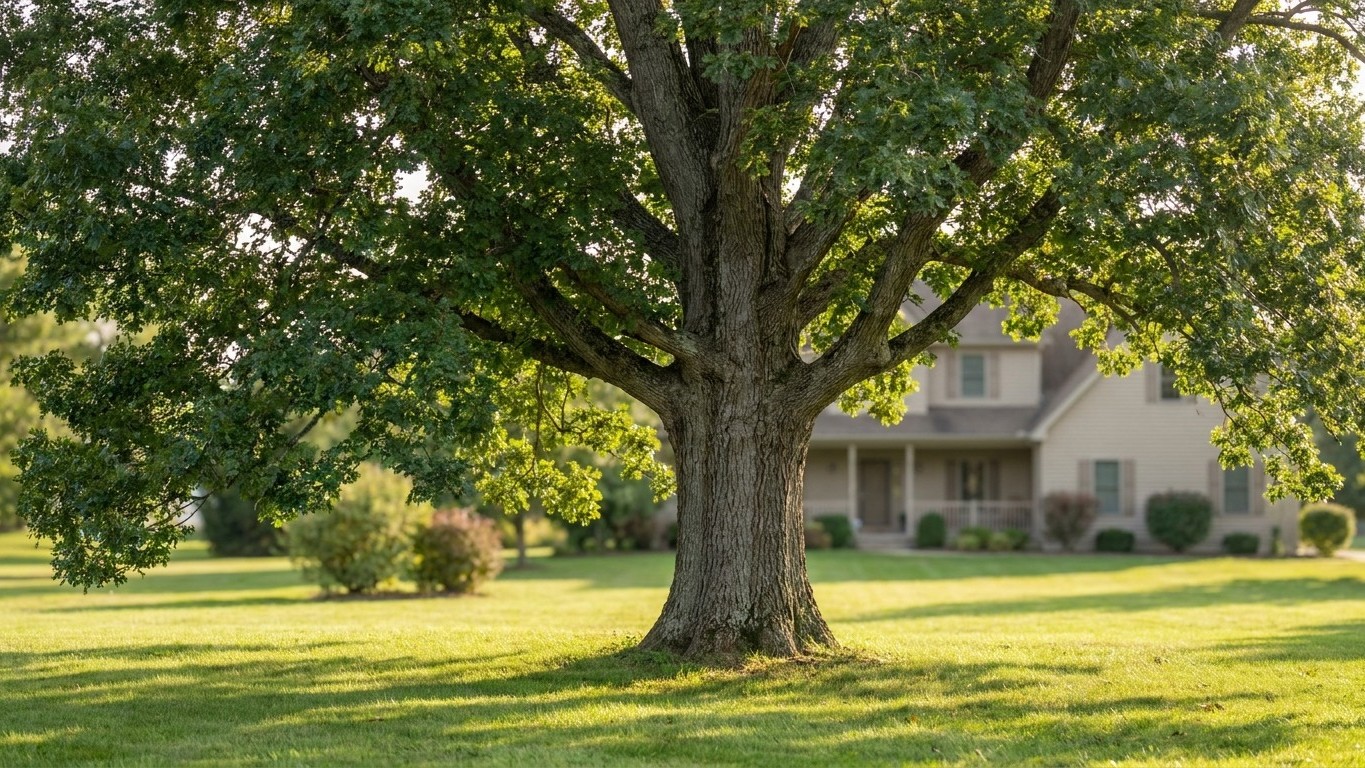

Quercus alba, sold and known under a cluster of common names including American White Oak, Eastern White Oak, Northern White Oak, Forked-leaf White Oak, and simply White Oak, survives across USDA hardiness zones 3a-9b. That’s a wide range, but a tree hardy at one end isn’t necessarily comfortable there. The bigger planning problem isn’t cold tolerance anyway, it’s space. This is a tree that eventually needs more than 60 feet, and that number, not the zone map, is what determines whether it belongs where you’re standing.
Where it will and will not survive

The USDA hardiness range for Quercus alba is 3a-9b. Read that as a boundary, not an endorsement. Below the bottom of this range, the tree will not reliably survive winter cold. Above the top, the same is true in reverse. Everything inside the range is where survival is possible, but survival and thriving are different claims, and the source behind this range makes only the first one.
A tree hardy to the warm edge of its range is not automatically well-suited to a long hot summer, any more than a tree hardy to the cold edge is automatically at its best in a short one. The zone number tells you whether the plant lives through winter. It says nothing about vigor, summer stress tolerance, or how it looks in year twenty. Those questions depend on the site conditions covered further down.
Check your own zone before you plant
Don’t assume your zone from a general sense of climate. Zones shift by elevation, proximity to large bodies of water, and microclimate within a single county. This site maintains a hardiness zone guide broken out for exactly this reason, find your specific zone there before assuming Quercus alba is or isn’t an option where you live.
The USDA hardiness range, 3a-9b, is a national standard and applies wherever you’re reading this. But that same source also gives regional growing notes specific to North Carolina’s coastal, piedmont, and mountain regions. Those notes are local to North Carolina and shouldn’t be carried over to a different state just because the plant profile came from there.
One more classification worth flagging: this source labels Quercus alba as a Native Plant, Perennial, Poisonous, and Tree. “Native” in that listing means native to the southeastern United States, the region this extension source covers, not native to wherever you happen to be reading from. Confirm native status against a regional source for your own area.
The mistake that costs the most: space
The source gives the space at maturity for Quercus alba as more than 60 feet, with a habit described as broad, dense, pyramidal, rounded, spreading. This is not a tree for a small yard corner or a spot ten feet off a foundation. A mature canopy stretching past 60 feet needs real distance from a wall, a driveway, a septic field, and especially from overhead utility lines.
This is the mistake that shows up expensive, not the one that shows up cheap. A tree planted too close to a structure looks fine for the first decade. Ten or fifteen years later, roots may lift a walkway, the canopy may scrape a roofline, or a utility crew may schedule a crown reduction that leaves the tree lopsided. At that point the fix isn’t a light prune, it’s often removal of a tree now too large to relocate and too compromised to leave standing near a structure.
Before you dig
- Look up: note any overhead wires, and account for the tree’s eventual height and spread when deciding whether the planting spot clears them.
- Look down: call before you dig to have underground utility lines and any septic infrastructure marked, since a mature root system will extend well beyond the trunk.
- Measure the canopy reach: using more than 60 feet as the mature width, sketch that radius from the planting spot to see what it will eventually overlap.
- Consider the shade direction: think through which side of the property the canopy will fall across as the tree matures, and whether that shade is wanted there.
The site it actually wants
The North Carolina Extension source describes a plant that tolerates a fairly broad set of conditions rather than demanding one narrow ideal. It’s tempting to flatten a tolerant list into a single “prefers rich, well-drained soil” line, but that loses the useful part: this tree accepts more than one kind of ground.
| Condition | What Quercus alba tolerates, per the source |
|---|---|
| Light | Full sun (6+ hours direct) or partial shade (2-6 hours direct) |
| Soil texture | Clay, loam (silt), or sand |
| Soil pH | Acid, below 6.0 |
| Drainage | Good drainage, moist, or occasionally dry |
Notice the spread across soil texture and drainage. Clay and sand sit at opposite ends of how soil behaves, and this source lists both as tolerated, along with loam in between. Same with drainage: moist and occasionally dry ground both make the list, alongside straightforward good drainage. The one place the source is specific rather than broad is soil pH, listed as acid, under 6.0.
Checking your site without equipment
You can get a rough read on drainage without tools: dig a hole about a foot deep, fill it with water, and see how long it takes to drain. Water still sitting after several hours points to heavy, slow-draining soil; water gone within an hour or two suggests fast-draining, sandier ground. For pH, a home soil test kit or a sample sent to your local extension office will give you an actual number rather than a guess, which matters here since acid soil is the one condition this source states plainly. If your soil tests above 6.0, that’s a real mismatch worth weighing against the tree’s other flexibility.
Planting it so it establishes
Getting a young Quercus alba through its first year or two in the ground matters more than almost anything you’ll do to it later. Follow these steps in order:
- Time it using frost guidance for your area rather than a fixed month, planting when the ground has warmed enough and frost risk has passed, or in fall well ahead of a hard freeze; check the frost date guide on this site for your specific location.
- Dig the planting hole wide, two to three times the width of the root ball, rather than deep.
- Locate the root flare, the point where the trunk widens into roots, and keep it at or slightly above grade rather than buried.
- Tease out any circling or matted roots around the root ball before it goes in the hole, so they grow outward instead of continuing to spiral.
- Backfill with the same native soil that came out of the hole rather than swapping in something different.
- Water deeply right after planting, then continue on a deep, infrequent schedule rather than frequent shallow watering.
- Apply mulch in a ring around the base, keeping it pulled back from the trunk itself rather than piled against the bark.
Two mistakes account for most young tree deaths, and both are avoidable: planting too deep, which suffocates the root system slowly over seasons, and mounding mulch against the trunk, which holds moisture against the bark and invites rot and pests. Keep the flare visible and mulch a few inches clear of the bark.
One more point worth saying directly: the source notes Quercus alba tolerates dry soil and drought once established. That description applies to a mature root system that’s had years to spread. A tree in its first season has none of that and needs regular water regardless of the mature plant’s tolerance profile. Don’t let “drought tolerant” talk you out of watering a first-year tree.
What it resists, and what it does not
“Resistant” is worth defining before using it. A resistant plant is browsed, damaged, or affected less often than a susceptible one, it is not immune. A deer-resistant plant can still get eaten by a hungry deer in a lean winter with nothing else available.
With that in mind, here’s what the source actually says about Quercus alba’s resistance across several common challenges: deer, fire, heat, salt, drought, dry soil, and black walnut. For all seven, the North Carolina Extension source lists the rating as unspecified. That’s a meaningful gap, not an oversight to gloss over: there’s no verified claim, one way or the other, tying this species to resistance against any of those pressures in this dataset. Don’t assume resistance where none is stated, and don’t assume vulnerability either; treat it as an open question your local extension office may be able to answer.
| Factor | What the source reports | What that means for you |
|---|---|---|
| Deer, fire, heat, salt, drought, dry soil, black walnut | Unspecified | No resistance rating is given either way; don’t assume either outcome |
| Growth rate | Slow | Expect gradual size increase year to year, not a fast-filling canopy |
| Maintenance | Medium | Some ongoing attention expected, not a plant-and-forget tree |
The growth rate matters for planning around the space requirement discussed earlier. A slow grower buys you time: the eventual spread past 60 feet is real, but it arrives gradually rather than crowding a structure within a handful of seasons. That’s cushion, not a reason to plant closer than the mature size calls for. Medium maintenance suggests a tree that isn’t fuss-free but isn’t demanding either, consistent with a species that attracts butterflies, moths, pollinators, small mammals, and songbirds, and produces acorns from September through November most years once mature.
Common questions
Is Quebec Oak really the same tree as White Oak?
The source lists Quebec Oak among the common names in use for Quercus alba, alongside White Oak and several regional variants. It’s worth noting the geographic mismatch: Quebec sits well north of this species’ typical range, while the USDA hardiness data runs 3a-9b, including zones far warmer than Quebec’s climate. Common names for oaks overlap and get applied loosely across regions, so confirm the botanical name, Quercus alba, before assuming it matches what’s described here.
Can you eat the acorns from a white oak?
The source states that the acorns are edible after tannins are leached or boiled out. Raw acorns are naturally high in tannins, and processing removes that bitterness, but this is a note about edibility after preparation, not a claim about flavor.
How fast does it grow, and when do the acorns show up?
Growth rate is listed as slow, so size increases gradually rather than quickly filling out a yard. The acorns mature in the first year, appearing green before ripening to light brown, and show up from September through November, often in large numbers once the tree reaches bearing age.
Is white oak actually poisonous?
The source classifies Quercus alba under several labels at once, including Poisonous, alongside Native Plant, Perennial, and Tree. The same source separately notes the acorns become edible once tannins are leached out through boiling, which points to parts of the plant carrying compounds that are a concern in their raw or unprocessed state. Treat any unprocessed plant material, including raw acorns, as something to keep away from pets and children rather than something to sample directly from the tree.