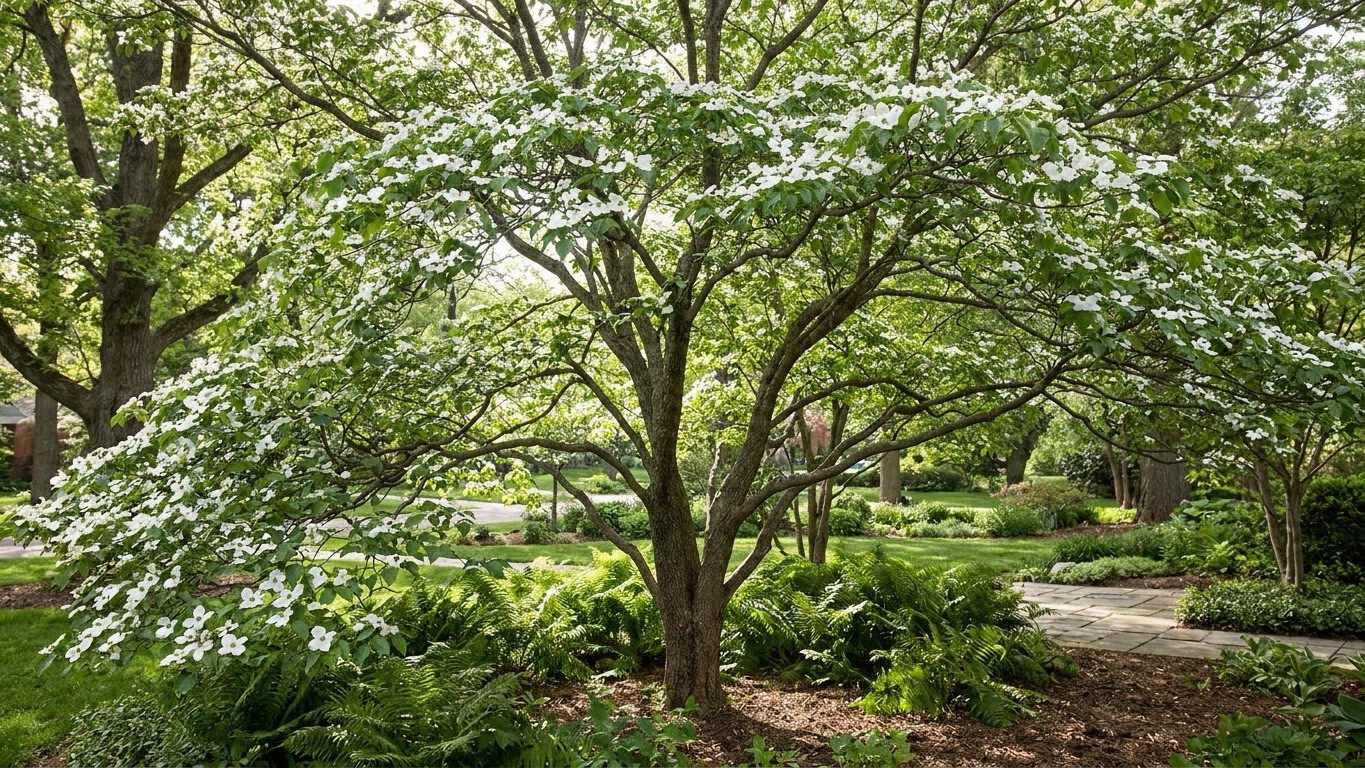

Cornus florida, commonly called Flowering Dogwood, survives across USDA hardiness zones 5a-9b, a wide band covering most of the eastern and central United States, though survival isn’t the same as thriving at either edge. The source classifies it as a native plant (to the southeastern U.S.), a deciduous perennial grown as a shrub or a small tree, with a mature spread ranging from 12 feet up to 60 feet depending on habit. Before planting, the two numbers that decide whether this tree fits a given yard at all are your zone and that mature spread.
Where it will and will not survive

The USDA hardiness range for Cornus florida is 5a-9b. Below 5a, winter temperatures routinely fall past what this tree can survive, and it will die back or fail rather than merely struggle. Above 9b, the climate doesn’t deliver the winter chill this species needs to function correctly year over year.
A range like 5a-9b describes survival, not comfort. A tree rated to the warm edge, 9b, isn’t necessarily happy there through a long, humid summer any more than one at the cold edge, 5a, is thriving through a harsh winter, it’s simply not dead. That distinction matters more for this species than for a lot of ornamentals, because its site tolerances, covered below, already ask a fair amount of a gardener. Stacking a marginal zone on top of marginal soil is how a tree limps along for years instead of establishing.
Zone boundaries shift within a state, sometimes within a county, and the only reliable way to know yours is to look it up rather than assume based on general climate. This site’s hardiness zone guide breaks zones down at a level of detail a single national figure like “5a-9b” can’t provide.
One note on sourcing: the plant data behind this page comes from the North Carolina Extension Gardener Plant Toolbox. The USDA hardiness range it reports is a national standard and applies wherever you garden. That same source also publishes regional growing notes for North Carolina’s Coastal, Piedmont, and Mountain regions specifically, tuned to that state’s soils and rainfall. Those regional notes don’t travel outside North Carolina, so they aren’t repeated here. What does travel is the hardiness range itself and the site-condition tolerances covered later, both general to the species rather than local to one extension service’s territory.
The mistake that costs the most: space
The source lists two figures for space at maturity: 12 to 24 feet, and 24 to 60 feet. That’s not an error, the same entry classifies this plant under several growth habits at once (ascending, pyramidal, rounded, spreading) and under two plant types at once (shrub and tree), which is almost certainly why the mature footprint spans two ranges. A dogwood grown or pruned toward an ascending, pyramidal form will likely settle toward the smaller figure; one left to develop as a rounded or spreading small tree can reach the larger one. Plan for the wider number unless you know which habit your tree will take.
That’s the expensive mistake, because it doesn’t show up on planting day. A tree set too close to a foundation looks fine for its first five or six years. The problem arrives a decade or more later, when the canopy presses into a roofline, lifts a walkway, or shades a bed that used to get full sun. At that point the fix isn’t a prune, it’s removal, and removal costs far more, in money and lost years of growth, than the extra clearance would have cost at planting time.
Four checks, run before the shovel goes in, catch most of this:
- Look up. Note any overhead utility lines within what could become a 60-foot-wide canopy.
- Check underground. Have utility lines located before digging near a septic field, water line, or buried electrical or gas line.
- Measure the canopy reach. Pace out 12 feet in every direction as the minimum, and 30 feet as the outer edge, from the trunk to any wall, drive, or fence line.
- Track the shade. Note which direction the canopy will fall as it fills in, and whether that shade will land on a vegetable bed, solar panel, or neighbor’s border.
None of these checks take more than twenty minutes, and all are cheaper than a removal call placed in year twelve.
The site it actually wants
The source doesn’t describe a single ideal spot for Cornus florida so much as a list of what it tolerates, and that list is wider than most gardeners expect. This species is reported to handle clay, sand, and everything between.
| Condition | What Cornus florida tolerates, per the source |
|---|---|
| Light | Full sun (6+ hours direct) or partial shade (2-6 hours direct) |
| Soil texture | Clay, high organic matter, loam/silt, or sand |
| Soil pH | Acid (below 6.0) or neutral (6.0-8.0) |
| Drainage | Good drainage, consistently moist, or occasionally dry |
That spread of tolerance is real, but it isn’t unlimited. Soil texture is the easiest to check without equipment: squeeze a handful of moist soil. A slick, sticky ribbon means clay; soil that falls apart instantly and feels gritty means sand; something in between that holds a loose shape but crumbles under light pressure is closer to loam, and any of the three is workable here.
Drainage takes a little longer: dig a hole about a foot deep, fill it with water, let it drain once, then fill it again and time the second fill. Water gone within a few hours points to good drainage; standing water after half a day points to a heavier, slower-draining site, which this species can still handle as long as it isn’t permanently waterlogged.
Soil pH is the one item genuinely hard to eyeball. A home test kit or a sample sent to a local extension office is the reliable way to know where a site falls. Given that the source lists acid through neutral, below 6.0 up to 8.0, as the tolerated band, most residential soils already fall inside it; the exception is soil pushed well above neutral by heavy lime application or certain foundation backfill, worth checking before planting rather than after.
Planting it so it establishes
Getting a young dogwood through its first two years matters more than almost anything done afterward, and most of the risk comes down to a handful of steps done in the right order.
- Pick the season using frost timing rather than a fixed calendar month. This site’s frost date guide gives local timing for planting after the ground has warmed and before summer heat sets in.
- Dig the hole wide, not deep: roughly two to three times the width of the root ball, but no deeper than the root ball itself.
- Find the root flare, where the trunk widens into the roots, before backfilling. It should sit at, or very slightly above, the surrounding soil grade once planting is finished.
- Tease out any roots circling the inside of the container, or they will eventually girdle the trunk and choke the tree years later.
- Backfill with the same soil that came out of the hole rather than amended soil, so roots spread into native ground instead of staying confined to a rich pocket.
- Water deeply right after planting, then water deeply but infrequently through the first season rather than a little every day.
- Mulch two to three inches deep in a ring kept clear of the trunk, never piled against the bark.
Two mistakes account for most young tree deaths. Planting too deep, so the root flare ends up buried, suffocates the roots and slows or stops establishment before it starts. Piling mulch against the trunk holds moisture against the bark and invites rot right at the tree’s most vulnerable point. Neither mistake shows damage right away, which is exactly why they’re so common; the tree can look correctly planted for months before it starts to decline.
One more point worth being direct about: the source lists “occasionally dry” among the tolerated drainage conditions, and this species is generally described as drought tolerant once established. That word, established, is doing real work. A tree in its first growing season hasn’t built the root system that lets it ride out a dry spell, regardless of what a mature plant can handle. It needs regular deep watering through that first year, dry spell or not, before any drought tolerance actually applies.
What it resists, and what it does not
Resistance, wherever it appears on a plant label, means a tendency, not a guarantee. “Deer resistant” means deer browse a plant less often than favorites, not that they never touch it.
For Cornus florida specifically, the source doesn’t assign a resistance rating to deer, fire, wind, compaction, or storm damage. Each category is listed but left unspecified, which is a gap in the data rather than a claim that this tree resists nothing. A reader shouldn’t count on this species to solve a deer problem, hold up in a wind corridor, or bounce back from storm damage based on documented resistance, because none is documented either way.
| Challenge | What the source says | What that means for a reader |
|---|---|---|
| Deer browsing | Unspecified | No documented resistance; treat young trees as vulnerable |
| Fire | Unspecified | No basis for planting it as a fire-resistant choice |
| Wind | Unspecified | No documented tolerance for exposed, wind-heavy sites |
| Soil compaction | Unspecified | Keep heavy foot or vehicle traffic off the root zone regardless |
| Storm damage | Unspecified | No documented resilience; standard storm-damage pruning care applies |
Where the source is specific is growth rate and maintenance. Growth rate is listed as medium: not a tree that shoots up several feet a year and outpaces its site within a few seasons, but not a slow grower that stalls for a decade either. Maintenance is listed as low, tracking with a species that isn’t demanding about pruning once shaped in its early years.
Together, medium growth and low maintenance predict a tree that reaches the space-at-maturity figures discussed earlier at a manageable pace, giving a homeowner time to notice a canopy heading toward a wire or wall and adjust, or decide on removal, well before the tree is fully grown into that spot. It also means this isn’t a species that needs a yearly pruning routine to stay in bounds; the work is mostly up front, in site choice and planting.
Common questions
Is “Flowering Dogwood” just another name for Cornus florida?
Yes. Flowering Dogwood is the common name in use for Cornus florida according to the source, and it’s the name most nurseries and garden centers use on plant tags. The botanical name is used as the primary reference here because common names aren’t always unique to one species across regions.
What does “native plant” mean for this species specifically?
The source classifies Cornus florida as native to the southeastern United States, not native to every U.S. region. A tree can carry a “native” label on a nursery tag while still being outside its native range in a given yard, which matters for wildlife value more than for whether it will grow there.
Can I eat the red fruit this tree produces?
No. The source describes the fruit as glossy, bright red, oval drupes about half an inch long, growing in tight clusters of three or four, displaying from August to October. It’s described as bitter and inedible to humans, though birds readily eat it.
When does it bloom?
Bloom time is listed as spring, without a specific month. Because bloom timing shifts with latitude, elevation, and the particular year’s weather, the exact week varies by location rather than following a fixed date on a calendar.