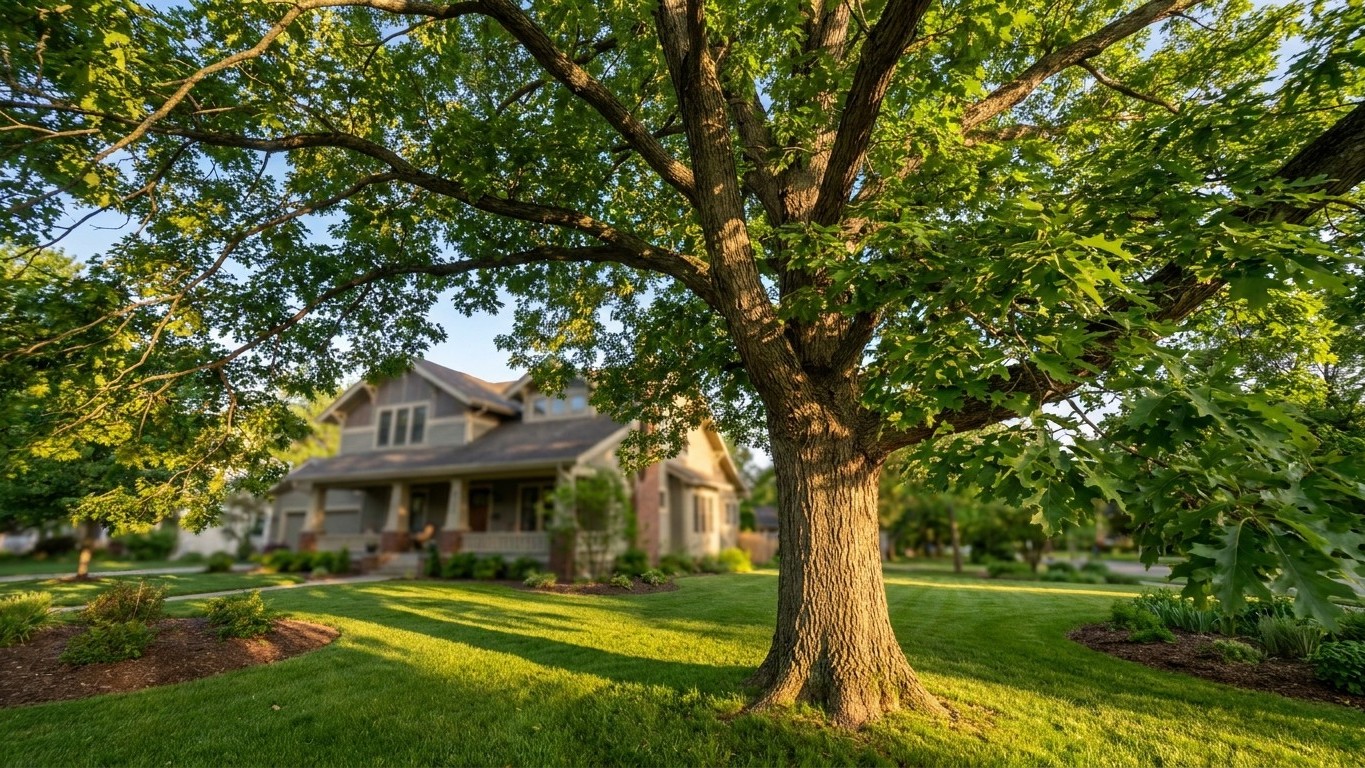

Quercus rubra, better known as Northern Red Oak, survives across USDA hardiness zones 4a-8b and needs more than 60 feet of open space once mature. It’s a fast grower with low long-term upkeep, tolerant of sun or partial shade and more than one soil type, but the costliest mistake homeowners make with it isn’t picking the wrong zone. It’s underestimating how much room a full-grown red oak actually claims. Here’s where it won’t survive, how much space it truly demands, the site conditions it tolerates, and how to plant one so it establishes instead of struggling.
Where it will and will not survive

Names, classification, and what “poisonous” means here
This tree carries several names depending on the catalog or extension sheet you’re reading: American Red Oak, Eastern Red Oak, Mountain Red Oak, Northern Red Oak, Red Oak, sometimes just “Oaks.” None of those is the official one. Quercus rubra is the name that ties them together, which is why it’s used here.
The North Carolina Extension Gardener Plant Toolbox classifies it as Native Plant, Perennial, Poisonous, and Tree, all at once. “Native” there means native to the southeastern United States specifically, not everywhere. The “Poisonous” tag sits alongside a note that the acorns are “edible after tannins are leached or boiled out”, raw, untreated acorns are bitter, and it’s that untreated tannin content behind the poisonous label, not the tree as a whole. It’s deciduous and blooms in spring, though oak flowers are small enough that most people never notice them.
The hardiness range that decides survival
The number that actually decides whether this tree belongs in your yard is USDA hardiness zones 4a-8b. That’s a survival range, not a comfort range. A tree rated to survive at the cold edge of 4a isn’t thriving the way it might mid-range, and one at the warm edge of 8b is tolerating summer heat, not enjoying it.
Below the bottom of that range, winters cold enough to fall outside 4a bring dieback severe enough to eventually kill the tree, not just damage leaf tips. Above the top, past 8b, heat and humidity stress shows up as stunted growth and a shortened lifespan rather than a quick kill. Neither end is tied to a specific state or region here, the USDA range is the only universal figure in play, and any regional planting advice tied to this data comes from a North Carolina source and doesn’t travel.
Check your own zone before shopping for the tree, rather than assuming it based on a general sense of climate. This site’s hardiness zone guide breaks zones down in detail so you can confirm your exact location instead of guessing, a step that avoids planting something that was never going to make it through your winter or your summer.
The mistake that costs the most: space
Quercus rubra needs more than 60 feet of space at maturity. That figure, straight from the North Carolina Extension, describes canopy spread, not just trunk footprint, and 60 feet is wider than the depth of most suburban backyards.
Combine that with a rapid growth rate and low maintenance once established, and you get a tree that reaches problem size fast and then needs little attention, which is exactly the situation where a homeowner forgets it’s there until it’s already too big to move.
The consequence doesn’t show up right away. It shows up a decade or more later, when roots have reached a septic line, branches are scraping a roofline, or dense shade has killed the lawn beneath it. By then the fix isn’t a pruning cut. It’s full removal, at a cost far higher than planning ahead would have been.
Run these checks before you dig
- Look up for power lines or anything overhead within 60 feet in any direction.
- Call to have underground utilities, septic lines, and irrigation marked before digging.
- Pace out roughly 30 feet in every direction from the planting spot, since more than 60 feet of mature space usually means a canopy radius in that range.
- Keep that same radius clear of the foundation, driveway, and any structure with a shallow footing.
- Note which direction the canopy will eventually block sun, since a tree this size will shade whatever sits south or west of it permanently.
None of that rules the tree out. It just points toward the right spot: a large lot’s far corner, a property-line buffer, or anywhere 60-plus feet of eventual shade is the plan rather than a surprise.
The site it actually wants
The Extension’s data reads as a list of tolerances, not one ideal recipe. That’s worth keeping straight, since several of these conditions are either/or options, not requirements.
| Condition | What it tolerates |
|---|---|
| Light | Full sun (6+ hours direct) or partial shade (2-6 hours direct) |
| Soil texture | Loam/silt or sand |
| Soil pH | Acid (below 6.0) or neutral (6.0-8.0) |
| Drainage | Good drainage, moist, or occasionally dry |
That’s a wide tolerance band for a tree that also needs 60-plus feet of open space, which is part of why it shows up so often along property edges and in naturalized areas rather than tight foundation beds.
Checking your own site without lab equipment
A squeeze test covers texture: grab moist soil and squeeze it. Sand falls apart right away. Loam holds a loose shape and crumbles with light pressure. A slick, dense ribbon that holds together is clay, which falls outside the two textures this tree tolerates according to the source.
For drainage, dig a hole about a foot deep, fill it with water, and time how long it takes to drain. Gone within a few hours points to good drainage; standing water after half a day points toward the “moist” or “occasionally dry” end of the range, both of which this tolerance list already covers. For pH, a basic soil test, whether a home kit or a sample sent to a county extension office, tells you whether you’re in the acid or neutral range this species accepts.
When a site doesn’t match any of these tolerances, the more realistic fix is choosing a different spot on the property, or a different tree altogether, rather than amending soil across an area a mature canopy will eventually cover anyway.
Planting it so it establishes
Getting this tree into the ground correctly matters more than anything done afterward. The rapid growth and low maintenance in its profile describe an established tree. A first-season transplant is neither, and treating it that way is how young trees fail.
- Pick the season using this site’s frost guidance rather than a specific month, since frost timing shifts with zone.
- Dig the hole wide, not deep, two to three times the width of the root ball, with undisturbed soil left at the bottom.
- Find the root flare, where the trunk widens into roots, and keep it at or slightly above grade rather than buried.
- Tease out any circling or matted roots at the root ball’s edge so they grow outward instead of spiraling.
- Backfill with the same native soil that came out of the hole, skipping amended or bagged soil that creates a soft-edged bowl.
- Water deeply and infrequently so moisture reaches the actual root zone instead of staying at the surface.
- Mulch in a flat ring out to the canopy edge, kept several inches clear of the trunk itself.
The two mistakes that kill young trees
Planting too deep, so the root flare ends up under soil or mulch, slowly suffocates the roots over a season or two. Piling mulch against the bark keeps the trunk wet and invites rot right at the base. Both are easy to avoid and both are close to permanent once the damage sets in.
The drought tolerance associated with this species applies to an established root system, not a first-year tree. A newly planted red oak needs consistent deep watering through its first growing season regardless of what a mature tree can handle later. Skipping that because the label says “drought resistant” is a common way to lose a tree before it gets the chance to prove it.
What it resists, and what it does not
Resistance means a tendency, not immunity. Deer resistant means browsed less often, not never. A hard winter with little else available changes that fast, for this tree or any other listed as resistant.
| Challenge | What resistance means here | What you’d actually see |
|---|---|---|
| Deer | Less preferred browsing target | Occasional nibbling on young growth, more in high-pressure years |
| Fire | Some tolerance to fire exposure | Better odds through a light burn, not guaranteed survival of a severe one |
| Drought | Established roots handle dry spells | Reduced growth or leaf drop rather than death, once established |
| Dry soil | Tolerates soil drying between waterings | Normal appearance without consistent moisture |
| Pollution | Some tolerance to urban air and soil pollution | Reasonable performance near roads and developed areas |
| Black walnut | Some tolerance to juglone | Fewer symptoms than juglone-sensitive species growing nearby |
The source lists these as areas of resistance without specifying degree, so read the table as directional: this tree handles these six pressures better than a species with no listed resistance, not that any of them bounce off it completely.
What growth rate and maintenance predict
Rapid growth and low maintenance predict most of what the next couple of decades look like. Rapid growth means this tree reaches its 60-plus-foot mature spread faster than a slow grower planted the same year, which loops back to the spacing issue: planted too close to a structure, it runs into that wall sooner rather than later. Low maintenance means it won’t demand regular feeding or spraying once settled, but young trees still benefit from structural pruning to avoid weak branch angles that turn into storm damage decades on.
It also attracts butterflies, hummingbirds, moths, pollinators, small mammals, and songbirds, and settles into a conical, dense, erect, or rounded habit depending on the individual tree and its site, one more reason the space around it matters as much as the spot it goes into.
Common questions
Is Quercus rubra the same as Northern Red Oak?
Yes. Northern Red Oak is one of several common names used for the same species, alongside American Red Oak, Eastern Red Oak, Mountain Red Oak, and simply Red Oak. The botanical name is the one constant across all of them.
Can you eat the acorns?
The source describes the acorns as “edible after tannins are leached or boiled out.” Raw, untreated acorns are bitter and carry the tannins behind this tree’s “Poisonous” classification, so processing isn’t optional.
How long before a red oak produces acorns?
The tree may reach 40 years of age before it starts producing acorns, according to the source, with nuts appearing from August to October once it does.
Does it need full sun?
No. It tolerates full sun, 6 or more hours of direct light, as well as partial shade, 2 to 6 hours, according to the growing conditions on record.