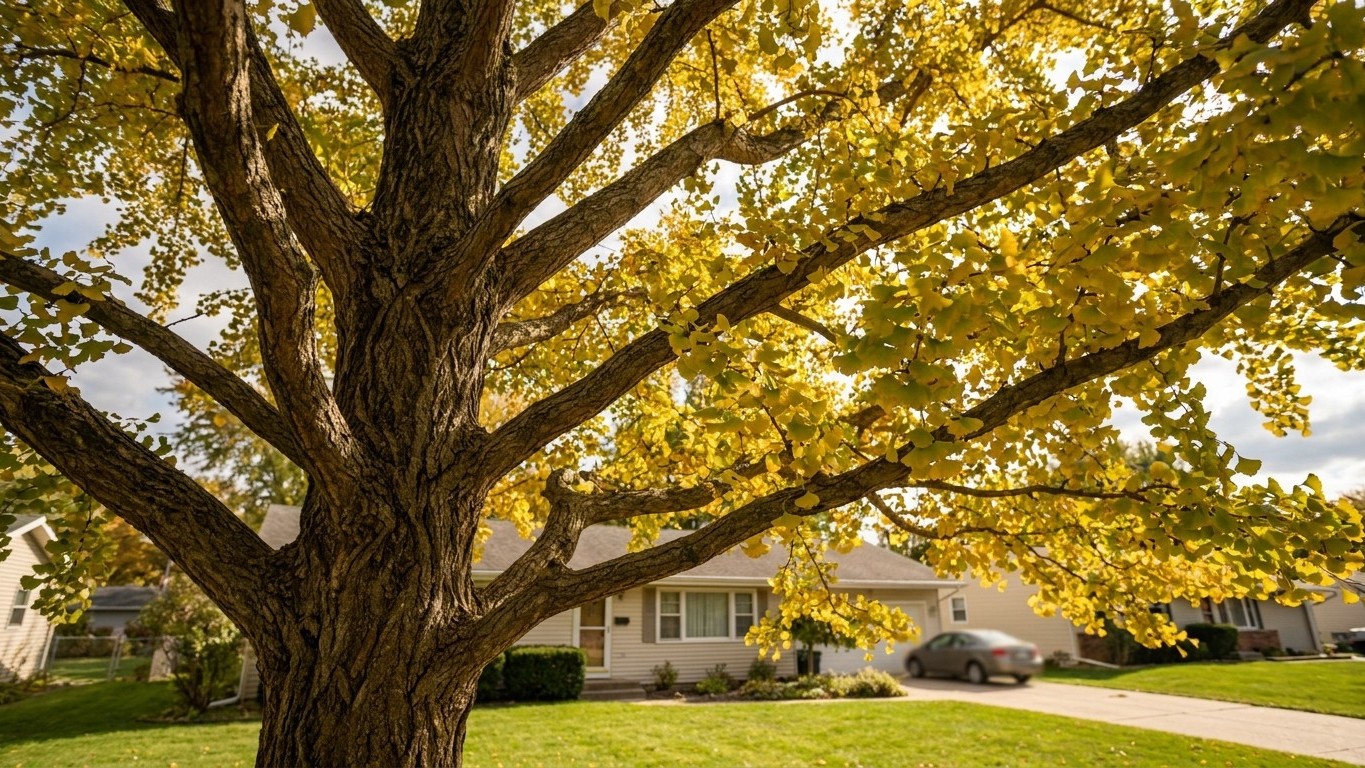

Ginkgo biloba, sold as Ginkgo or Maidenhair Tree, survives across USDA hardiness zones 3a-9b, tolerates full sun and a wide range of soils from clay to sand, and grows at a medium pace toward a mature spread the North Carolina Extension lists as 24-60 feet, sometimes more than 60. The single detail that causes the most regret later isn’t the cold tolerance. It’s the space this tree eventually claims.
Where it will and will not survive

The USDA hardiness range for Ginkgo biloba is 3a-9b. That’s the number to work from, and the more useful way to read it isn’t “where does this tree thrive” but “where does it fail to survive at all.” Below the bottom of that range, winter cold routinely kills the tree outright or damages it past recovery. Above the top of it, the plant simply isn’t rated to take the summer heat and winter conditions found there, whatever a nursery tag might suggest.
A range like 3a-9b covers a lot of ground, and it’s worth being honest about what that width actually means. Surviving in zone 9b is not the same as being comfortable there. A tree rated to the warm edge of its range can still struggle through the hottest, longest summers that edge produces, showing stress even if it doesn’t die. The same logic runs the other direction at the cold edge: a plant hardy to 3a is surviving winter there, not necessarily putting on vigorous growth or reaching full ornamental potential.
Here’s the part that trips people up: nobody actually plants in “zone 6” as an abstraction. They plant in a specific yard, and that yard sits in a zone that depends on elevation, local microclimate, and sometimes even which side of a county line the property falls on. Rather than assuming where you land on this scale, check your own zone using the hardiness zone guide on this site, which carries the county-level detail this national range can’t.
One more thing worth flagging: the source behind these growing facts is the North Carolina Extension Gardener Plant Toolbox. The USDA hardiness range itself is a national standard and applies wherever you garden. But when an extension resource adds regional notes, things like which part of a state handles a species best, that guidance is local to North Carolina’s coastal plain, piedmont, and mountains. It isn’t meant to be carried into a different state’s climate. Stick with the universal zone range, cross it against your own location, and treat anything more specific as belonging to wherever it was written.
The mistake that costs the most: space
Ginkgo biloba reaches 24 to 60 feet across at maturity, and in many cases more than 60 feet. That’s not a typo or a wide guess, it reflects real variation in how these trees develop depending on growing conditions, but even the low end of that range is a full-grown shade tree, not a foundation shrub. A canopy that wide needs real distance from a house wall, a driveway, a septic field, or a property line, and it needs overhead clearance too, since a tree that spreads 40 or 60 feet across is also gaining serious height along the way.
The reason this is the expensive mistake, more than a wrong hardiness guess, comes down to timing. A tree planted too close to a structure doesn’t show the problem in year one, or even year five. It looks fine, modest, manageable. The trouble surfaces ten or fifteen years in, when roots have found a foundation or a septic line, when branches are scraping a roofline, when the shade pattern has shifted onto a neighbor’s garden. At that point the fix usually isn’t a pruning job. It’s removal, and removing a tree that size costs far more than the ten minutes it would have taken to measure the site correctly at planting time.
Before digging, run through a short list:
- Look up: note any power lines, low branches from other trees, or roof eaves within the space this canopy will eventually fill.
- Look down: call for utility locates and check for septic lines, drain fields, or buried cable before the shovel goes in.
- Measure out from the planting spot in every direction, accounting for a canopy that could reach past 60 feet at full spread.
- Walk the site at different times of day and picture that mature canopy’s shadow falling across a patio, a vegetable bed, or a neighbor’s windows.
None of this requires special tools, just patience before the hole gets dug rather than after the tree is thirty feet tall.
The site it actually wants
Ginkgo biloba’s growing requirements, as the North Carolina Extension lists them, read less like one ideal setup and more like a range of conditions the tree tolerates. That distinction matters, because flattening a tolerance list into a single “likes rich, moist loam” description throws away the useful part: this tree handles more variation than that.
| Condition | What Ginkgo biloba tolerates |
|---|---|
| Light | Full sun (6 or more hours of direct sunlight a day) |
| Soil texture | Clay, loam (silt), or sand |
| Soil pH | Acid (below 6.0), alkaline (above 8.0), or neutral (6.0-8.0) |
| Drainage | Good drainage, moist, occasionally dry, or occasionally wet |
That’s a plant that accepts heavy clay just as readily as sandy soil, tolerates acidic and alkaline extremes, and doesn’t demand perfectly even moisture. It’s a genuinely adaptable list, not a narrow window.
Checking your own site without lab equipment
Drainage is easy to test at home: dig a hole about a foot deep, fill it with water, let it drain, then fill it again and time how long the second fill takes to disappear. Water gone within a few hours points to fast-draining soil; standing water after half a day signals the “occasionally wet” end of what this tree can handle, which, per the tolerance list above, still falls within range.
Soil pH is harder to eyeball accurately, and guessing wrong matters more than guessing wrong on drainage. A basic soil test, sent through your local extension office, ends the guesswork. Given how wide this tree’s tolerance runs on both pH and texture, most home sites will already sit within its accepted range without amendment. The one condition that isn’t negotiable is light. Full sun means six or more hours of direct exposure, and a shadier spot simply isn’t what this list supports.
Planting it so it establishes
Getting a Ginkgo biloba into the ground correctly matters more than most people assume, because the two most common mistakes here don’t show up as a failed planting right away. They show up as a slow decline over the following year or two, by which point the cause is hard to reverse.
- Pick the planting window using the frost guidance on this site for your area, rather than a calendar month that might not match your local last-frost date.
- Dig the hole wide, roughly two to three times the width of the root ball, but no deeper than the root ball itself.
- Locate the root flare, the point where the trunk widens into roots, before backfilling anything.
- Set the tree so that root flare sits right at grade, level with the surrounding soil surface, not buried below it.
- Gently tease apart or cut any roots that are circling the root ball, so they grow outward into the surrounding soil instead of continuing to spiral.
- Backfill using the same native soil that came out of the hole, without swapping in amended soil that can create a bathtub effect for water.
- Water deeply right after planting, then continue with deep, infrequent watering rather than frequent light sprinkling.
- Spread mulch in a ring around the tree, keeping it a few inches clear of the trunk itself.
The two errors that kill young trees more than anything else are planting too deep, which suffocates the root flare, and piling mulch up against the bark, which invites rot and pest access at the trunk base. Both are avoidable with a five-minute check before backfilling.
One more point worth stating plainly: any drought tolerance associated with this species applies to an established tree, one that’s had a year or more to grow roots out into the surrounding soil. A first-season planting has none of that root system yet, and it needs regular, deep watering through its first year regardless of how tough the species is once mature.
What it resists, and what it does not
Resistance, in plant terms, means a tendency, not a guarantee. “Deer resistant” describes a plant deer browse less often than others nearby, not one they’ll never touch, and a hard winter with scarce food can change that calculation fast. The North Carolina Extension Gardener Plant Toolbox lists several resistance categories for Ginkgo biloba, including deer, heat, salt, drought, pollution, and urban conditions, but does not specify a rating for this species in any of them. That gap is worth stating honestly rather than guessing at a level the source doesn’t actually give.
| Category | What the source specifies |
|---|---|
| Deer | Not specified for this species |
| Heat | Not specified for this species |
| Salt | Not specified for this species |
| Drought | Not specified for this species |
| Pollution | Not specified for this species |
| Urban conditions | Not specified for this species |
What the source does give clearly is growth rate and maintenance level: medium for both. A medium grower reaches its eventual size gradually rather than shooting up in a handful of seasons, which buys a homeowner more time to correct a spacing mistake before it becomes a real problem, though it doesn’t remove the need to plan for that eventual 24-to-60-plus-foot spread. Medium maintenance suggests a tree that won’t demand constant attention once established, consistent with a horizontal or pyramidal habit that doesn’t typically need heavy structural pruning to hold its shape.
Common questions
Is Ginkgo biloba edible or poisonous?
The source classifies this species under several labels at once, including both edible and poisonous. The edibility note is specific: the seed, once freed of its outer pulp and washed, is boiled or roasted and eaten. That processing step matters, since the description doesn’t suggest other parts of the plant, including the fleshy, foul-smelling pulp around the seed, are meant to be eaten as they are.
Do all Ginkgo biloba trees produce that messy fruit?
No. As a gymnosperm, this species doesn’t technically produce fruit, but its seeds, which appear only on female trees, are described as plumlike, yellow-orange, and messy when they drop. Most ornamental ginkgoes planted in the United States are male, which avoids that seed drop entirely.
What does “Native Plant” mean for this species on an extension source?
When a North Carolina extension resource labels a plant “Native,” it means native to the southeastern United States specifically, not native across the entire country. Gardeners outside that region should read the label with that regional qualifier in mind.
When does Ginkgo biloba bloom?
The source lists bloom time as spring, without tying it to a specific month. Exact timing shifts with latitude and elevation, so a spring bloom in one region can land weeks apart from the same event elsewhere.