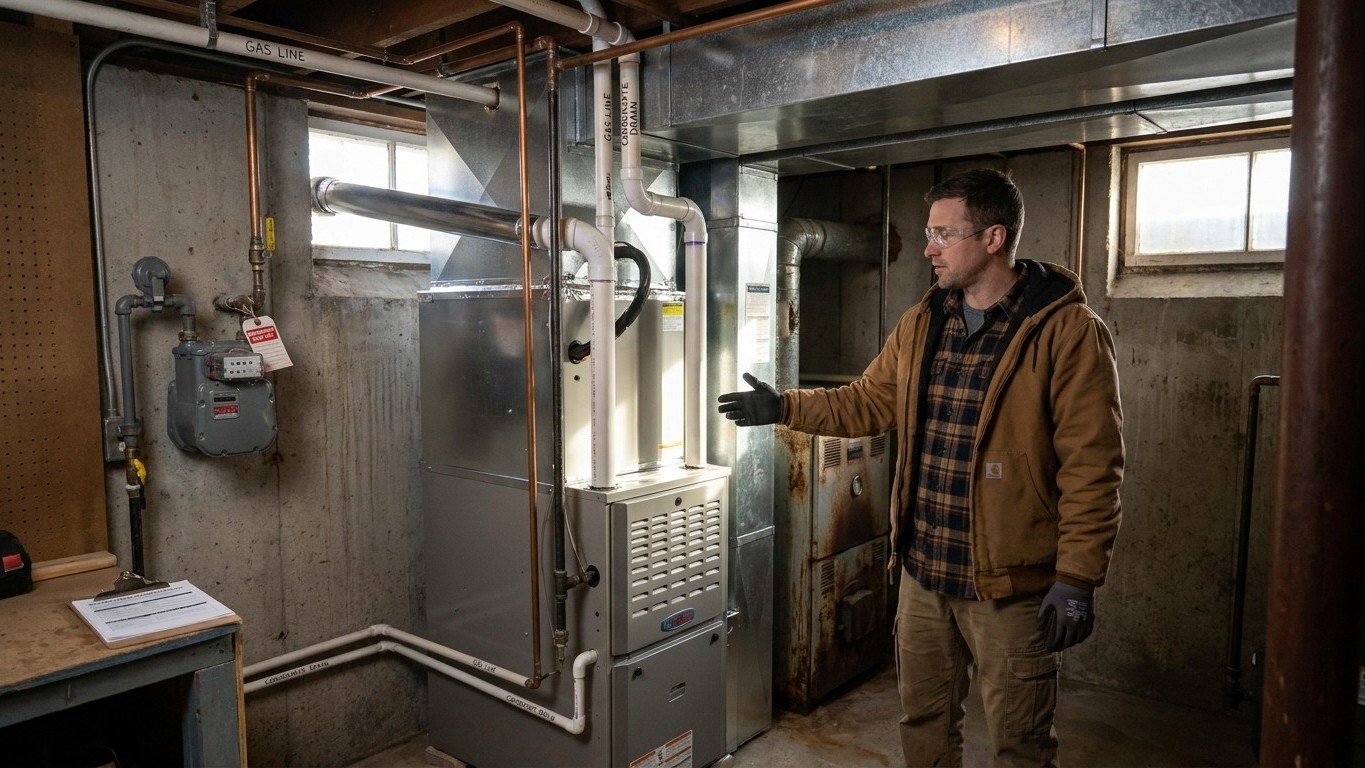

Converting a home from oil to gas heat means replacing far more than the furnace itself. The job typically covers a new gas supply to the property, a meter, interior pipework, the appliance, a new vent path, and the fate of the old oil tank. Whether any of that pencils out financially depends on local fuel prices and site conditions this page doesn’t have numbers for. What follows is the actual scope, piece by piece.
Who is asking, and why

This question comes up on a predictable schedule: a gas main finally reaches a street that never had one, or an oil furnace hits the point where a repair no longer makes sense and the homeowner starts pricing alternatives. It’s not a rare situation. According to the U.S. Energy Information Administration’s 2020 Residential Energy Consumption Survey, fuel oil or kerosene is still the main heating fuel in 49% of Maine homes, with propane covering another 16%. That’s a lot of households running on delivered fuel in a region where the conversation about switching never really stops.
The same survey breaks out equipment separately from fuel, and the two get mixed up constantly. In Maine, 46% of homes heat with a furnace and 31% with a steam or hot-water boiler, but that tells you nothing about what those systems burn. A furnace can run on natural gas, oil, propane, or electricity. So can a boiler, more or less. Compare that to Maryland, where 64% of homes use a furnace, 49% have natural gas, and 41% use electricity, or Washington, where 47% use a furnace, 55% rely on electricity, and 37% have natural gas. Three states, three very different fuel pictures, all using similar equipment categories. Converting from oil to gas is really a fuel conversion riding along with an equipment swap, and mixing up those two ideas is where a lot of confusion starts.
This page is not going to tell a reader whether converting is a good financial move. That answer hinges on the delivered price of oil in a given county this winter versus the price of gas on the same street, on how far a service line has to run, and on incentive programs that shift from year to year and place to place. None of that belongs on a page meant to stay accurate over time. What this page will do is lay out, honestly, what the conversion job actually contains, because that part doesn’t move with the market. Knowing the full scope before calling a contractor changes the questions a homeowner knows to ask, and it changes what a quote should be judged against.
What is actually in the job
A full oil-to-gas conversion is really a chain of separate pieces of work, not one appliance swap. Laid out in the order they usually get tackled, the job generally includes:
- Bringing supply to the property. If a gas main already runs along the street, this means a service line from the main to the house, arranged with the local utility. If no main exists nearby, this step may not be possible at all, which is often the first thing that rules conversion in or out.
- Installing a meter. The utility typically sets and owns the meter, and its placement (usually on an exterior wall, chosen for clearance and code access) is decided as part of the connection process.
- Running interior pipework. Gas has to travel from the meter to wherever the furnace sits, sized and routed to serve that appliance and any other gas equipment in the house, existing or planned.
- Installing the new furnace. The appliance itself, matched to the home’s heating load and the ductwork or piping already in place.
- Installing a new vent. This is the piece that catches people off guard, and it’s covered in its own section below because it isn’t optional.
- Dealing with the oil tank. Removal or proper abandonment, which is its own project with its own rules, not a footnote to the main job.
Two of those items deserve more than a passing mention because they’re the parts homeowners tend to underestimate. The venting change surprises a lot of people who assume the new furnace will simply tie into the chimney the old oil unit used. It generally won’t, and that has consequences covered next. And the tank isn’t something a crew just hauls away on installation day. An aboveground tank still needs proper draining and disposal. A buried tank raises a separate set of questions around soil testing and environmental rules that vary by state and by whether any leakage is suspected. Treating the tank as a five-minute afterthought is one of the more common ways an oil-to-gas conversion runs into unplanned time and unplanned cost.
What happens to the chimney
An oil furnace typically vents up through a masonry or metal chimney, often the same flue the water heater uses. A high-efficiency gas furnace doesn’t work that way. It vents through a wall, usually in plastic pipe, at a much lower temperature and with different draft characteristics. Once the furnace stops using the chimney, whatever else was still sharing that flue, and in most homes that means the water heater, is now venting into a flue built for a much bigger appliance. An oversized, cold chimney can behave differently than it did before, and getting that wrong is a real combustion-safety issue, not a cosmetic detail to sort out later.
This is exactly the kind of condition that yearly heating-system inspections exist to catch. The U.S. Consumer Product Safety Commission puts it plainly: “CPSC urges consumers to schedule a yearly professional inspection of all fuel-burning home heating systems, including furnaces, boilers, fireplaces, wood stoves, water heaters, chimneys, flues and vents.” Notice that water heaters and chimneys are named right alongside furnaces. That’s not incidental. A conversion that removes one appliance from a shared flue changes how the remaining appliance vents, and that’s squarely what this kind of inspection is meant to find before it becomes a problem.
The U.S. Environmental Protection Agency makes a related point in its October 1997 guidance (EPA 402-K-97-002): “EPA does, however, recommend that if you have a fuel burning furnace, stove, or fireplace, they be inspected for proper functioning and serviced before each heating season to protect against carbon monoxide poisoning.” Both agencies are describing fuel-burning equipment specifically. Neither statement extends to an electric furnace or a heat pump, since there’s no combustion involved and nothing to vent.
A properly scoped conversion job assesses the chimney and whatever else vents into it as part of the work, not as a surprise discovered after the old furnace is already disconnected. If a water heater is going to be left venting alone into an oversized flue, that gets evaluated and, if needed, addressed, whether through a liner, a different venting approach, or another fix suited to the specific chimney. For more on why this matters and what the warning signs look like, see our carbon monoxide safety guide.
What decides whether it is worth doing
None of the factors that actually decide whether a conversion makes sense are prices, and that’s worth sitting with for a second. The distance from the street to the house matters more than almost anything else, since a long service line run adds real work regardless of what gas costs that year. Whether the property already has gas for a stove, a dryer, or a water heater matters too, because part of the supply and metering work may already be done. The condition of the existing oil furnace matters, since a unit near the end of its life changes the calculation differently than one with years of service left. The state of the oil tank matters on its own terms, particularly if it’s buried and its condition is unknown. And the local price gap between oil and gas matters, but that gap moves with the market and with the season, which is exactly why no number for it belongs on a page meant to stay useful past this winter.
None of this adds up to a single answer, and it shouldn’t. What it adds up to is a short list of questions worth having answered in writing before comparing bids. A written quote worth comparing against another should itemize the service line and connection fees from the utility, the interior pipework, the furnace itself, the venting work specifically (since that’s where scope quietly expands or contracts), and the tank removal or abandonment as its own line item rather than a vague allowance folded into the total. Two quotes that break costs down this way can actually be compared apples to apples. Two quotes that just list a single number can’t, and that’s usually where surprises show up later.
Common questions
Can an oil furnace just be swapped for a gas one without touching the chimney?
No, not in most cases. A gas furnace generally vents through a wall rather than up the existing chimney, so the old flue arrangement has to be reassessed, especially if a water heater still shares it.
Does every home near a gas main qualify for conversion?
Proximity to a main is the starting point, but the utility still has to run a service line to the house and set a meter, and the distance and site conditions affect how straightforward that step is.
What happens to the old oil tank after conversion?
It has to be removed or properly abandoned. An aboveground tank needs draining and disposal; a buried tank involves additional considerations around soil condition and local rules, and that work is typically handled separately from the furnace installation itself.
Is a carbon monoxide detector enough to cover the risks during and after conversion?
A carbon monoxide detector is a useful safeguard for fuel-burning equipment, but it’s not a substitute for the yearly professional inspection that both the CPSC and EPA recommend, and it does not detect propane or natural gas leaks on its own.