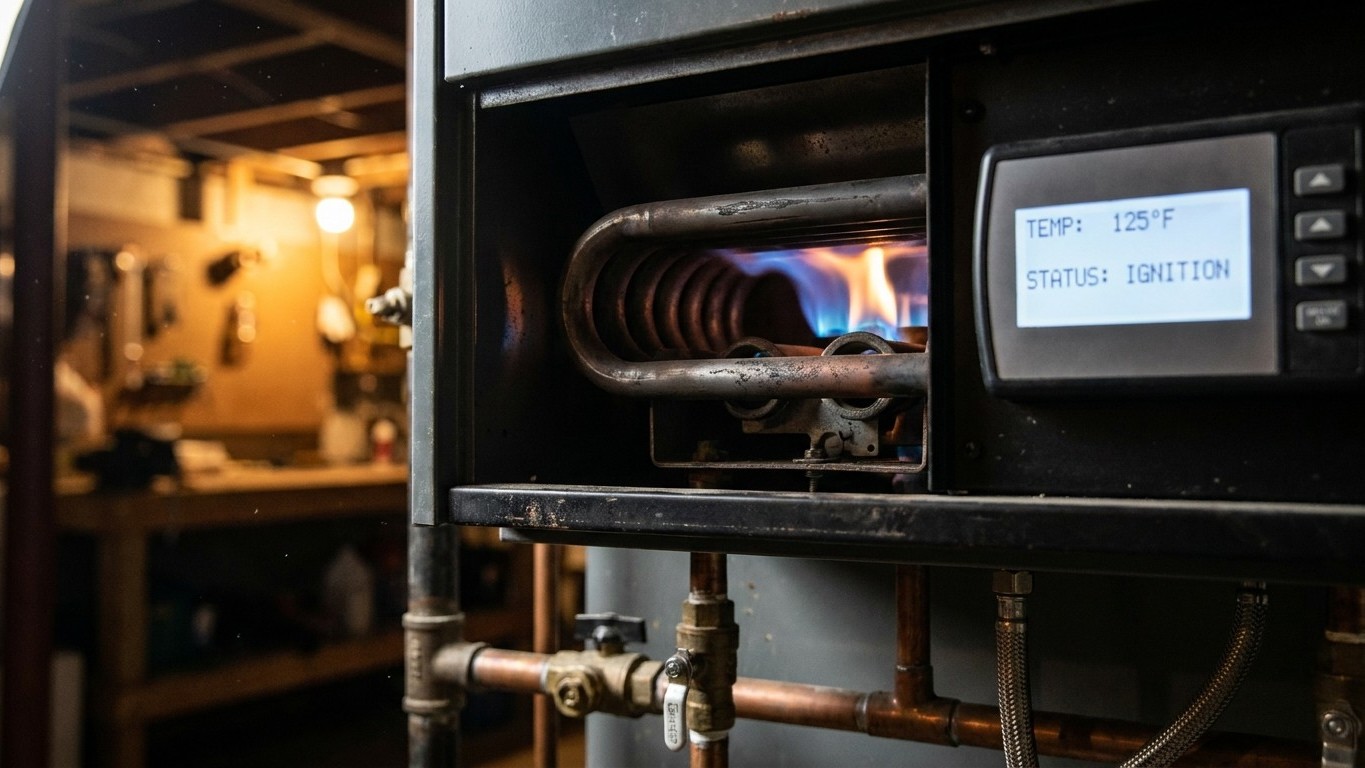

Short cycling means the boiler fires, runs for only a minute or two, then shuts off, over and over, instead of completing a full, steady heating run before resting. The fix depends entirely on the cause behind the pattern. Oversizing is the most common culprit, but zoning, water flow, a dirty heat exchanger, and a control setting can each produce the exact same rapid on-off rhythm, and each has a different remedy.
Firing is the expensive part
Every time a boiler ignites, it burns fuel less efficiently than it does once combustion has stabilized. The burner has to purge the chamber, establish a flame, and bring the heat exchanger up to a working temperature before the system starts delivering heat at its rated efficiency. A boiler that starts and stops every few minutes spends a disproportionate share of its runtime in that expensive startup phase and never settles into the steady, efficient burn the appliance was designed to sustain.
This matters because of what AFUE actually measures. AFUE is the ratio of a boiler’s annual heat output to the total annual fossil fuel energy it consumes, so an AFUE of 90% means 90% of the fuel’s energy becomes heat in the home and 10% leaves up the flue and elsewhere. That rating is built around normal operating cycles, not a boiler locked into constant restarts. The U.S. Department of Energy’s Federal Energy Management Program, writing for federal purchasing decisions, notes that an ENERGY STAR-qualified residential gas boiler meets 0.90 AFUE, and its worked comparisons run models at 0.84, 0.90, and 0.97 AFUE side by side. Those numbers describe appliances running as intended. A unit trapped in short cycling is quietly operating below whatever number is printed on its label, because so much of its output is going toward repeated ignition rather than heat delivery.
Wear tells the same story from a different angle. Ignition components, the circulator, and the gas valve all see a mechanical cycle every time the boiler starts, and a system firing dozens of times a day accumulates that wear far faster than one that fires a handful of times. Fuel cost and component life move together here, and both get worse the shorter the cycles get.
Normal looks different. A properly matched boiler runs long enough after ignition to satisfy the heating call across the space it’s serving, then shuts off and stays off for a stretch before the thermostat asks for heat again. The exact length of that run varies by house, weather, and system design, but the shape of it is steady: fire, run, rest, repeat at a reasonable pace, not fire, stop, fire, stop within minutes. When a homeowner notices the rhythm has collapsed into rapid bursts, that’s the signal something in the sizing, the zoning, or the controls has gone wrong.
The commonest cause is size
Most boilers that short cycle are simply too big for the house they’re heating. This happens more often than it should, because a failing boiler is frequently replaced like-for-like with a new unit sized to match the old one’s output, and if the original was oversized, so is its replacement. Heat loss calculations get skipped in favor of matching a nameplate number, and the new boiler inherits the same mismatch that may have gone unnoticed for years, or that shows up as a new problem once a smaller, more efficient replacement can’t sustain a run the way an old, inefficient unit could.
The size mismatch shows up because an oversized boiler produces heat faster than the house can absorb it. The thermostat is satisfied within a few minutes, the boiler shuts off, and the space cools back down quickly enough that another call for heat follows soon after. The boiler never gets the chance to settle into a longer, steadier run because there simply isn’t enough heating load to soak up its full output for any length of time.
Modulating versus single-stage
Whether a boiler can compensate for being oversized depends heavily on its design. A modulating boiler can turn its firing rate down to match a smaller load, so even if its maximum output exceeds what the house needs, it can throttle back and run at a lower rate for longer instead of firing at full blast and shutting off. A single-stage boiler has no such option. It fires at one output level only, full on or off, so if that single output level is larger than the house’s actual heat loss, short cycling is close to guaranteed.
| Boiler type | Response to an oversized match | Typical cycling result |
|---|---|---|
| Modulating | Can lower firing rate to match load | Longer, steadier runs even when maximum output exceeds the house’s needs |
| Single-stage | Fires at one fixed output only | Rapid on-off cycling when that output exceeds the house’s needs |
Getting the sizing right before replacement is the surest way to avoid this problem altogether, and it starts with an actual heat loss calculation for the house rather than a guess based on the old boiler’s rating. A closer look at how that calculation works, and what it should account for, is covered on the boiler sizing page.
The causes that are not size
When a boiler is correctly sized and still short cycles, the cause is usually one of a handful of things, each of which behaves differently in practice:
- A single small zone calling alone. In a multi-zone system, if one small zone, such as a single room or a short loop, calls for heat by itself, the boiler may satisfy that limited load almost instantly and shut down, then fire again minutes later when the same small zone calls again.
- A system short of water flow. Closed or partially closed valves, an undersized circulator, or restrictive piping can starve the boiler of the flow it needs to move heat away from the heat exchanger fast enough. The boiler water reaches its upper limit quickly, the high-limit control shuts the burner off, and the cycle repeats.
- A fouled heat exchanger. Scale on the waterside or soot on the fireside insulates the heat exchanger surfaces, so the boiler water hits its limit temperature before enough heat has actually transferred into the system, again tripping the high-limit control well ahead of a normal run.
- A control differential set too tight. The gap between the temperature that turns the boiler on and the temperature that turns it off can be narrow enough that the boiler swings between those two points in just a few minutes.
A technician can typically adjust the last two of these directly. Flow restrictions get corrected by opening valves, replacing a weak circulator, or clearing piping obstructions, and a heat exchanger fouled with scale or soot can be cleaned as part of routine service. Control differentials can often be widened on the boiler’s control board or aquastat, giving the system a longer run before it shuts off and a longer rest before it fires again. The U.S. Department of Energy’s study on optimizing hydronic heating, which covers multifamily buildings and central hydronic systems rather than single-family homes, put it plainly: “Unfortunately, control settings are often best guesses and are not typically optimized.” That study found an average gas savings of 11% and a maximum of 33% from correcting settings like these, figures that belong specifically to the multifamily buildings it studied and shouldn’t be assumed to carry over to a single house, but the underlying point, that control settings often go unchecked for years, holds regardless of building type.
A zone calling alone is harder to fix with a simple adjustment. It’s usually a zoning design issue, sometimes addressed with a buffer tank or a different zoning strategy, rather than something a technician resolves by turning a dial.
Because all of this involves a fuel-burning appliance, the same carbon monoxide precautions that apply to any gas or oil boiler apply here in full. CO is colorless and odorless, and a working CO alarm is required regardless of what’s causing the short cycling. An electric boiler, by contrast, burns no fuel and produces no CO. Whatever the cause of the cycling turns out to be, the U.S. Fire Administration’s general guidance still applies: “Maintain heating equipment and chimneys by having them cleaned and inspected each year by a professional.” That annual inspection is often exactly when a fouled heat exchanger or a drifting control setting gets caught before it turns into a bigger problem.
Common questions
Does short cycling damage a boiler over time?
Frequent starts put more wear on ignition components, the circulator, and the gas valve than steady runs do, and the boiler spends more time in its least efficient operating phase. Left unaddressed, that combination tends to shorten component life and raise fuel costs.
Can a homeowner fix short cycling without a technician?
Some causes, like a stuck valve on a radiator or an obviously restricted zone, can sometimes be spotted by a homeowner, but diagnosing flow issues, control differentials, or a fouled heat exchanger requires a technician with the right gauges and access to the boiler’s control settings.
Is short cycling the same as the boiler simply cycling on and off normally?
No. Every boiler cycles on and off as the thermostat calls for heat and is satisfied. Short cycling specifically refers to a pattern where that on-off rhythm happens every few minutes instead of allowing a full, steady run each time the system fires.
Will replacing an oversized boiler with a correctly sized one always fix short cycling?
Correct sizing removes the most common cause, but if flow restrictions, a fouled heat exchanger, or a tight control differential are also present, those issues need to be addressed separately even after a properly sized boiler is installed.