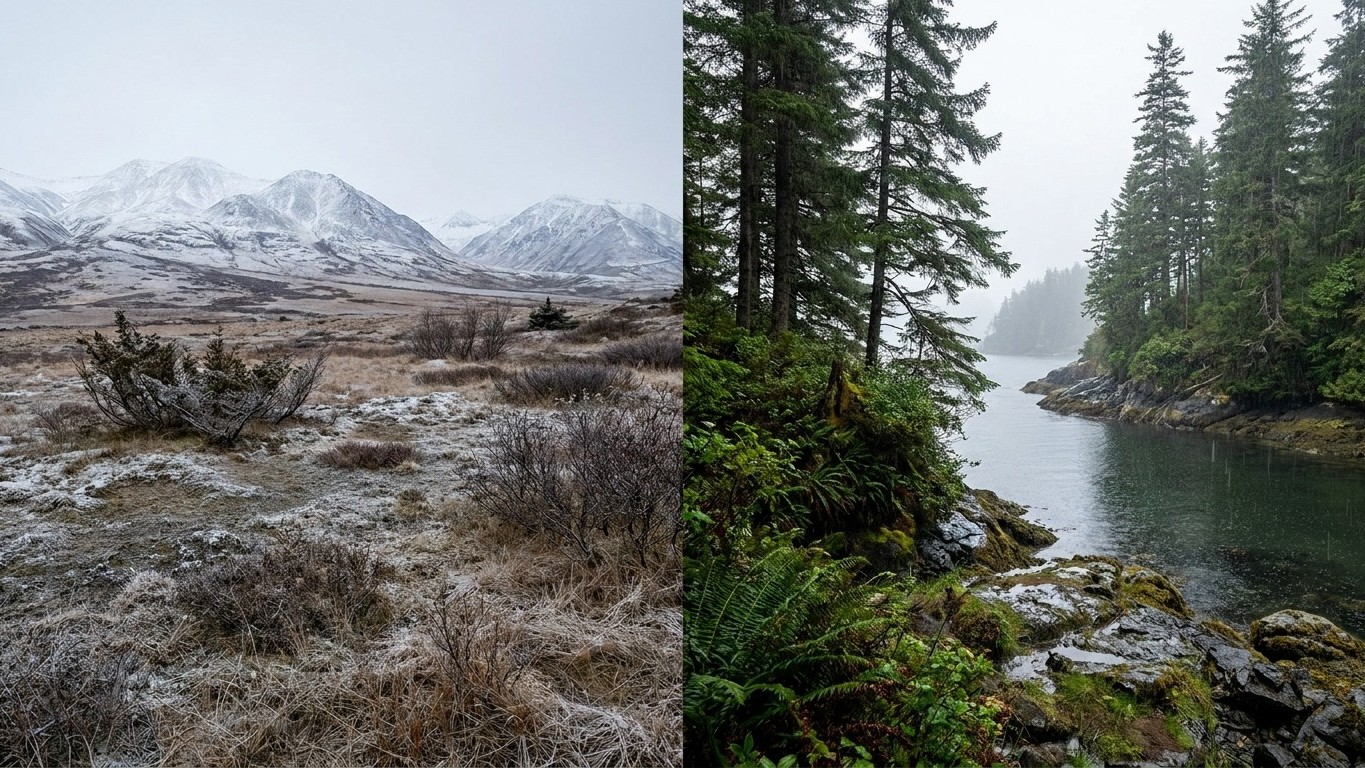

Florida’s USDA hardiness range runs from 8b to 11b, and none of the 65 landscape plants tracked on this site are hardy across that whole span. Sixty-one work in part of the state only. Four don’t survive anywhere in it. The state’s sandy Myakka soil and near-frost-free southern half change the planting calendar as much as the cold does.
What will not survive a winter in Florida

Start with the plants that make this simple: no zone in Florida, from the coldest sliver of the Panhandle at 8b to the tropical edge of the Keys at 11b, will carry them through. Four species on this site’s list fall into that bucket, and they’re worth naming before anything else because a reader who plants one of these is planting toward a loss regardless of where in the state they garden.
The direction of the mismatch matters here. Hardiness zones measure winter cold tolerance, and Florida’s zones are all on the warm end of the national range. A plant that fails in every one of them typically isn’t failing because Florida gets too cold. It’s failing because none of Florida gets cold enough. These are species built for a real winter, and the state’s warmest-in-the-nation baseline sits above their upper limit.
| Plant | Type | Where the mismatch falls |
|---|---|---|
| Syringa vulgaris (common lilac) | Shrub | Too warm, no part of the state’s 8b-11b range reaches its documented hardiness ceiling |
| Amelanchier canadensis (shadblow serviceberry) | Tree | Too warm, same pattern, fails statewide |
| Picea abies (Norway spruce) | Tree | Too warm, a cold-climate conifer with no foothold in any Florida zone |
| Thuja occidentalis (arborvitae) | Tree | Too warm, fails from the Panhandle to the Keys |
These four are the plants this site documents that fail statewide, not a count of everything that exists. A lilac from a catalog, a spruce from a nursery two states north, an arborvitae hedge copied from a photo of a New England yard: all four run into the same ceiling no matter which county in Florida they’re planted in. That’s a different problem from the next section, where the answer depends entirely on where in the state you stand.
The plants that work in part of the state and not the rest
This is where a single, one-size answer for “Florida” stops being useful. The state’s 8b-11b range covers a real climate gradient, from a Panhandle winter that can flirt with the 20s to a Keys winter that barely dips below 60. Sixty-one plants on this site’s list are hardy somewhere in that range and not hardy elsewhere in it. Sorting them by where they fail, rather than lumping them into a single yes-or-no, is the only honest way to answer this.
Two patterns show up in the data, and both fail at the warm end, meaning south Florida is the harder limit for this group, not north Florida.
Fails only in the warmest zones (10a through 11b)
This is the larger group. These plants are hardy from 8b through 9b, which covers the Panhandle down through roughly central Florida, but their range stops before it reaches the coast south of Orlando or the Keys. It includes familiar landscape trees like Acer rubrum (red maple), Cornus florida (flowering dogwood), Magnolia grandiflora, Quercus alba and Liquidambar styraciflua, along with shrubs such as Ilex glabra, Hydrangea macrophylla, Kalmia latifolia and Itea virginica, and perennials like Lavandula angustifolia, Asclepias tuberosa and Monarda didyma.
Fails from 9a through 11b, hardy only in the coldest sliver (8b)
This narrower group tolerates only the northern edge of the state. It includes Acer saccharum (sugar maple), Quercus rubra (red oak), Tilia americana and Pinus strobus among the trees, Buxus sempervirens, Viburnum dentatum and Weigela florida among shrubs, and Echinacea purpurea, Phlox paniculata and Salvia nemorosa among perennials.
Neither group is a lost cause for the reader in the wrong zone, since the whole point is that the same plant is a fine choice for a Tallahassee garden and a bad one for a Fort Myers garden. Finding out which zone applies to a specific address takes more than knowing the state falls in 8b-11b. The insulation guide for Florida on this site carries the county-level zone picture, and that’s the reference to check before planting anything from either group above.
The soil and the summer they will be planted into
Florida’s official state soil is the Myakka series, a Spodosol that runs about 97 percent sand at the surface with a pH around 5.1, strongly acid. On paper, a soil that sandy should drain fast, and the top few inches usually do. But USDA survey data classifies Myakka as poorly drained overall, which is the quiet catch in Florida gardening: the sand lets water through quickly near the surface, while a denser layer underneath can hold it, leaving roots sitting in wet ground even after the topsoil looks dry.
That matters more than winter cold for a lot of woody plants here. Root rot from standing water kills more shrubs and young trees in the Southeast than a cold snap does, and a soil that combines low organic matter (about 2.0 percent at the surface) with poor internal drainage is a setup for exactly that, especially in a low spot or a yard where fill has been added.
Summer rainfall compounds the picture rather than simplifying it. The reference station used for these normals gets about 21.2 inches of rain across June, July and August combined, out of 53.4 inches for the year. July is technically the driest of the three summer months at 6.77 inches, with June at 7.6 and August at 6.88. Those numbers describe rain falling as a regime, not a schedule, and they land differently depending on what’s underneath them. On a well-drained sandy rise, 21 inches over a summer soaks in and moves on. On a low or compacted Myakka-type site, the same rain can sit, and a plant that would tolerate the rainfall total just fine on better-drained ground can struggle with wet feet on this one. A soil test and a look at how a specific yard drains after a heavy storm tell a gardener more than the rainfall figure alone ever will.
When to plant, here
The reference station’s frost dates put the last spring freeze between February 16 and March 7, and the first fall freeze between November 26 and December 13. Those windows apply to north Florida, where the station sits; central and south Florida run effectively frost-free, and there the whole calendar flips, with winter as the main growing season and summer heat as the limiting factor instead of cold. Anyone gardening south of roughly Orlando should treat these dates as irrelevant to their own yard.
For the part of the state where frost is a real event, the logic behind timing matters more than memorizing a date. A woody plant put in the ground needs time to grow roots into the surrounding soil before it’s asked to either push new leaves in spring heat or sit through a hard freeze. Roots that haven’t spread are roots that can’t pull enough water to support a plant through either stress.
| Window | What it suits | Main risk |
|---|---|---|
| Spring (after March 7, before summer heat builds) | Most Trees, Shrubs and Perennials; roots get several months to establish before the first freeze returns | Late unexpected frost right after the average date, since these are averages, not guarantees |
| Autumn (October through late November, before the first frost date) | Cold-hardy woody plants that benefit from cooler root-establishment conditions | In north Florida, the window between planting and the first freeze on December 13 or earlier is short, leaving less time to root in than spring offers |
Whichever window is used, a newly planted specimen needs regular water through its entire first year regardless of what its mature drought tolerance rating says. Those ratings describe an established root system, not one that’s a few months old, and skipping water on a “drought-tolerant” plant in its first Florida summer is a common way to lose it before it ever gets the chance to prove that rating right.
Where to read about each one
Every hardiness figure used above comes from the North Carolina Extension Gardener Plant Toolbox, a university extension database, crossed against Florida’s own 8b-11b range as held on this site. That’s a different kind of number from the apple variety adaptation zones found elsewhere on this site’s fruit pages, which describe how a fruiting variety performs in a region rather than whether it survives winter there. The two shouldn’t be read as interchangeable.
Among trees that suit part of Florida, the list includes Acer rubrum, Cornus florida, Magnolia grandiflora, Quercus alba, Liquidambar styraciflua, Juniperus virginiana, Lagerstroemia indica, Nyssa sylvatica, Ginkgo biloba, and, for the coldest sliver of the state only, Acer saccharum, Quercus rubra and Tilia americana.
Shrubs that work somewhere in the state include Ilex glabra, Ilex verticillata, Itea virginica, Kalmia latifolia, Hydrangea macrophylla, Hydrangea paniculata, Clethra alnifolia, Aronia arbutifolia, and, again limited to the north, Buxus sempervirens, Viburnum dentatum and Weigela florida.
Among perennials, Achillea millefolium, Asclepias tuberosa, Baptisia australis, Heuchera americana, Lavandula angustifolia, Monarda didyma and Rudbeckia fulgida cover the milder two-thirds of the state, while Echinacea purpurea, Phlox paniculata, Salvia nemorosa, Iris sibirica and Amsonia hubrichtii hold only in the coldest zone, 8b.
None of these names are a substitute for checking the zone at a specific address first. A shrub rated for zones 8b through 9b is a solid pick in Gainesville and a bad bet in Naples, and the county-level zone map on this site’s insulation page is the fastest way to find out which side of that line a given yard falls on before anything goes in the ground.