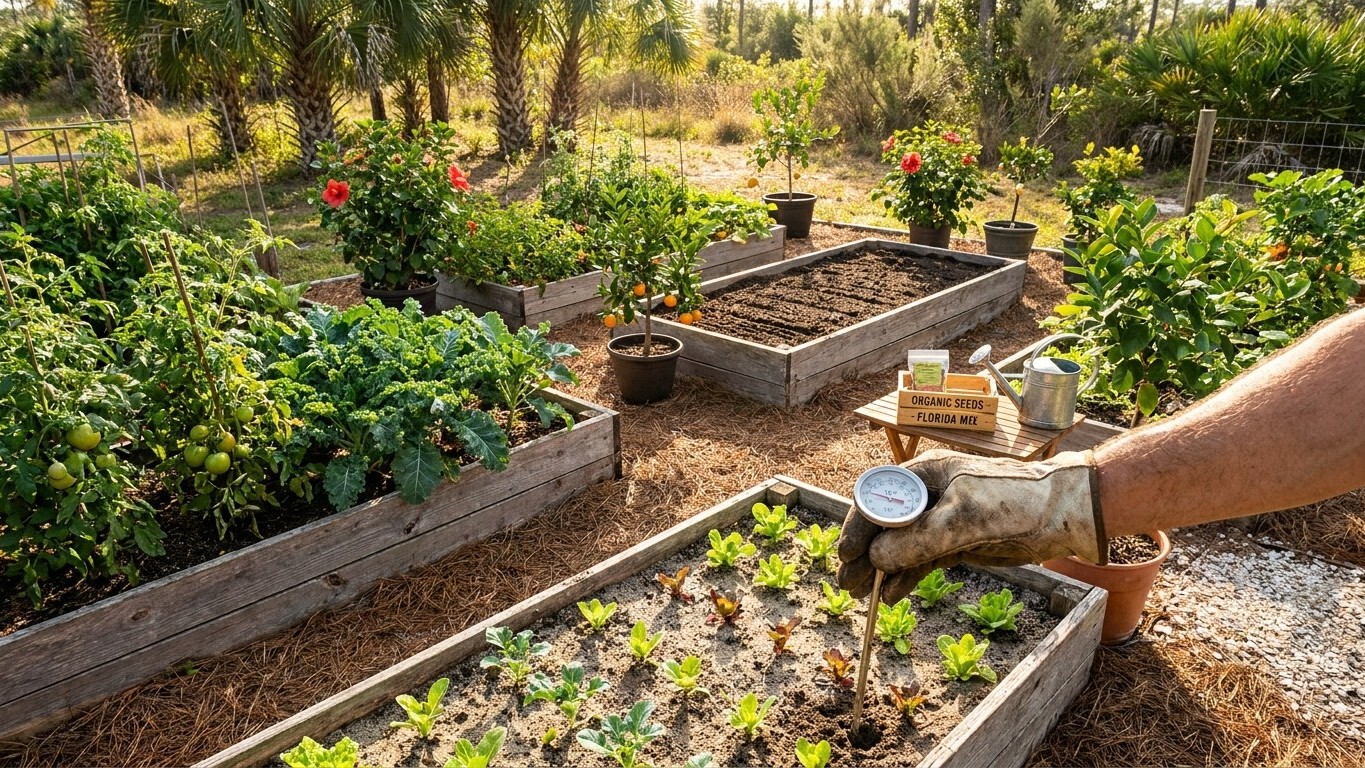

Florida’s growing calendar isn’t one calendar at all. A single hardiness zone number can’t describe a state that runs from the Georgia line to the Keys, and the frost dates that matter in Jacksonville mean almost nothing in Orlando or Miami. Here’s what the numbers actually say, and where they stop applying.
How long your season really is

Start with the official reference points. USDA places Florida across zones 8b to 11b on its Plant Hardiness Zone Map, a system built on one variable only: the average annual extreme minimum winter temperature. That range alone tells you this state can’t be treated as a single garden. At the reference station used here, Jacksonville, NOAA’s 1991-2020 climate normals put the average last spring frost between February 16 and March 7, and the average first fall frost between November 26 and December 13.
Do the arithmetic on those two windows and you get a frost-free stretch running somewhere between roughly 260 and 300 days a year, depending on which edge of each band you land in. That’s long. Long enough that even a slow-maturing, 90-day crop like Growing Potatoes in Florida has room to finish before frost returns, at least on paper, and it’s also why heat-loving crops such as those covered in Growing Peppers in Florida can settle into a long, uninterrupted run, or those detailed in Growing Sweet Corn in Florida, while a cool-season root crop like Growing Carrots in Florida can slot into the cooler edges of that same window, much like the timing needed for Growing Parsnips in Florida. It’s also enough runway for a perennial crop that needs a longer view of the calendar, as anyone attempting Growing Asparagus in Florida quickly learns. But two things chip away at that comfort. First, these are probability bands, not guarantees: NOAA builds them from the years when frost had a 30 to 70 percent chance of occurring by that date, which means by definition half of all years fall outside the average. A late frost in an unlucky spring can still nip something planted right at the edge of that window, and a gardener who treats February 16 as a safe date rather than a coin flip is planning for the average year, not this year.
Second, and more important: none of this applies once you move south. Jacksonville sits in north Florida, and the station behind these numbers is an inland airport site where three of the last thirty falls saw no freeze at all. Central and south Florida are close to frost-free most winters, and there the whole calendar flips. Instead of a cool-season garden bracketed by two frost dates, the main growing season runs through fall, winter, and spring, and summer becomes the season you’re protecting plants from, not frost. If you garden anywhere near Orlando or south of it, the dates above aren’t a shorter version of your season. They belong to a different climate entirely.
What the summer does to a garden here
Heat isn’t automatically friendly to a vegetable garden, and Florida gets a lot of it. The Jacksonville station averages 73.2 days a year at or above 90F, which is a measure of accumulated heat load, not just a warm afternoon here and there. That number matters because a lot of common garden plants have a hard ceiling. Tomatoes, for instance, tend to stop setting fruit once daytime and nighttime temperatures both stay high, dropping blossoms without pollination even while the plant itself stays green and alive. Lettuce and other leafy greens respond to sustained heat by bolting, running up a flower stalk and turning bitter, well before they’d normally be ready to harvest.
Winters, by contrast, run mild. The coldest month at the same station averages a daily minimum of only 42.9F, which is not a record low but the typical overnight floor during the coldest stretch of the year. That’s cold enough to matter for tropical and subtropical plants, but nowhere near cold enough to stop cool-season crops from growing through most of the winter.
Put those two facts together and the shape of the Florida gardening year comes into focus. This isn’t one long uninterrupted growing season the way the frost-free window alone might suggest. It’s closer to two workable stretches, a cooler one from fall into spring and a milder one bracketing summer, with a real dead zone in the middle where heat-sensitive crops simply stop performing regardless of how much water or fertilizer they get. Planning a Florida garden means planning around that gap, not just around frost.
What tends to go wrong in Florida
UF/IFAS Extension, the state’s land-grant service, tracks a long list of pests that show up in home gardens, but a handful account for most of the damage a gardener actually sees. Pickleworm and melonworm arrive with summer heat and go straight for the fruit, not the leaves, boring into squash, cucumber, and melon before you notice anything wrong from the outside. Fall armyworm follows later in the season, moving through turf and vegetable leaves in waves and stripping foliage fast enough that damage can look overnight even though the insects have been building for days. Whiteflies stay active through the warm months, clustering on the undersides of leaves, sapping plants of vigor, and leaving behind a sticky residue that turns into sooty mold. And the eastern lubber grasshopper, a large, slow-moving, hard-to-miss insect, does its worst chewing in spring and early summer, capable of stripping a whole plant of leaves in a matter of days once populations build.
None of these four show up year-round or in every part of the state at the same intensity, and this isn’t the full extension list. UF/IFAS Extension also flags chilli thrips, aphids, cycad aulacaspis scale, root-knot nematodes, fire ants, and hornworm caterpillars as regular problems for Florida gardeners, but the pests above are the ones most likely to actually cost you a harvest. Identification, and any decision about how to respond, is exactly the kind of question a county extension office answers better than a general article ever could.
Where to check before you plant
Everything above is a state-level average, and Florida is one of the last states where that phrase should come with a warning label. A single hardiness zone range spanning 8b to 11b, a frost station sitting in the north of the state, a growing calendar that inverts once you cross into central Florida: all of it points to the same conclusion. A planting date written for Jacksonville can be three weeks wrong, in either direction, by the time you reach the Panhandle or the Keys.
The state’s land-grant extension service, UF/IFAS Extension, publishes county-level offices precisely because a single statewide calendar can’t hold up across that much latitude. Their county staff can confirm local frost patterns, current pest pressure, and soil conditions specific to your address, none of which a state-level article is positioned to know. Before committing seeds or transplants to the ground, that’s the call worth making. Your county office is where you find out what it allows for you.
Where to Go Next, Crop by Crop
Everything above comes down to the same handful of numbers — first freeze, last freeze, how many days climb past 90°F — and those numbers play out differently depending on what you’re trying to grow. If garlic’s on your list, start with planting dates and varieties for Florida garlic, which gets into why hardneck types need a real cold stretch to divide into cloves, and how thin that window actually is most winters. The grass under your feet runs into the opposite problem — too much heat, not too little — so what to plant and when to feed a Florida lawn lays out why cool-season turf never had a chance here and what the summer heat count means for feeding schedules. And if tomatoes are the goal, the timing is tighter than either of those: planting dates, varieties and local pests for Florida tomatoes walks through the three-week window built around the last freeze, and what’s worth planting inside it. Read whichever one matches what’s already in the ground, or what you’re about to put there.