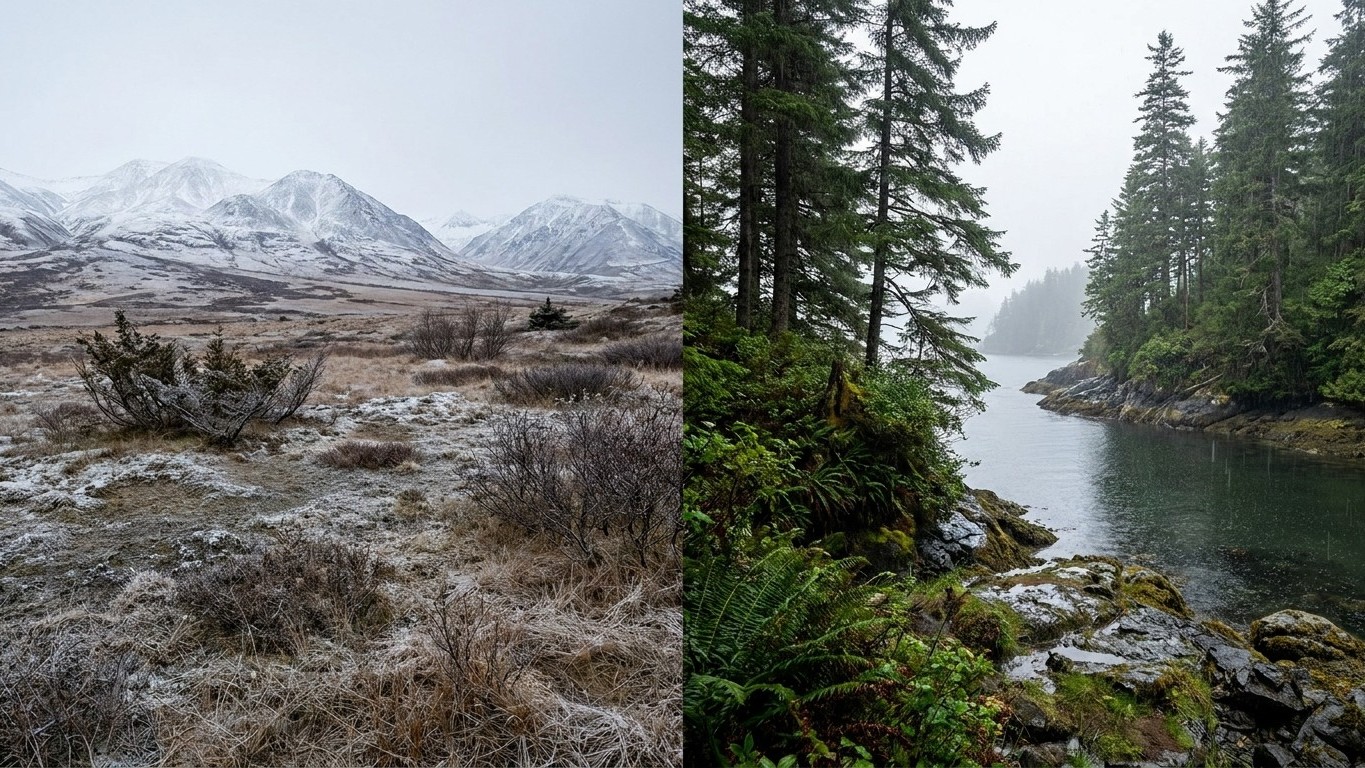

Every plant on this page either survives a Virginia winter everywhere in the state, or it survives only in part of it. Of the 65 landscape trees, shrubs and perennials tracked on this site, 56 are hardy across the entire state and 9 only in a slice of it. None fail the whole state outright, but “fails part of it” still means real losses if you’re gardening in the wrong zone.
What will not survive a winter in Virginia

Virginia’s USDA hardiness range runs from 5a to 8b, according to the USDA Plant Hardiness Zone Map, built on the 1991-2020 climate normals. That’s a wide band. Zone 5a marks winters where the average annual extreme minimum can drop to -20F, the kind of cold you’d expect in the mountains of far southwest Virginia. Zone 8b sits near the coast, where that same extreme minimum rarely dips below 15F. A single state hardiness range spanning seven half-zones is unusual, and it’s the reason a plant list for Virginia can’t be a simple yes-or-no exercise.
Here’s the part that matters most for anyone about to spend money on a tree or a hedge: of the 65 species this site documents against that 5a-8b range, zero fail across the entire state. Every one of them survives winter somewhere in Virginia. That’s not the same as saying every one of them thrives everywhere in Virginia, and it’s worth separating those two ideas cleanly.
Hardiness ratings measure survival, not comfort. A plant listed as hardy at the warm end of a range can still sulk there, heat stress, humidity, and a lack of winter chill hours can all leave a technically “hardy” plant weak, short-lived, or simply unattractive, even though it never freezes to the ground. The upper bound of a hardiness range is frequently a heat limit rather than a cold one, so a species that clears the bar for zone 8a can still be the wrong choice for a hot, humid Tidewater summer even though it won’t die from frost.
So the honest starting point for Virginia isn’t a list of plants to avoid outright. It’s a reminder that “hardy in Virginia” is a state-wide claim, and the state isn’t one climate. The next section is where that distinction actually changes what a reader should plant, because 9 of the 65 species documented here are hardy in only part of the 5a-8b range, and which part depends entirely on where in Virginia you’re standing.
The plants that work in part of the state and not the rest
Nine species on this list carve out an exception to the “hardy everywhere” rule, and they split cleanly into two groups: plants that fail at Virginia’s cold end and plants that fail at its warm end. One more sits in an odd middle gap. None of this is about which plant is “better”, it’s about matching a species to the zone a reader is actually gardening in.
| Plant | Its hardiness range | Fails in these Virginia zones |
|---|---|---|
| Ficus carica (fig) | hardy outside 5a-6b | 5a, 5b, 6a, 6b |
| Hydrangea macrophylla | hardy outside 5a-5b | 5a, 5b |
| Lagerstroemia indica (crape myrtle) | hardy outside 5a-5b | 5a, 5b |
| Magnolia grandiflora | hardy outside 5a-5b | 5a, 5b |
| Weigela florida | gap in 7a-7b | 7a, 7b |
| Syringa vulgaris (lilac) | hardy outside 7b-8b | 7b, 8a, 8b |
| Picea abies (Norway spruce) | hardy outside 8a-8b | 8a, 8b |
| Thuja occidentalis (arborvitae) | hardy outside 8a-8b | 8a, 8b |
| Amelanchier canadensis (serviceberry) | hardy outside 8b | 8b |
Four of these, the fig, the bigleaf hydrangea, crape myrtle, and southern magnolia, come up short at Virginia’s cold end: zones 5a and 5b, which describe the mountainous far west and the higher elevations of the Blue Ridge. Four others fail at the opposite end: lilac, Norway spruce, and arborvitae all struggle in zones 7b through 8b, the warmest slice of the state, which covers the coastal plain and Hampton Roads. Serviceberry loses only the single warmest pocket, 8b. Weigela is the outlier, hardy at both the cold and warm ends of Virginia but not in the 7a-7b band that sits in the middle, roughly the Piedmont.
None of this tells you why a given plant drops out of a zone; the data only says where. Figuring out your own zone starts with knowing which one you’re in, and Virginia’s zones don’t follow county lines neatly. The insulation guide for this state carries the county-level hardiness zone picture, which is the faster way to confirm whether you’re gardening in a 5b mountain valley or an 8a stretch of the coastal plain before picking anything off this table.
The soil and the summer they will be planted into
Virginia’s representative soil, the Pamunkey series, is an Alfisol: a forest soil of moderate fertility, loam to silt in texture (about 50 percent sand, 39 percent silt, 11 percent clay), with a surface pH near 6.2 and roughly 1.2 percent organic matter, according to USDA NRCS Soil Data Access. It’s classified well drained. For a newly planted tree or shrub, that drainage detail matters more than almost anything else in the soil report, because winter wet drowns more woody roots than winter cold ever does. A root ball sitting in saturated clay for weeks doesn’t get the chance to freeze; it suffocates first.
That said, the Pamunkey series describes the soil that represents Virginia on a map, not the soil in any one backyard. Builders scrape and fill lots, river bottoms run heavier and wetter, hill country runs thinner and rockier. A soil test on the actual planting site is the only way to know whether the ground drains like the state average or nothing like it.
Layered on top of that soil, Virginia gets about 15.0 inches of rain across June, July and August, according to NOAA’s 1991-2020 climate normals at station USW00013769. June is the driest of the three months at 4.15 inches, July climbs to 5.76, and August settles at 5.09. That’s a meaningful amount of summer rain, but the figure only tells half the story until it’s crossed with the ground it’s falling on.
The same 5.76 inches of July rain behaves differently depending on the texture underneath it. On a sandy surface, water moves through within a day, leaving the root zone dry again quickly even after a solid storm. On a heavier clay surface, that same rain can sit for the better part of a week. A loam like the Pamunkey series, sitting roughly in between, still varies lot to lot. None of this converts into a watering schedule on its own, a rain gauge on the actual property is what tells a gardener whether a given summer’s rainfall was enough, not the regional normal.
When to plant, here
Virginia’s last spring frost, at the NAS Oceana reference station, falls between March 20 and April 3, and the first fall frost arrives between November 10 and November 24, both drawn from NOAA’s 1991-2020 freeze-probability normals. Those two windows bracket the state’s growing season, and they also bracket the two times of year that make sense for putting a woody plant in the ground.
The logic behind picking a planting window isn’t about hitting an exact date. It’s about giving roots time to establish before the plant is asked to do something demanding, whether that’s pushing out a full canopy of leaves in the heat of June or sitting through a hard freeze with a root system that hasn’t spread yet.
| Window | What it suits | The risk |
|---|---|---|
| Spring (after March 20-April 3) | Broad range of trees and shrubs; a full growing season ahead to establish roots before winter | A late, out-of-pattern frost can still nip new growth right after planting |
| Autumn (before Nov. 10-24) | Cooler air reduces transplant stress; roots keep growing after leaves drop | Less time to establish before the ground freezes, especially at the cold end of the state’s range |
Autumn planting works well across most of Virginia because the soil stays workable well after the air cools, but that math changes in the coldest part of the state’s 5a-8b range. In the higher elevations near the 5a and 5b end, the gap between a reasonable autumn planting date and the first fall frost narrows considerably, leaving a newly planted shrub less time to root in before the ground locks up.
Both frost dates are averages for one reference station, not a guarantee for any specific yard, and a garden a few hundred feet higher or lower in elevation can run noticeably different. Whichever window is chosen, a first-season plant needs consistent water regardless of what its mature drought rating says. Drought tolerance ratings describe an established plant with a developed root system, not one that went into the ground eight weeks ago.
Where to read about each one
The 56 species hardy across all of Virginia’s 5a-8b range split naturally into three groups worth knowing by name before heading to a nursery.
Among the trees: red maple (Acer rubrum), sugar maple (Acer saccharum), river birch (Betula nigra), American hornbeam (Carpinus caroliniana), eastern redbud (Cercis canadensis), flowering dogwood (Cornus florida), ginkgo (Ginkgo biloba), eastern redcedar (Juniperus virginiana), sweetgum (Liquidambar styraciflua), black gum (Nyssa sylvatica), eastern white pine (Pinus strobus), American sycamore (Platanus occidentalis), white oak (Quercus alba), red oak (Quercus rubra), and American basswood (Tilia americana) all clear the whole state.
Among the shrubs: red chokeberry (Aronia arbutifolia), boxwood (Buxus sempervirens), summersweet (Clethra alnifolia), dwarf fothergilla (Fothergilla gardenii), panicle hydrangea (Hydrangea paniculata), inkberry holly (Ilex glabra), winterberry holly (Ilex verticillata), Virginia sweetspire (Itea virginica), mountain laurel (Kalmia latifolia), ninebark (Physocarpus opulifolius), Japanese spirea (Spiraea japonica), and arrowwood viburnum (Viburnum dentatum) hold up statewide too.
Among the perennials: yarrow (Achillea millefolium), Arkansas bluestar (Amsonia hubrichtii), butterfly weed (Asclepias tuberosa), false indigo (Baptisia australis), purple coneflower (Echinacea purpurea), coral bells (Heuchera americana), Siberian iris (Iris sibirica), lavender (Lavandula angustifolia), bee balm (Monarda didyma), garden phlox (Phlox paniculata), black-eyed Susan (Rudbeckia fulgida), and sedum (Hylotelephium spectabile) round out the list.
The hardiness ranges behind every plant on this page come from the North Carolina Extension Gardener Plant Toolbox, a university extension database, crossed here against Virginia’s own 5a-8b zone range. These are hardiness figures for cold survival, not the adaptation ranges used elsewhere on this site for fruit-tree and apple varieties, which measure something different and shouldn’t be read against the same table.