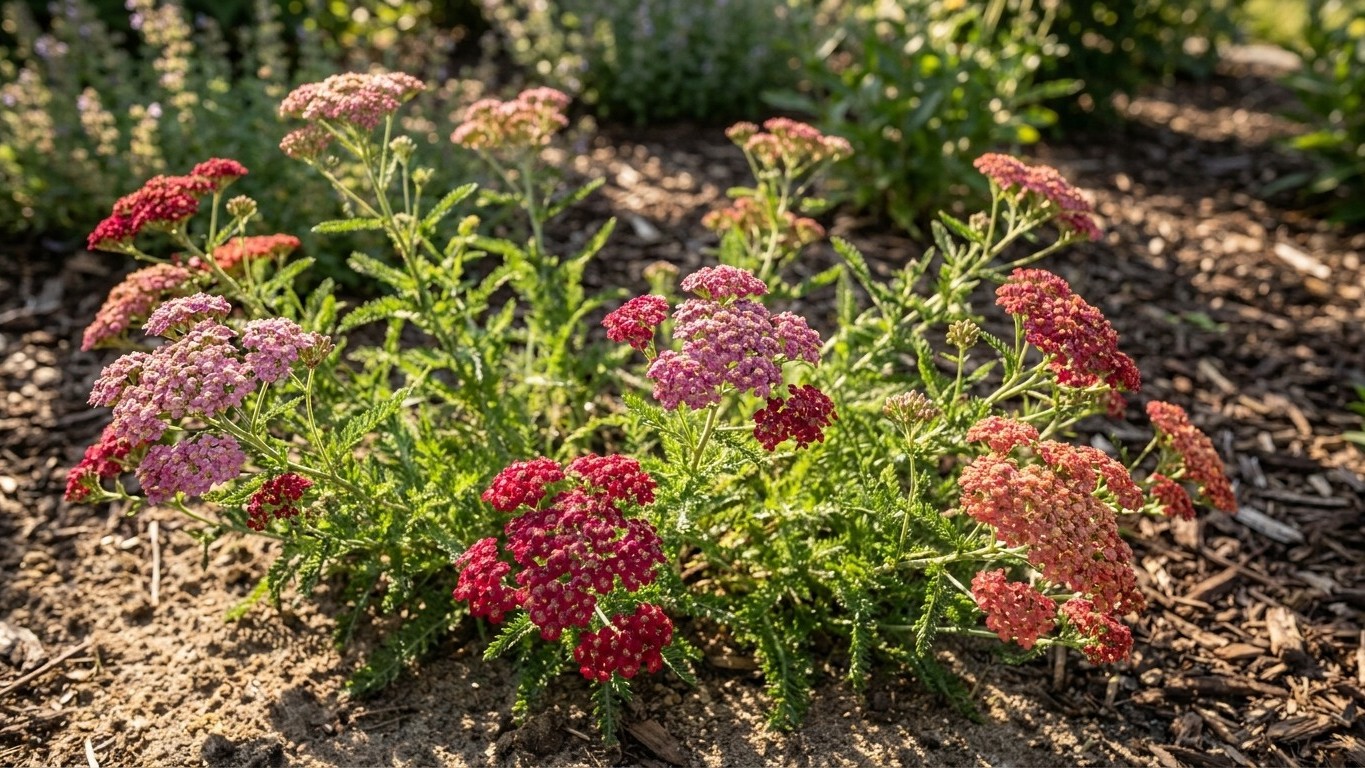

Achillea millefolium goes by several names in nursery catalogs and old gardening books: Common Yarrow, Devil’s Nettle, Dog Daisy, Milfoil, Soldier’s Woundwort, Thousandleaf, Western Yarrow, Yarrow. One of those, Devil’s Nettle, causes real confusion, since it’s also used loosely for stinging nettle, an entirely different plant with a painful sting Achillea doesn’t share. Whatever name lands on the plant tag, this is a low, ferny groundcover that survives across USDA zones 3a to 9b, tolerates lean sandy soil, blooms through summer, and eventually needs its clump split apart. What decides whether it actually thrives, though, has less to do with cold than with what happens underfoot in winter.
Where it will and will not survive

The USDA hardiness range for Achillea millefolium runs from zone 3a to zone 9b. That’s a wide band, but it isn’t a promise. Below the bottom of this range, winter cold kills the plant outright, no amount of mulch or siting changes that outcome. Above the top of it, the plant may survive, but survival isn’t the same as thriving; a perennial rated to the warm edge of its range is often stretched by summer heat and humidity even when it technically lives through the year.
A range describes what a plant can endure, not what makes it comfortable. That distinction matters here because 3a to 9b covers an enormous amount of climate variation, from short cold summers to long hot ones. A gardener sitting near the middle of that range has an easier job than one gardening at either edge, where extra siting decisions (afternoon shade in hot climates, a sheltered spot in cold ones) start to matter more than the plant tag suggests.
None of this is useful without knowing your own zone first. Rather than guess from a general map or a neighbor’s growing habits, check your specific hardiness zone using a county-level guide, since zone boundaries shift more within a single state than most people expect. This site’s hardiness zone guide breaks that down county by county, which is the only way to know with confidence whether 3a to 9b actually includes your yard.
Light, soil and drainage
The growing conditions reported for this plant are specific enough to check against your own site before planting, rather than after.
| Condition | What Achillea millefolium tolerates |
|---|---|
| Light | Full sun, 6 or more hours of direct sunlight a day |
| Soil texture | High organic matter, loam (silt), or sand |
| Soil pH | Neutral, 6.0 to 8.0 |
| Drainage | Good drainage, occasionally dry, occasionally wet |
For a perennial like this one, winter drainage decides survival far more often than the cold itself does. A plant rated hardy to zone 3a can still die in a spot that stays soggy from November through March, because saturated soil around dormant roots does more damage than frost alone. That single fact gets left off more plant tags than almost anything else, and it explains a large share of the “hardy perennial died over winter” complaints in gardening forums.
A drainage check you can run yourself
Dig a hole about a foot deep and a foot across, fill it with water, and time how long it takes to drain. If the water is gone within a few hours, the site drains well enough for occasional wet spells. If water is still standing after half a day, that ground holds moisture longer than this plant’s “occasionally wet” tolerance was built for, and raised beds or amended soil will matter more than the hardiness zone ever will.
When it flowers and how long
Bloom time for Achillea millefolium is summer, not a specific month, since that window shifts earlier at lower latitudes and lower elevations and later as you move north or gain altitude. The flat-topped flower clusters sit above ferny, aromatic foliage and, while in bloom, draw in bees, butterflies, pollinators generally, and predatory insects that help keep other pest populations in check.
That last point matters for how you manage the plant through the season. Deadheading spent flower heads can extend the bloom display and keep the clump looking tidy, while cutting the whole plant back hard after flowering encourages fresh foliage rather than a second late flush. Either approach is reasonable; what doesn’t work is ignoring the plant once it stops flowering and expecting the same pollinator traffic to continue, since attracting bees and butterflies is a property of the open flowers, and it stops when the flowering does.
Out of bloom, which is most of the year, this is simply a low, spreading mat of deciduous, feathery foliage, erect in some spots and prostrate or spreading in others depending on how it’s grown. According to the source data, the leaves and flowers are bitter but edible raw or cooked in moderation, used in salads and teas, and the flowers and leaves are also used in making some liquors and bitters. The fruit itself is described only in botanical terms, as a small achene-like structure called a cypsela, which is a seed description rather than anything to do with taste.
Planting, and dividing it later
Getting a new plant established well sets up everything that follows, including how easy the eventual division will be.
- Plant in spring or fall once the soil is workable and temperatures are moderate, avoiding the peak of summer heat for transplanting.
- Space plants 12 inches to 3 feet apart, matching the wider end of that range for the spreading, low-habit form and the tighter end where a fuller, quicker groundcover effect is wanted.
- Set the crown at grade, not buried; planting too deep is a common cause of rot in a plant that tolerates dry soil far better than smothered soil.
- Water consistently through the first growing season while roots establish, then taper off, since established plants handle occasional dry spells better than new ones.
- Mulch lightly around, not over, the crown, leaving a small gap so moisture doesn’t collect against the base.
Because this is a herbaceous perennial with a rapid growth rate, it fills in fast, and that same vigor is exactly why it eventually needs dividing. The signs are straightforward to spot: a bare or woody patch opening up in the middle of the clump, noticeably fewer flowers than in previous seasons, or a plant that has simply outgrown the space it was given. None of these show up on a fixed schedule, they show up when the clump shows them, which is the only timing that actually matters here.
- Dig up the entire clump, lifting with a garden fork to keep as much root intact as possible.
- Split it into sections by hand or with a clean spade, keeping several shoots and healthy roots in each piece.
- Discard the old, woody center, which rarely produces strong new growth.
- Replant the divisions at the same depth as before, spaced according to the mature size above.
- Water the new divisions well to settle the soil and support root contact.
What it resists, and what it does not
Resistance in a plant profile means a tendency to shrug off a stress, not immunity from it. A “deer-resistant” plant can still get nibbled when browsing pressure is high or food is scarce, and “drought-resistant” applies to plants that are already established, not to a division planted three weeks ago.
For Achillea millefolium specifically, the source data doesn’t assign a resistance rating in either direction for any of the usual categories:
| Category | Source rating |
|---|---|
| Deer | Not specified |
| Rabbits | Not specified |
| Drought | Not specified |
| Dry soil | Not specified |
| Heat | Not specified |
| Humidity | Not specified |
| Salt | Not specified |
| Pollution | Not specified |
That absence is worth taking seriously rather than filling in from general reputation. Deer resistance in particular is the claim gardeners lean on most, and here there’s no basis for either a green light or a warning, so plant with a wait-and-see approach if deer pressure is a known problem locally. Wet soil is the other category that matters most for a perennial, and while it isn’t listed as a formal resistance rating, the drainage tolerance above already covers it: this plant handles occasionally wet ground, not consistently wet ground, and that distinction is the more actionable one anyway.
Maintenance is listed as low to medium, which in practical hours means the plant doesn’t demand weekly attention, but it isn’t maintenance-free either. Expect an annual cutback after flowering, occasional deadheading if you want a longer bloom window, and eventual division once the clump shows the signs described above. That’s a modest workload compared to many perennials, but “low-maintenance” here still means some maintenance, not none.
Common questions
Does yarrow spread aggressively?
Its growth rate is listed as rapid and its habit includes spreading forms, so it fills space quickly and can move beyond its original planting area, especially in loose, well-drained soil. Give it room at planting rather than crowding it against slower neighbors.
Can it be grown in clay soil?
The listed soil textures are high organic matter, loam, and sand, with no mention of heavy clay. Since winter drainage is the deciding factor for survival, clay that stays wet for extended periods is a poor match unless it’s amended or the bed is raised.
Is this the same plant as an invasive roadside weed?
The common names list includes several overlapping terms, and one of them, Devil’s Nettle, is also used for an unrelated stinging nettle. That overlap in common names is a real source of confusion; the botanical name Achillea millefolium is the only reliable way to confirm which plant is actually being discussed.
Does it need regular fertilizing?
No fertilizing schedule appears in the source data, and a plant suited to sand and lean, high-organic-matter soil generally doesn’t need heavy feeding. Excess fertilizer on a plant like this tends to produce floppy growth rather than better flowering.