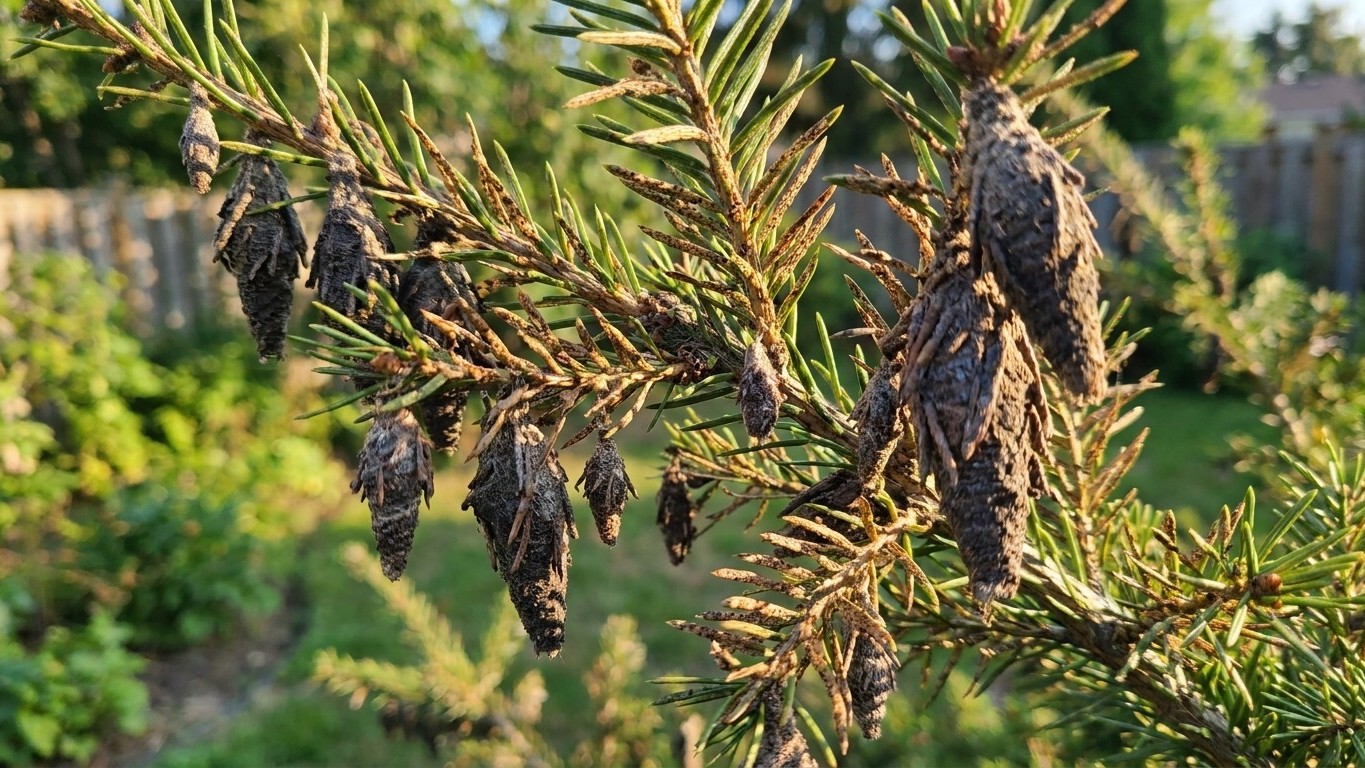

Bagworm larvae hatch in late spring and must be treated by June in Missouri, before they grow too large for control measures to work. After that window closes, the caterpillars build tougher cases and start closing themselves off from anything sprayed or picked, so the six-to-eight-week stretch after the state’s last frost is the real deadline gardeners need to track.
The weeks to watch

Bagworms need to be dealt with in June, because by July they’ve grown large enough that control becomes far less effective. That single line, from University of Missouri Extension’s gardening calendar, is the clearest timing marker published for this pest in the state. It doesn’t give a hatch date down to the day, and it’s worth saying plainly: MU’s public guide sheets on bagworm biology weren’t accessible for this piece, so the window here rests on that one calendar mention rather than a detailed generation study.
One generation, one hard deadline
Bagworms produce a single generation per year in Missouri, unlike Japanese beetles or hornworms, which MU tracks with multiple emergence peaks or two full broods. That single-generation biology is exactly why the June cutoff matters so much. There’s no second wave coming later in the summer to catch missed larvae. Eggs that overwinter inside last year’s bags hatch as spring warms, the young caterpillars feed and build their own protective cases through late spring, and by the time July arrives those cases have thickened enough that the larvae are, in MU’s phrasing, “almost too big to treat.” Missing the window doesn’t just reduce your odds. It largely closes them for the season, and the next real chance to affect the population starts over the following spring.
Reading the calendar from your last frost

Bagworm larvae respond to soil and air warming, not to a printed date, so the timing above shifts with however early or late spring runs in a given year. The one date most Missouri gardeners already have penciled in, the last spring frost, gives a workable anchor for figuring out roughly when that June treatment window opens.
- Start with your last frost date. NOAA’s 1991-2020 climate normals put the last spring freeze for mid-Missouri between April 6 and April 20. The Kansas City station used for that data sits well north of the city itself, downtown runs about five days earlier, and southern Missouri trends milder still, so treat this as a normal range, not a promise.
- Add roughly six to eight weeks. Counting forward from an April 6-20 frost lands squarely in the first three weeks of June, right where MU’s guidance says treatment needs to happen before larvae outgrow it. An early frost year nudges that window earlier; a late one pushes it toward late June.
That arithmetic only gives another range, never a single calendar day, and it’s meant as a planning tool rather than a guarantee. Gardeners who scout their arborvitae or junipers starting in early May, then check weekly through June, will catch the larvae while they’re still small enough for hand-picking or treatment to matter.
What it attacks, and what the damage looks like

The first sign most homeowners notice isn’t a caterpillar at all. It’s a patch of browning, thinning foliage on one side of an evergreen, or small spindle-shaped bags made of silk and bits of the plant’s own needles hanging from the branches like tiny pinecones. Those bags are easy to mistake for actual cones or seed pods until you notice they’re attached by silk thread and move if you tug them.
Bagworms feed on a range of woody plants, though evergreens tend to suffer the worst because they can’t regrow lost foliage as quickly:
- Arborvitae
- Eastern red cedar and other junipers
- Spruce
- Pine
- Honeylocust and other deciduous shade trees, though damage there is usually lighter
The damage comes entirely from the larval stage. Caterpillars inside the bags chew foliage as they crawl and grow, dragging their case along with them, and that feeding is what causes the browning. Once a larva seals itself in to pupate in mid-to-late summer, it stops feeding altogether, which is exactly why treatments applied after that point don’t accomplish much. The insect is no longer eating anything you’d spray.
How Missouri sits in this pest’s range

Bagworms are a widespread pest across the eastern and central United States, not a species confined to one corner of the country. That matters for how Missouri gardeners should think about the timing above: the differences from one state to the next are mostly about when the June-style deadline falls, not whether the insect shows up at all. A gardener in a warmer, more southern state might see that treatment window open in May; one further north might see it slide into late June or even July.
Missouri sits in the middle of that range rather than at an edge, which is part of why the state’s own extension calendar treats bagworm control as a routine June task rather than an unusual event. The state’s own climate variation plays a bigger role locally than its position in the species’ overall range does. Southern Missouri’s milder spring can pull the hatch and the treatment window earlier than what a gardener near the northern border experiences, echoing the same frost-date spread NOAA records for the state.
What actually works against it

Cost and effort climb fast with this pest once the calendar works against you, so the cheapest, simplest steps belong at the front of the list.
- Hand-pick bags off plants in fall or winter. Each bag can hold several hundred overwintering eggs, and removing and destroying them before spring physically cuts next year’s population before it ever hatches. This costs nothing but time and a pair of gloves.
- Scout in May and treat by early-to-mid June. Young larvae are smaller, softer, and far more exposed than the ones that have built thick, well-camouflaged cases by midsummer. Acting inside MU’s stated window is the single biggest factor in whether control works at all.
- Avoid dense, all-conifer plantings. A row of identical arborvitae or junipers gives a bagworm population an unbroken buffet and lets an infestation spread from one plant to the next with little resistance. Mixing in deciduous species or spacing evergreens further apart won’t prevent bagworms outright, but it limits how far a local outbreak travels.
- Clear old bags and debris from around affected plants. Bags that fall to the ground or get left on pruned branches can still hold viable eggs, so cleanup after treatment matters as much as the treatment itself.
- Know when to stop trying. Once larvae have sealed themselves into bags for pupation, typically by later summer, neither hand-picking nor spraying does much of anything, since the insect is no longer feeding and is increasingly protected inside its case. At that point, the more useful move is marking the calendar for next spring’s scouting rather than chasing this year’s population.
Common questions
Can bagworms kill a mature evergreen?
Repeated years of heavy feeding can kill or severely disfigure evergreens, since conifers don’t regrow lost needles the way broadleaf plants regrow leaves. A single light season of feeding is less likely to be fatal on an established tree.
Do the bags themselves need to be destroyed, or is removing them enough?
Bags need to be destroyed or disposed of away from the plant, not just knocked off and left nearby, since eggs inside can survive on the ground and larvae can still hatch and crawl back onto host plants.
Is it worth treating a plant once bagworms are found in July?
By MU’s own timing, July is past the point where control is reliable, since larvae have grown large enough to be far harder to affect. Marking the location for early scouting the following spring tends to be a better use of effort than treating late-season bags.