
Missouri gardeners deal with a fairly consistent set of ten pests each year, according to the University of Missouri Extension’s integrated pest management program (MU IPM), with most of the damage landing between June and August — including the Japanese beetle Missouri gardeners have come to expect on roses and fruit trees by midsummer, as well as the Tobacco hornworm Missouri tomato growers watch for come July, often alongside its close relative, the Tomato hornworm Missouri growers can just as easily mistake it for, not to mention the hot, dry stretches that bring on Spider mites in Missouri gardens seemingly overnight, and later in the season the shield-shaped Brown marmorated stink bug in Missouri gardens see clustering on tomatoes and peppers as they ripen. Check squash and cucumber stems for a small entry hole starting in early June, before the squash vine borer larva gets far enough inside the stem to make hand removal the only option left.
What Missouri gardens actually deal with

A hole no bigger than a pencil tip at the base of a squash or cucumber stem — that’s the one to catch, and June is when it shows up. Once the larva of the Squash vine borer in Missouri works its way past that entry point, you’re not spraying anything, you’re cutting the stem open and pulling the grub out by hand. So before you do anything else this week, walk your squash and cucumber patch and run a finger along the lower few inches of every stem, feeling for that small hole and the sawdust-like frass sitting next to it.
Striped and spotted cucumber beetles

Cucumber beetles in Missouri show up as soon as squash, melon and cucumber seedlings break the surface. Both species are small, quarter-inch beetles: the striped one yellow with three black stripes down its back, the spotted one yellow-green with black dots. They chew ragged holes in leaves and can kill a seedling outright by feeding on the stem below the soil line, and the adults also spread bacterial wilt as they feed. A seedling carrying more than a couple of beetles before it has four true leaves is at real risk, so check plants daily through the first two weeks after they emerge.
Squash bugs

Squash bug populations in Missouri follow close behind, moving in as squash and pumpkin vines start to run. The adults are flat, shield-shaped and brownish-gray, about five-eighths of an inch long. Nymphs are gray with black legs and cluster in tight knots on leaf undersides. Both stages suck sap from leaves and stems, leaving yellow speckles that turn brown and cause whole leaves to wilt and blacken. Crushing the egg clusters, copper-colored and laid in neat rows on leaf undersides, does more to slow this pest than any spray applied after the nymphs hatch.
Squash vine borer

Adults emerge around June, per MU IPM, and look like a wasp with an orange-and-black abdomen, flying during the day rather than at night like most moths. The damage comes from the larva, not the adult: a cream-white grub that bores into the base of the stem and feeds inside it, where no contact spray can reach. The first sign is often a vine that wilts suddenly despite moist soil, with a small hole and sawdust-like frass near the base. Once a larva is inside, the only real fix is to slit the stem lengthwise, remove the grub, and mound moist soil over the wound so the stem can root again.
Hunting billbug

This one attacks lawns, not vegetables. The adult is a dark, weevil-like beetle about half an inch long with a long curved snout, and it lays eggs in grass stems in early summer. The larvae, legless white grubs, tunnel into the crown and roots, leaving patches of turf that pull up easily and look drought-stressed even when the soil underneath is damp. Because the damage mimics both grub injury and a simple dry spell, digging a few inches into the turf at the edge of a dead patch is the most reliable way to tell billbug from drought.
Bagworms

Bagworms build a spindle-shaped bag from silk and bits of the host plant, one to two inches long, that hangs from branches and looks enough like a small pinecone to go unnoticed. MU IPM’s calendar is blunt about the timing: bagworms need to be dealt with in June, because by July the caterpillars inside have grown large enough that most insecticides stop working well on them. The feeding shows up as browning, especially on junipers and arborvitae, before the plant looks bare on one whole side.
Japanese beetle

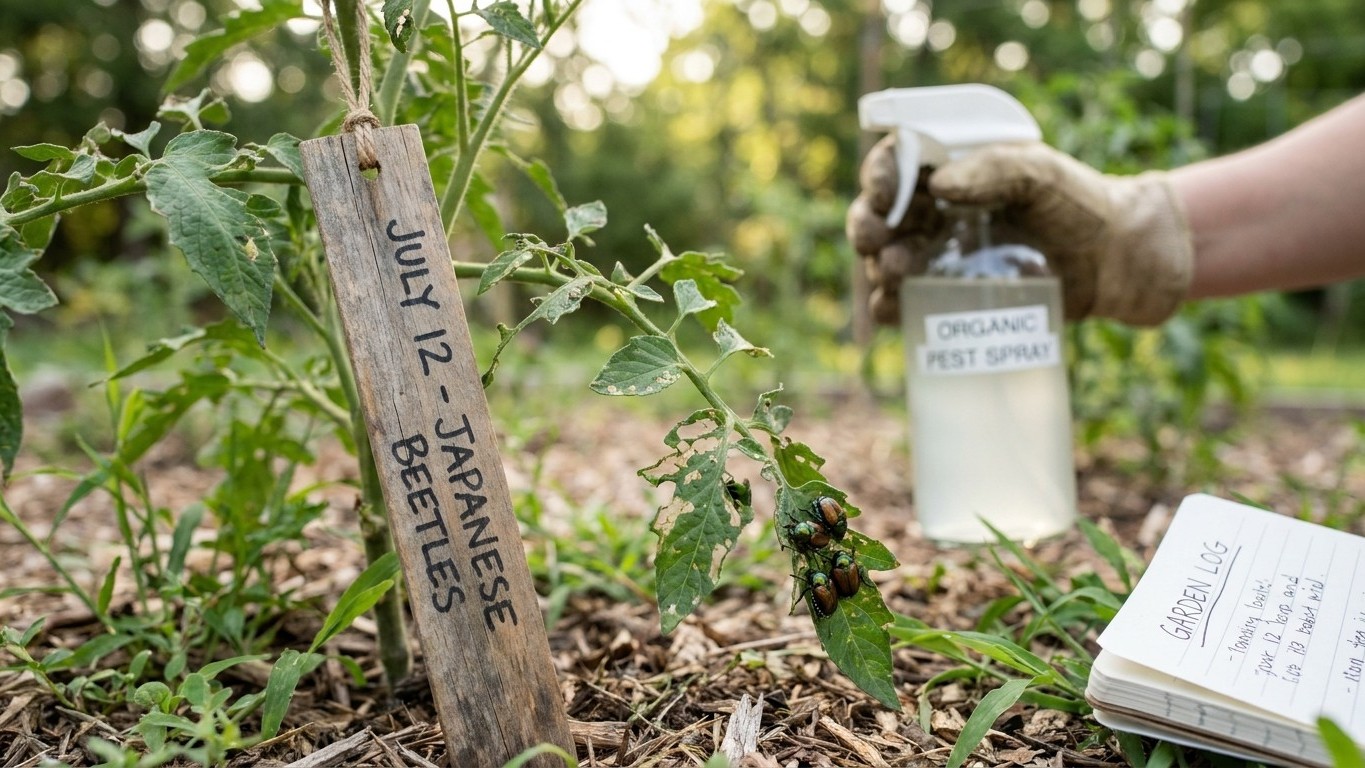
Japanese beetle is the one Missouri gardeners complain about most. The adult is roughly three-eighths of an inch long, with a metallic green head and thorax and coppery-brown wing covers. MU IPM’s tracking near Kansas City puts emergence at mid to late June, a peak in the second week of July, and a decline by early August. Adults skeletonize leaves between the veins, leaving a lace-like pattern, and they favor roses, grapes and beans as much as anything in the vegetable patch. Grubs feeding on turf roots earlier in the season are the same insect at an earlier life stage.
Tomato hornworm
Tomato hornworm is a large green caterpillar, up to four inches long, with white V-shaped marks along its sides and a black horn at the tail end. MU IPM notes hornworms produce two generations over a Missouri summer, so a garden clear of them in June can have a fresh batch in August. They strip leaves first, then move to green fruit, and a plant can lose most of its foliage in a matter of days once the caterpillars reach full size.
Tobacco hornworm
Tobacco hornworm looks almost identical at a glance but has diagonal white stripes instead of Vs, and a red horn rather than a black one. It feeds the same way, on the same plants, and the two species are often found side by side on a single tomato plant. Hand picking works on both, but check the horn color before deciding the problem is cleared, since mistaking one species for the other already found is a common way to miss a second wave.
Spider mites
Spider mites are barely visible without a magnifying glass, tan to reddish specks that gather on the undersides of leaves along with fine webbing. MU IPM notes their numbers climb under hot, dry conditions, which makes them a midsummer problem more than an early one. Leaves take on a stippled, dusty look before they bronze and drop, and by the time webbing is obvious the population underneath it is already large.
Brown marmorated stink bug
This one is a newer arrival: a shield-shaped bug about five-eighths of an inch long, mottled brown, with banded antennae and light-and-dark markings around the edge of its back. It feeds on a wide range of vegetables and fruit, leaving small discolored, dimpled spots where it pierced the skin to feed, and it becomes most noticeable in late summer as it looks for places to spend the winter, often inside sheds, garages and homes.
Telling damage apart

The shape of the damage tells you more than the pest itself, and it’s the fastest way to rule out most of the possible causes before touching a spray bottle. Chewed edges and ragged holes mean an insect with jaws, something like a beetle or a caterpillar working through tissue from the outside in. Stippling, that fine dusty speckling that fades leaf color from green to a dull bronze, points to something sucking sap instead of biting, which narrows the list to spider mites, squash bugs or stink bugs.
Wilting is the trickiest symptom because it has three unrelated causes that all look similar from a few feet away. A plant that wilts despite damp soil and shows a small hole near the base of the stem has almost certainly got a squash vine borer inside it. A plant that wilts because the soil is dry six inches down is a watering problem, not a pest. A plant that wilts, yellows from the bottom up, and shows no boring damage at all is more likely a soil-borne disease such as fusarium or verticillium wilt, and no insecticide will touch that.
Sticky residue on leaves, often followed by a black sooty coating, isn’t chewing damage at all. It’s honeydew, a sugary waste left behind by sap-feeding insects such as aphids or squash bugs, and the black film growing on top of it is sooty mold living off the sugar rather than attacking the plant directly. Wash it off and deal with the insect underneath, not the mold on top.
- Ragged holes or skeletonized leaves: a chewing insect, check for beetles or caterpillars
- Fine speckling with dulled color: a sap-feeding insect, check leaf undersides for mites or bugs
- Sudden wilting with a hole at the stem base: squash vine borer
- Wilting with dry soil below the surface: a watering problem, not a pest
- Sticky leaves with a black film: honeydew and sooty mold, treat the insect causing it
None of this replaces a look with a hand lens or a sample carried to your county extension office, but it keeps you from spraying a fungicide on an insect problem, or an insecticide on a watering mistake, which happens more often than most gardeners admit.
When each one shows up
Pest pressure in Missouri tracks the plant’s growth stage and the weather more closely than it tracks a date on a calendar, but MU IPM’s monitoring near Kansas City gives a rough rhythm to work from. Gardeners elsewhere in the state should expect it to shift by a week or two in either direction.
Early season, seedlings to first bloom
Cucumber beetles arrive the moment squash and cucumber seedlings emerge, so the first two weeks after germination are the highest-risk window for young cucurbits, before the plant has enough leaf area to shrug off feeding. Squash bugs move in as vines start to run, and squash vine borer adults begin flying around June, which is also when hunting billbug adults are laying eggs in turf.
Midsummer, June into July
This is the busiest stretch. Bagworm caterpillars are still small enough to control in June, but MU IPM is clear that they get much harder to kill by July, so that’s not a window worth letting slide. Japanese beetles emerge mid to late June near Kansas City, build to a peak in the second week of July, and taper off by early August. Hornworms show up on tomatoes through this stretch too, and with two generations across a Missouri summer per MU IPM, a plant checked clean in June isn’t necessarily clean in August.
Late summer, heat and dry spells
Spider mites become the dominant complaint once hot, dry weather sets in, since MU IPM ties their population growth directly to those conditions rather than to a fixed date. Gardeners just north in Nebraska deal with the same dry-summer mite pressure, covered in our guide to garden pests in Nebraska, worth a look if a dry spell is dragging on longer than usual. Brown marmorated stink bugs also become more visible in this window as they look for a place to spend the winter, often turning up on ripening tomatoes and peppers before moving indoors.
None of these windows are fixed. A cool, wet June pushes beetle emergence back and can suppress mites almost entirely, while an early heat wave can compress two months of pest pressure into three or four weeks. Watch the plant and the weather together, and treat the calendar as a rough guide, not a schedule.
What actually works
Prevention beats intervention for nearly every pest on this list, and it starts before you plant rather than after you spot damage.
Prevention
Rotate cucurbits, tomatoes and other susceptible crops to a different bed each year where space allows, since several of these pests overwinter in soil near where they fed the previous season. Row cover keeps cucumber beetles and squash vine borer adults off young plants entirely, but it has to come off once flowers open so pollinators can reach them, or it has to be lifted daily for hand pollination. Floating row cover pinned down tight at the edges also blocks the egg-laying stage of squash bugs, which matters more than any spray applied after the eggs have already hatched. Encouraging predators, ground beetles, spiders and birds, by leaving some standing mulch and skipping broad-spectrum insecticides, keeps populations of soft-bodied pests from building up in the first place.
Targeted intervention
Hand picking is genuinely effective on hornworms and Japanese beetles because both are large enough to see and slow enough to catch, and dropping them into soapy water kills them without leaving any residue on the plant. Crushing squash bug egg clusters before they hatch does more than any spray timed after nymphs appear. For bagworms, MU IPM’s June deadline matters: small caterpillars can still be controlled, but by July they’ve grown large enough that most treatments stop being effective, so pulling bags off by hand becomes the more reliable option late in the season. Spider mites respond to a strong jet of water knocking them off leaf undersides, repeated every few days during a dry spell, which often does more than a miticide applied just once.
What doesn’t work
Marigolds planted around the garden as a blanket pest deterrent have never held up in controlled trials, despite the persistent gardening folklore. Ultrasonic pest repellers do nothing measurable against insects. And spraying a broad-spectrum insecticide on a wilting squash plant after a vine borer is already inside the stem is wasted product. Once a borer larva is inside the stem, physically removing it is the only intervention that works, and putting row cover on before the adult moths fly is the only way to avoid that surgery entirely.
What control costs
Cost here is mostly a trade between money and time, and for a home garden the balance almost always favors time.
| Method | Money cost | Time cost | Repeat frequency |
|---|---|---|---|
| Hand picking | None | A few minutes per plant | Every few days through the season |
| Row cover and barriers | Low, reused for years if stored dry | Set once, lift for pollination or hand-pollinate | Installed once per season, removed at bloom |
| Biological controls (Bt, beneficial nematodes) | Moderate | Mixing and applying to foliage or soil | Every one to two weeks while pests are active |
| Sprays (insecticidal soap, pyrethrin, others) | Moderate to higher over a season | Suiting up, mixing, timing around rain and pollinators | Often weekly during peak pressure |
Hand picking is the cheapest option in dollars and works best on larger, slower pests like hornworms and Japanese beetles, but it demands a walk through the garden every couple of days, which is its real cost. Row cover asks for money and effort up front, once per season, and after that mostly just sits there working, which makes it the best return on time for cucumber beetles and squash vine borer if you’re willing to hand-pollinate covered squash blossoms.
Biological controls like Bt sprays for caterpillars or beneficial nematodes for grubs cost more than a bar of soap and water but less than a full spray program, and they need reapplication on a schedule since both break down in sunlight and rain. Sprays, organic or synthetic, tend to be the most expensive option over a full season once repeat applications are added up, and they’re also the option most likely to knock back the predator insects that would otherwise be doing some of the work for free. For most home gardens dealing with the pests on this list, a combination of row cover early and hand picking through summer costs the least overall, with sprays reserved for outbreaks that get away from both.
Local help
The University of Missouri Extension tracks outbreaks across the state through its integrated pest management program and can identify a specimen you’re not sure about, either at a county office or through its Missouri Environment and Garden newsletter. Send a photo or a sample to your county office before you spray anything you can’t confidently name, since the wrong treatment wastes money and can hurt the predator insects doing free work in your garden. Reach the statewide directory at extension.missouri.edu to find the office nearest you. For other seasonal tasks around the state, our Missouri guides hub covers planting windows and frost dates alongside pest timing, and gardeners farther south dealing with a different mix of pressure can compare notes in our Mississippi pest guide, since species like the hornworms cross state lines with little change in behavior.
Common questions
Why do I have Japanese beetles all over my roses but barely any on my vegetables?
Japanese beetles have clear favorites, and roses, grapes and beans usually rank above most other vegetable crops. Once they strip a preferred plant or the local population is heavy, they’ll move to whatever is left standing nearby, so a light vegetable garden this week doesn’t mean it stays that way through the peak in early July.
Is it too late to do anything about bagworms if I notice them in August?
Spraying is far less effective by then, since MU IPM’s own guidance is built around treating bagworms in June before the caterpillars grow large. In August, pulling the bags off by hand and dropping them in soapy water or the trash is the more reliable option, even though it’s slower than a spray would have been earlier.
Will ladybugs in my garden take care of squash bugs or Japanese beetles for me?
Not really. Ladybugs are useful predators of aphids and spider mite eggs, but they don’t do much against squash bug nymphs or adult Japanese beetles, which are too large and too well armored for a ladybug to tackle. Encouraging ladybugs helps with a different set of pests, not these two.
My tomato leaves have big holes but I can never find a hornworm – what am I missing?
Hornworms are surprisingly hard to spot even when they’re four inches long, since their green coloring blends into the foliage and they often feed at dusk or dawn. Look for dark green or black droppings on the leaves below the damage, that’s frass, and check the same spot again after dark with a flashlight, since the caterpillar is usually still nearby. If you still can’t find anything, a county extension office can help rule out other chewing pests.