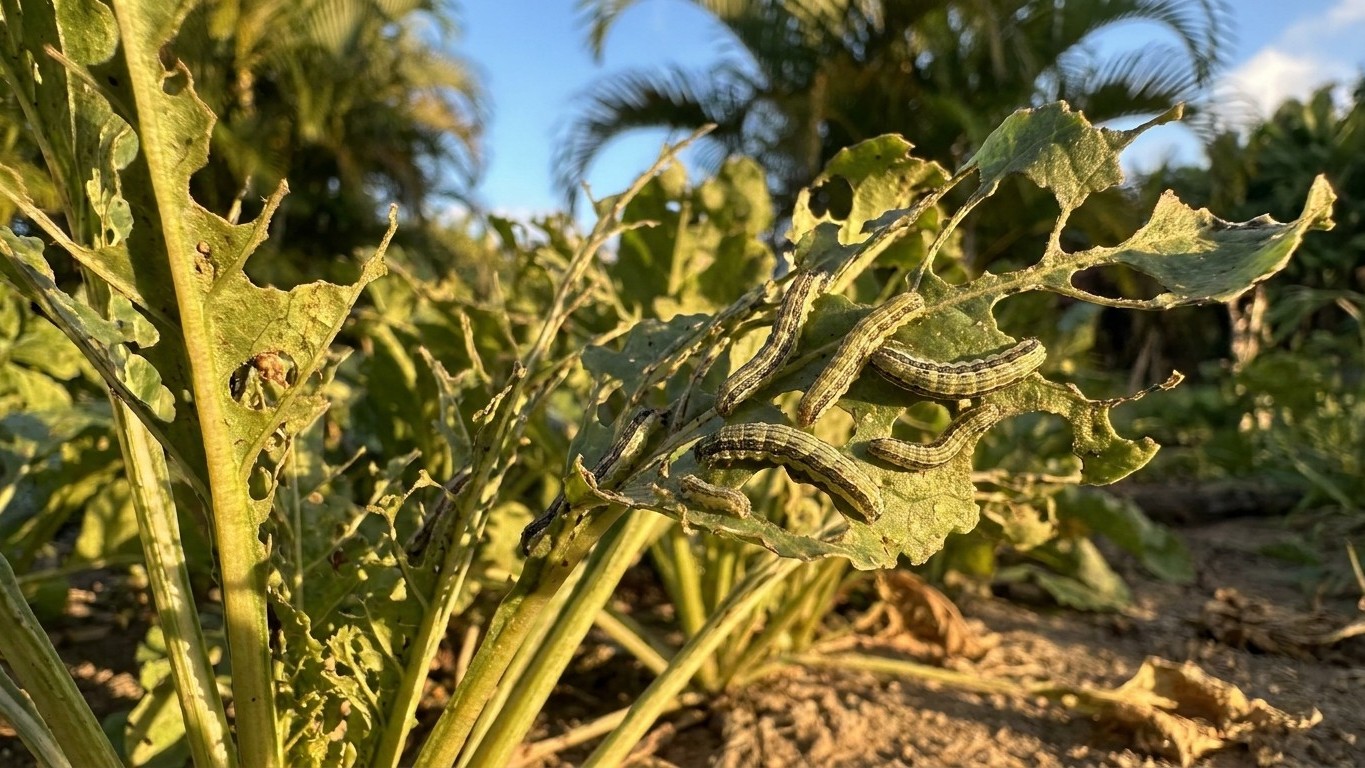

Beet armyworm shows up in Hawaii year-round, not on a seasonal schedule like it does on the mainland. The islands’ warm, frost-free climate lets the moth breed continuously, so the real question isn’t “when” but which weeks of dry, warm weather push populations high enough to strip a garden bed before you notice the first hole in a leaf.
The weeks to watch

The University of Hawaii’s cooperative extension service (CTAHR) does not publish a specific flight-window calendar for beet armyworm the way mainland extension offices do for regions with a hard winter. That absence is itself useful information: without a killing frost to reset the population each year, there’s no single “season” to circle on a calendar. Instead, the general pattern for Spodoptera exigua in tropical and subtropical zones applies directly to Hawaii, and it points to warm, dry stretches as the trigger for outbreaks rather than a calendar date.
Generations overlap constantly
In frost-free climates, beet armyworm can complete a generation in roughly three to four weeks under warm conditions, and because adults, eggs, larvae, and pupae are all present at once in the same field, the population doesn’t build in one clean wave the way it might further north. That overlap is why an infestation in Hawaii can seem to appear overnight: you’re not seeing a single generation hatch, you’re seeing several stages converge during a warm, dry stretch.
Dry spells matter more than months
Heavy rain knocks eggs and young larvae off leaves and can drown pupae in the soil, so extended dry periods, especially on leeward coasts, tend to line up with population spikes. A gardener on the dry side of an island should expect pressure to build faster during rainless weeks than someone gardening on a wetter, windward slope, regardless of what month it is.
Reading the calendar from your last frost

Hawaii has no frost-based planting calendar to read from. NOAA’s 30-year climate data for the islands shows no measurable freeze days in inhabited areas at all, not a late date, not an early one, just none. Frost in Hawaii only happens above roughly 11,000 feet on Mauna Kea, Mauna Loa, and Haleakala, places nobody is transplanting tomatoes. So the arithmetic that works in Ohio or Minnesota, counting weeks forward from a last-frost date, simply doesn’t apply here.
What replaces it is a two-step read on your own microclimate, since beet armyworm answers to soil warmth and moisture, not a frost date:
- Identify your exposure: windward sites (rainier, cooler, more cloud cover) slow larval development compared with leeward sites (drier, hotter, more sun), even a few miles apart on the same island.
- Watch for the first feeding signs two to three weeks after transplanting on leeward, low-elevation ground, since that’s typically when soil and leaf temperatures are warm enough for rapid larval growth; expect that window to stretch longer at higher elevation or on wetter windward slopes.
Treat those weeks as a normal range for your yard, not a guarantee. A gardener at 2,000 feet on Hawaii Island’s Hamakua Coast will see a different pace than one gardening at sea level in Kona, even though both are frost-free.
What it attacks, and what the damage looks like

Most gardeners spot the damage long before they spot the caterpillar. Young larvae feed in groups on the underside of leaves, skeletonizing them into a papery, lace-like webbing that’s easy to mistake for wind damage or a fungal issue at first glance. As larvae mature, they scatter and chew ragged, irregular holes straight through leaf tissue, and on fruiting crops they’ll bore directly into the fruit itself, leaving a small entry hole that hides a much bigger cavity inside. The larval stage does essentially all the visible damage; adult moths only lay eggs and don’t feed on plant tissue, which matters because any control aimed at adults won’t stop feeding already underway.
Crops most commonly hit in Hawaii’s home gardens include:
- Beets and other leafy greens like chard and spinach
- Tomatoes, where larvae tunnel directly into ripening fruit
- Peppers and eggplant
- Sweet corn, particularly around the ear tip
- Beans and other legumes
Because young larvae feed together in a cluster before dispersing, an early infestation often looks worse than it is, one skeletonized leaf can mean a single egg mass, not a garden-wide outbreak. That’s the window where hand removal still matters most.
How Hawaii sits in this pest’s range

Beet armyworm is one of the more widely distributed caterpillar pests in the world, established across tropical, subtropical, and warm temperate regions on nearly every continent where warm-season vegetables are grown. In that context, Hawaii isn’t an edge case or a marginal outlier, it’s squarely inside the core of the range this insect prefers, since it thrives in exactly the warm, frost-free, agriculturally active conditions the islands provide year-round.
What separates Hawaii from a mainland state isn’t presence or absence, it’s the absence of a dormant season. In a state with real winters, beet armyworm dies back or overwinters in a reduced state, then rebuilds each spring, which naturally caps how many generations occur in a year. Hawaii skips that reset entirely. Populations can persist and reproduce continuously, which means growers here manage the pest as a constant background presence rather than a seasonal visitor that arrives and departs on a schedule.
What actually works against it

Cheapest, lowest-effort measures come first, and each one has a real mechanism, and a real limit, worth understanding before you rely on it.
- Stagger and rotate plantings. Avoid putting the same host crop in the same bed back to back. Continuous overlapping generations mean a field that’s hosted larvae once is likely to host the next wave too, so breaking that continuity by rotating to a non-host crop denies the next generation an easy target.
- Inspect the undersides of leaves weekly. Egg masses appear as small, fuzzy, whitish clusters. Crushing or removing an egg mass before it hatches eliminates dozens of future larvae in one step, and this works only before hatching, once larvae disperse across the plant, hand-picking becomes far less efficient.
- Use floating row covers on young transplants. A physical barrier keeps egg-laying moths off the plant entirely during its most vulnerable early weeks. This stops being useful the moment flowering crops need pollinator access, or once larvae are already established underneath the cover.
- Clear plant debris and weedy hosts after harvest. Pupae often survive in soil litter and on weedy alternate hosts nearby. Removing that debris cuts down the local population that would otherwise emerge to attack your next planting, though it does nothing for larvae already feeding inside a stem or fruit, at that point the damage is already committed.
- Encourage natural predators and parasitic wasps. Many gardeners report fewer outbreaks in beds with diverse plantings that support beneficial insects, though controlled trials on how much this reduces damage in home garden settings are limited and don’t offer a precise number to plan around.
Once larvae have tunneled into a tomato or corn ear, none of these measures reverse the damage already done, the value of every step above is in preventing that entry point in the first place, not repairing it after the fact.
Common questions
Does beet armyworm ever go dormant in Hawaii?
No true winter dormancy occurs. Without a killing frost, generations continue overlapping through the year, though dry, warm stretches on leeward coasts tend to see faster population buildup than cooler, wetter windward areas.
Can I use a planting date to avoid it entirely?
Not reliably. Since there’s no frost-based calendar in Hawaii and generations overlap continuously, timing alone won’t dodge the pest the way it might in a state with a defined off-season. Exclusion methods like row covers do more work here than timing does.
Is the damage the same on every crop it attacks?
No. On leafy crops like beets and chard, damage shows as skeletonized or ragged holes in foliage. On tomatoes, peppers, and corn, the more costly damage happens when larvae bore directly into the fruit or ear, which is harder to spot early and harder to reverse once it starts.