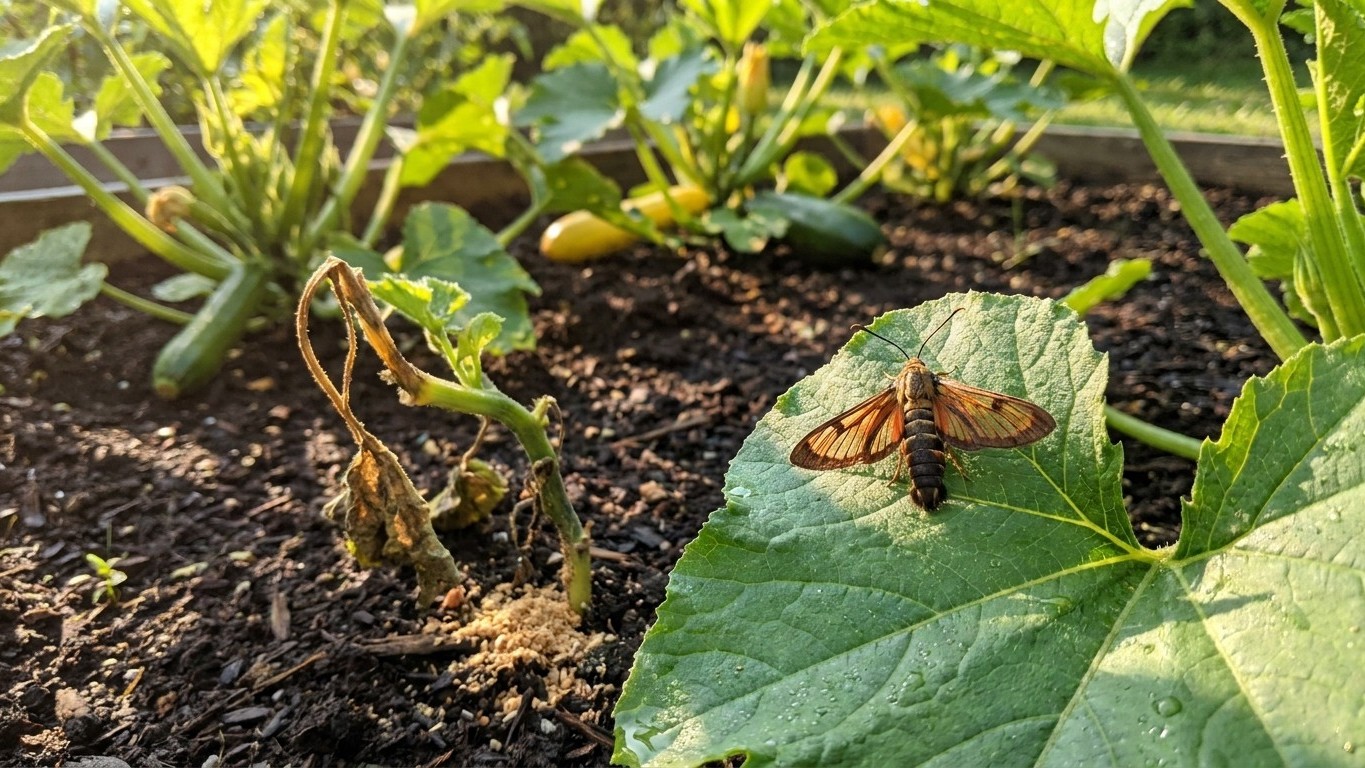

Six pests turn up on Ontario summer squash with any regularity, and the order they arrive in matters more than their names. Striped and spotted cucumber beetles hit seedlings first, squash vine borer moves in a few weeks later, and squash bug, aphids, and spider mites build through the hottest stretch of summer. Knowing the sequence tells you what to watch for and when.
Which pests attack summer squash in Ontario

Two Canadian and cross-border extension sources anchor what’s documented here: the Cornell University CALS Insect Diagnostic Laboratory, MSU Extension Bulletin E3276 on Michigan cucurbits, and Ohio State University Extension (Ohioline). Across that combined record, the pests actually reported on squash and other cucurbits are striped cucumber beetle, spotted cucumber beetle, squash bug, squash vine borer, aphids, twospotted spider mite, slugs, cutworms, seedcorn maggot, and European earwig.
That’s a shorter list than the full roster these services track for Ontario gardens overall, and it stays short on purpose. Several documented pests belong to other crops entirely and don’t show up on squash vines. Colorado potato beetle and three-lined potato beetle work the nightshade family, potatoes and eggplant, not cucurbits. Cabbage maggot, imported cabbageworm, and swede midge are brassica specialists. Onion maggot needs onions. Asparagus beetles need asparagus. Apple maggot, emerald ash borer, and viburnum leaf beetle are tree and shrub pests that have nothing to do with a vegetable bed. Japanese beetle and Asiatic garden beetle feed on a wide range of ornamentals and fruit but rarely show up as a primary squash problem in these bulletins. Spotted wing drosophila targets soft, thin-skinned fruit like berries and cherries, not thick-skinned summer squash.
What’s left is a working list of ten, and it splits cleanly by behavior. Cucumber beetles and squash bug chew and pierce leaf tissue and vector disease. Squash vine borer tunnels inside the stem. Aphids and spider mites are sap feeders that build up in heat. Cutworms, seedcorn maggot, slugs, and earwigs mostly attack the vulnerable seedling stage, before the plant has any size to spare. A gardener who only checks mature vines misses the window when four of these ten do their damage.
When each one shows up, and what it does first
Ontario’s frost-free window runs from an average last spring frost on April 30 to an average first fall frost on October 16 at the Toronto Pearson reference station, and that stretch sets the calendar for every pest below. Remember that this is a mean date, not a guarantee. In roughly half of all years the last frost lands later than April 30, so squash going into the ground right at that date still carries risk.
Seedcorn maggot and cutworms are the first problems, arriving as soon as seed goes into cool spring soil or transplants go in the ground. Seedcorn maggot larvae feed inside the seed itself, and the first sign is a gap in the row where nothing came up. Cutworms work a couple of weeks later, once seedlings have stems thick enough to sever; the classic sign is a young plant clipped off at soil level overnight, lying flat with no obvious feeding on the leaves.
Striped and spotted cucumber beetles show up next, often within the first two to three weeks after emergence or Transplant, chewing small round holes in cotyledons and young leaves and clustering in the flowers. This is the stage that matters most, since these beetles carry bacterial wilt, and an infection picked up now can kill the vine mid-summer with no further beetle activity needed. European earwigs and slugs overlap this window on the ground level, favoring damp conditions and ragged, irregular leaf margins rather than the beetles’ round holes.
Squash vine borer moths lay eggs at the base of the stem several weeks into the season, and the first visible sign is sawdust-like frass at the stem’s base, followed by sudden wilting of a single vine while the rest of the plant looks fine. Aphids and twospotted spider mites are the slow builders, showing up as curled new growth and fine stippling on leaf undersides, and they multiply fastest during the hottest, driest stretches of summer. Squash bug follows a similar late-season pattern, with adults and egg clusters on the underside of leaves showing up as vines mature and then causing collapse of individual leaves as feeding continues.
Telling the damage apart from everything else
Squash plants show stress for plenty of reasons that have nothing to do with insects, and mixing them up leads to treating a plant that isn’t being eaten at all. Powdery mildew, uneven watering, and simple nutrient shortfalls all mimic pest damage at a glance, and the details that separate them are usually visible if you look at the right spot.
| Symptom | Looks like | What tells them apart |
|---|---|---|
| Sudden wilting of one vine, plant otherwise healthy | Squash vine borer | Check the stem base for a small entry hole and sawdust-like frass; drought wilt affects the whole plant evenly |
| Round holes in leaves, beetles visible in flowers | Striped or spotted cucumber beetle | Ragged, torn-edge holes without visible beetles point to slugs or earwigs instead |
| Yellowing between leaf veins | Nutrient deficiency (often magnesium or nitrogen) | Pest feeding leaves visible chew marks or insects; a deficiency shows a consistent pattern across the whole plant with no physical damage |
| White powdery coating on leaves | Powdery mildew, not a pest | Wipes off with a finger and returns; no insect feeding is present |
| Wilting during the hottest part of the day, recovers by evening | Ordinary heat and drought stress | Squash bug feeding causes wilting that does not recover overnight |
The one habit that prevents most misdiagnoses is checking the stem base and the leaf undersides before assuming the problem is on the leaf surface. A lot of the real evidence, frass, egg clusters, beetle bodies, sits somewhere the eye skips past on a quick walk through the garden. When a symptom doesn’t match any of the patterns above, that’s the point to bring a photo or a sample to a local extension office rather than guess.
What actually works here, and what is a waste of time
On a growing season bounded by an April 30 average last frost and an October 16 average first frost, timing beats almost everything else. Floating row cover placed over seedlings right at transplant, and removed once flowers open so pollinators can reach the blossoms, blocks cucumber beetles and squash bug adults during the exact weeks they do the most damage. Removing row cover even a few days too late costs the plant its pollination window, since squash needs open flowers and bee visits to set fruit.
Checking stem bases weekly from the point vines start to run, and scraping off any squash bug egg clusters found on leaf undersides, catches both pests before populations build past what a home garden can tolerate. Crop rotation, moving cucurbits to a different bed each year, reduces the overwintering population of striped cucumber beetle and squash bug that would otherwise emerge right next to last year’s vines.
What wastes time is spraying anything on a calendar schedule rather than in response to what’s actually present. Cucumber beetles and squash bugs vector disease or cause direct damage mainly during a narrow feeding window, so treating on a fixed weekly schedule regardless of pest counts burns effort on weeks when nothing is there. Broad, repeated treatments also strip out the predators and pollinators the garden depends on for fruit set, without necessarily hitting the pest at its most vulnerable stage. This site doesn’t recommend specific products or active ingredients; what’s registered for use in Ontario changes, and a provincial extension office is the source that stays current on it.
Where to check this for your own county
Ontario spans a lot of growing conditions, and pest pressure documented at the provincial level doesn’t describe what’s in any one garden. A county along Lake Erie warms weeks ahead of a garden in the Ottawa Valley or further north, and that gap shifts every date discussed above.
The place to check specifics is the Ontario Ministry of Agriculture, Food and Rural Affairs, which maintains current pest monitoring and management guidance for the province. A local county or regional office within that same ministry network is worth contacting directly, since staff there track what’s actually being reported nearby that season, not just what’s documented for Ontario as a whole.
If a pest problem doesn’t match the patterns described here, or damage looks unusual for any of the ten species covered, a sample or clear photo brought to that local office is the fastest way to get an actual identification rather than a guess based on a website. That’s the next step worth taking before reaching for any treatment at all.