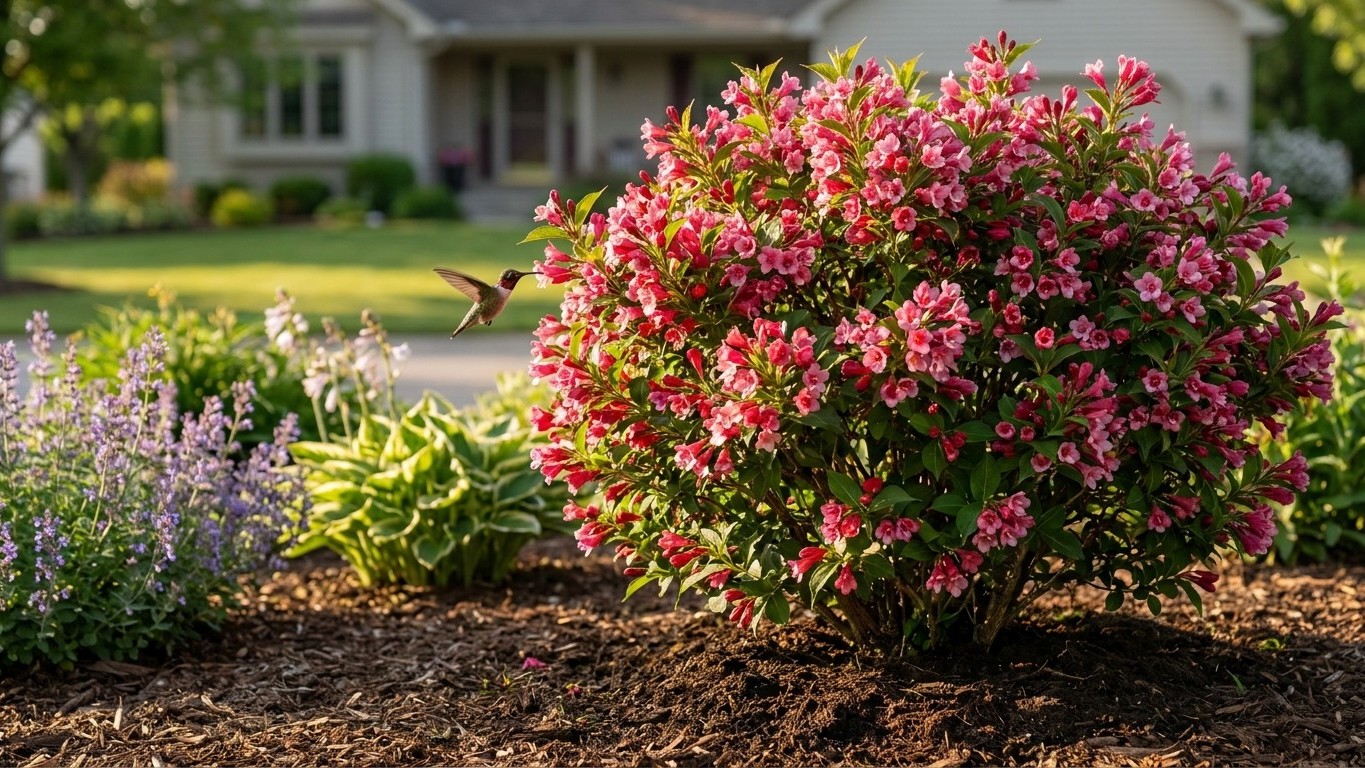

Weigela florida, sold under names like Old Fashioned Weigela or simply Weigela, is a deciduous flowering shrub hardy in USDA zones 4a, 4b, 5a, 5b, 6a, 6b, 8a, and 8b. It takes full sun to partial shade, adapts to clay, loam, or sandy soil, and needs 12 to 24 feet of room once mature. It blooms in spring and summer, draws hummingbirds and butterflies, and asks for low upkeep once it’s settled in. Where you plant it, and when you prune it, matter more than the label suggests.
Where it will and will not survive

The source lists this shrub as hardy in zones 4a, 4b, 5a, 5b, 6a, 6b, 8a, and 8b. Read that list carefully: it’s an enumeration, not a continuous span, and zone 7 (both 7a and 7b) is conspicuously absent. That doesn’t mean the plant is confirmed to die in zone 7, it means the source’s own data has a gap there, and rewriting this as “zone 4 to zone 8” would claim a level of hardiness the source never actually stated. Treat that missing zone as an unknown rather than filling it in with a guess.
What the enumeration does settle is the outer edge. Below zone 4a, winter is very likely to kill the plant outright or cut it back to the ground each year. Above zone 8b, the shrub is outside the conditions this data set covers, and heat and humidity stress become the more likely limiting factor rather than cold.
Survival is not the same as thriving
A shrub rated hardy at the warm edge of its range, zone 8b here, is not necessarily comfortable there. Hardiness zones measure whether a plant can survive the average winter minimum temperature of a region, they say nothing about summer heat stress, humidity, or how vigorously the plant will grow and bloom. A Weigela florida surviving in zone 8b may simply be surviving, not putting on the flush of bloom it would show mid-range. The same caution applies at the cold edge: a plant that makes it through winter in zone 4a may come through diminished, needing a season or two to recover before it flowers well again.
None of this replaces knowing your own zone. Hardiness zones are assigned by county, and two properties twenty miles apart can sit in different zones depending on elevation and local microclimate. Before planting, check your own zone rather than assuming it from a state name or a neighbor’s garden; this site’s hardiness zone guide breaks the USDA map down to that level of detail, and it’s a five-minute check that prevents a shrub from being planted somewhere it was never going to make it through winter.
Light, soil and where it belongs
The source gives a spread of conditions this shrub will tolerate, not a single ideal setup. A plant tolerating full sun and tolerating partial shade doesn’t perform identically in both, only that it will survive and grow in either.
| Condition | What the source lists as tolerated |
|---|---|
| Light | Dappled sunlight (shade through upper canopy all day), full sun (6+ hours direct), partial shade (2-6 hours direct) |
| Soil texture | Clay, loam (silt), sand |
| Soil pH | Acid (below 6.0), neutral (6.0-8.0), alkaline (above 8.0) |
| Drainage | Good drainage, moist |
That range covers most yard soils a homeowner is likely to have, which is part of why this shrub shows up so often as a foundation planting. It doesn’t cover standing water or soil that stays saturated for days after rain: “moist” and “good drainage” both appear on the tolerance list, but soggy, poorly drained ground is a different condition than either.
How it reads from the window and against a fence
The habit is described as arching, dense, erect, rounded, and spreading, depending on the individual plant and how it’s pruned. That combination makes it a shrub you look at, not through, it fills in solidly enough to block a sightline at eye level, making it a reasonable screening plant along a property line, but a poor choice where you want to preserve a view past it. Against a wall or fence, its arching branches reach outward as much as up, so give it distance from siding or fence boards rather than tucking it flush against them.
The 12-to-24-foot space at maturity implies two different spacings depending on the job. Planted as a hedge, spacing plants at roughly half that spread, 6 to 12 feet apart, lets neighboring shrubs knit together into a solid screen within a few seasons. Planted as a single specimen, give it the full 12 to 24 feet of clearance on all sides so it can reach its natural shape without crowding a walkway, foundation, or another shrub.
When it flowers, and what that decides
Bloom time is listed as spring and summer, a window that shifts depending on latitude and elevation. A shrub in a warmer part of its range will flower earlier than the same shrub in a colder zone, and the display can run into early summer in some years. Treat “spring and summer” as the season to expect flowers, not a calendar date to circle.
The more useful fact hiding inside that bloom time is what it means for pruning. Shrubs that bloom on old wood set their flower buds the previous growing season; prune those right after they finish flowering, since pruning them in late winter or early spring cuts off the buds that were about to open. Shrubs that bloom on new wood set buds on the current season’s growth, so they can be pruned in late winter or early spring, before growth starts, without losing a flower.
Which one is this
The source data doesn’t specify which category this shrub falls into, so don’t take a guess as settled fact. Watch one season instead: if flowers appear on branches that grew the previous year, before much new growth has emerged, that’s a sign of old-wood blooming, and the shrub should be pruned shortly after the flowers fade. If flowers instead appear on fresh growth put out that same spring, the shrub can be cut back before it breaks dormancy. One season of paying attention answers the question more reliably than a rule of thumb applied to a shrub you haven’t watched yet.
Planting and the first two years
Getting a young shrub through its first two seasons matters more than any single planting technique, but the technique still sets the stage.
- Plant in early spring or fall, when temperatures are moderate and the shrub isn’t stressed by summer heat or the risk of hard freeze right after planting.
- Dig the hole wider than it is deep, two to three times the width of the root ball, but no deeper than the root ball itself.
- Set the plant so the root flare, where the trunk widens into roots, sits right at or slightly above grade, never buried.
- Tease out any roots that are circling the root ball; left alone, they’ll keep growing in a circle and can eventually girdle the plant.
- Backfill with the native soil dug from the hole, rather than amending heavily, so roots don’t stay confined to a richer pocket and refuse to spread outward.
- Water deeply right after planting, enough to settle the soil around the roots and eliminate air pockets.
- Mulch two to three inches deep, keeping it pulled back from direct contact with the stems to avoid rot and rodent damage.
The source lists this shrub’s drought tolerance as an Established-plant trait, and that word “established” is doing real work. A shrub planted this spring has no deep root system yet; it depends on regular watering through its first two summers regardless of what the mature plant can handle later. Skipping that because the label says “drought resistant” is one of the more common ways a new shrub fails.
Expect the plant to sulk somewhat in year one, putting more energy into roots than visible growth. Year two usually brings noticeably more fill-in, and by year three the shrub is typically performing the way it will for years afterward. A slow first year is normal, not a sign of a dying plant, and digging it up to check the roots usually does more harm than the patience would have.
What it resists, and what it does not
Resistance in a plant description means a tendency to be bothered less by a given problem, not immunity to it. A shrub “resistant” to deer can still get browsed, especially by hungry deer in a hard winter with little else available; a shrub “resistant” to salt can still show damage from heavy or repeated exposure. Treat every resistance claim as a reduced likelihood, not a guarantee.
The resistance data available for this shrub flags deer and salt exposure as relevant categories, though the specific rating for each wasn’t captured cleanly in the source record. That’s worth stating plainly rather than filling in a confident answer that isn’t backed by the data.
| Factor noted | What “resistance” would mean here | What the record actually confirms |
|---|---|---|
| Deer | Less likely to be a preferred browsing target, not deer-proof | Rating not clearly recorded in the source |
| Salt | Tolerates some exposure, such as roadside spray, without dying | Rating not clearly recorded in the source |
Growth rate is listed as medium and maintenance as low, describing a shrub that doesn’t demand constant attention but also isn’t going to fill a gap overnight. Medium growth means it takes a few seasons to reach a size worth pruning hard, and low maintenance means that once established, it mostly needs an annual pruning tied to its bloom timing rather than ongoing feeding, staking, or pest treatment. Combined with the 12-to-24-foot mature spread, that argues for planting it somewhere it can spend years quietly filling its allotted space rather than a tight spot needing constant cutting back.
Common questions
Is Weigela florida deer resistant?
The source flags deer as a relevant resistance factor for this shrub, but doesn’t confirm a specific rating. Treat any deer resistance claim as reduced browsing risk, not a guarantee, deer under pressure will eat plants they’d normally avoid.
When should I prune Weigela florida?
That depends on whether it blooms on old wood or new wood, and the source data doesn’t settle which applies. Watch one bloom season: flowers on last year’s branches point to pruning right after bloom, flowers on fresh spring growth point to pruning before growth starts in late winter.
How far apart should I plant Weigela florida?
For a hedge, space plants at roughly half the 12-to-24-foot mature spread, so branches knit together. As a single specimen, give it the full spread as clearance from walls, fences, and other plants.
Does Weigela florida need full sun?
No, the source lists it as tolerating full sun, partial shade, and dappled sunlight. It will survive and grow in any of these; how full and vigorous the bloom is can vary with the amount of light it receives.