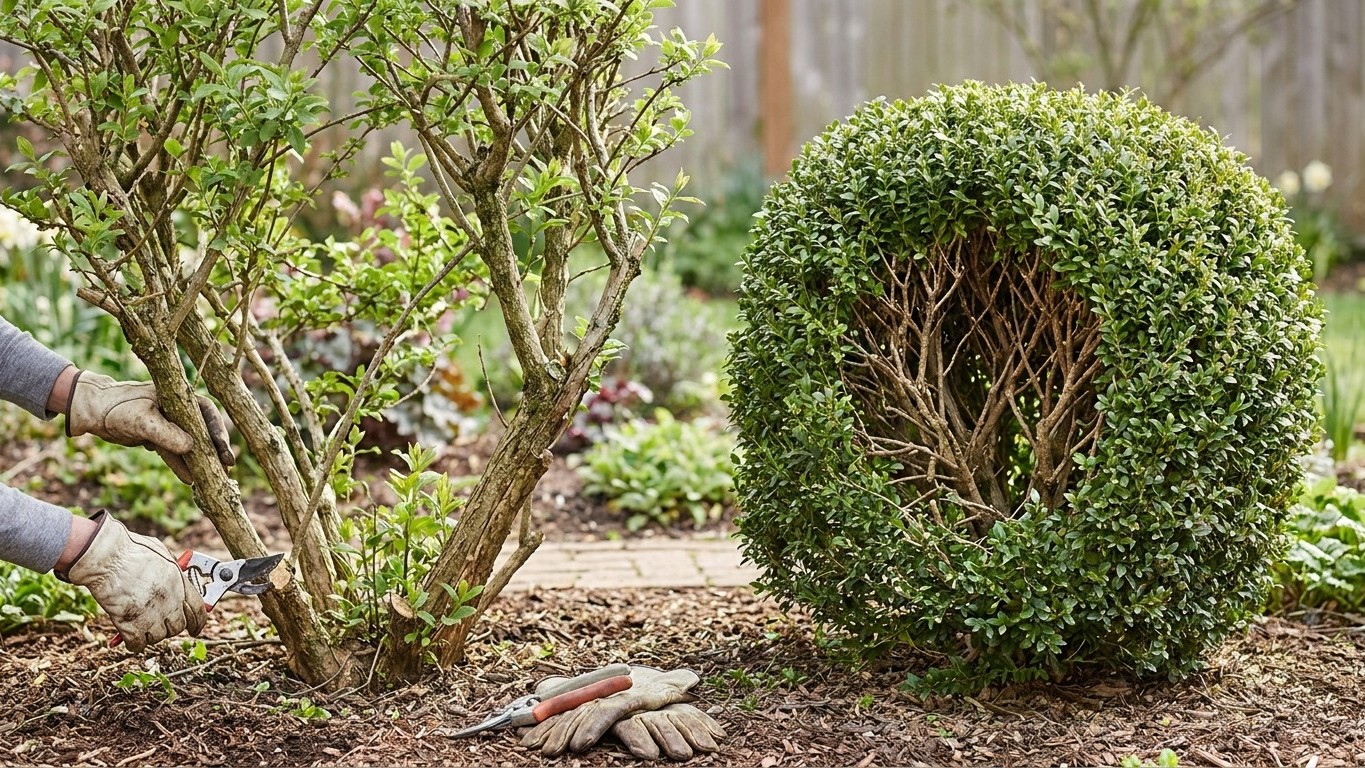

An overgrown shrub isn’t cured by cutting it back once. Renewal pruning removes the oldest, thickest stems at ground level over two or three seasons, letting younger wood take over gradually. The plant never loses all its leaf cover at once, so it keeps feeding itself while it rebuilds. Shearing does the opposite: it cuts the surface and leaves the woody core untouched, which is exactly why so many “pruned” shrubs still look hollow and stiff underneath.
Why shearing makes it worse

Shearing treats a shrub like a hedge, cutting every shoot to the same height regardless of its age or position. The plant responds the only way it can: it pushes new growth from just below each cut, right at that outer surface. Do this every year and the shrub builds a thin shell of leaves and twigs sitting over an interior that gets darker, more crowded, and less productive with every season. Inside that shell, older wood stops putting out new shoots at all. It just sits there, structurally holding the plant up but contributing nothing green.
The problem shows up the day someone decides the shrub needs to come down in size. Cut back into that shell and the saw passes through the leafy surface layer and lands in bare, woody interior. There’s nothing behind the cut to respond. No dormant buds waiting, no green tissue ready to push. The stem just sits there, cut short, dead at the tip, because the plant hasn’t kept any growing points in that zone for years. This is why a shrub that’s been sheared for a decade can’t simply be “cut back hard” the way people expect. The capacity to regrow from that spot was lost gradually, cut by cut, long before anyone noticed.
Renewal pruning avoids this trap by working from the base instead of the surface. Instead of cutting every stem at the same height, it removes entire stems, the oldest ones, all the way down to the ground or to a low framework. Younger stems, the ones still capable of vigorous growth, are left standing. They carry the plant through the transition, keeping enough leaf area to fuel root growth and new shoots while the oldest wood is phased out. Over time, the shrub is rebuilt from stems that still have the capacity to branch and fill in, rather than propped up by a shell of surface growth over dead wood.
The distinction matters because it changes what a cut can accomplish. A cut low on an old stem, at or near ground level, often triggers a strong flush of new growth from the base, because that’s where a shrub keeps its reserve of dormant buds and stored energy. A cut made high on a stem that’s been sheared for years usually doesn’t, because that reserve was never allowed to build up there. Same tool, same size of cut, completely different result, depending on where on the plant it happens and how that spot has been treated over time.
The method, over three seasons
Renewal pruning is less a single technique than a sequence, repeated as the shrub responds. The steps:
- Identify the oldest stems. They’re usually the thickest, with bark that’s rougher, darker, or more deeply furrowed than the smoother, lighter-colored younger growth nearby.
- Remove some of those oldest stems entirely, cutting them off at or near ground level rather than partway up.
- Leave the rest of the plant, including the younger stems and any stems not yet cut, to keep growing and producing leaves through the season.
- Repeat the process the following season, again choosing from what remains the oldest stems still standing, and cutting those out at the base.
Notice what’s absent from that list: a proportion. There’s no rule that says remove a third, or a quarter, or any fixed count of stems per season. The right amount to take is whatever the shrub can lose without stalling out, and that’s judged by looking at the plant, not by running numbers. A shrub with a dense thicket of stems can usually spare more in one pass than a thin, already-stressed one. A gardener who knows the individual plant will read that better than any formula could.
What happens after the cut is the plant redirecting resources. With the oldest, least productive stems gone, the root system that once supported them now feeds what’s left, and new shoots typically emerge from the base near the cuts, often within the same growing season. Those new shoots are usually more vigorous than anything the old growth was producing, because they’re drawing on an Established root system without the burden of the stems that used to soak up part of that energy.
The honest part of this timeline is that it takes longer than one round of cuts. A shrub that’s been sheared into a hollow shell for years typically needs the process repeated across two or three growing seasons before it looks proportioned and full again, not just thinner and shocked. Each season removes another share of the old wood and gives another round of new stems time to fill in. There’s no shortcut that compresses that into a single afternoon of cutting, and a shrub pushed too hard in one pass, with too much of its stem count removed at once, can lose enough leaf area that it struggles to recover at all.
Cutting the whole thing down
Some shrubs don’t need the gradual approach. They can be cut back hard, down to a low framework of stubs just above the ground, and will regrow vigorously from that base in a single season. For a shrub that’s badly overgrown and where the gradual method would take years to fix, this is tempting: one aggressive cut instead of three seasons of partial ones.
But plenty of shrubs won’t respond that way, and conifers in particular generally don’t regrow from bare old wood once it’s been cut back hard. A conifer that’s been cut into the brown, needle-free interior of its own growth usually stays that way permanently at that spot, because it doesn’t carry the same reserve of dormant buds along old stems that many broadleaf shrubs do.
The way to judge which category a shrub falls into isn’t guesswork about the species. It’s what’s visible on the plant itself. Two signs matter:
- Dormant buds low on the old stems, visible as small bumps or swellings along otherwise bare wood.
- Existing new growth already coming from the base of the plant, near the soil line, on its own.
If either of those is present, the shrub has already shown it can regenerate from low on the plant, and a hard cut back to that zone is a reasonable bet. If neither shows up, cutting hard is a gamble, and it’s the kind of gamble that can end with a shrub that simply doesn’t come back from the cut at all.
For a shrub that shows some of these signs but not enough to be confident, there’s a middle path: do the hard cut in stages rather than all at once. Take out a portion of the old stems hard, down low, and leave the rest untouched for a season to see how the plant responds. If new growth appears strongly from the cut stems, the rest can follow the next season. If it doesn’t, the remaining stems are still there, still producing leaves, and the shrub hasn’t been pushed past what it could recover from. This staged version of a hard cutback carries much less risk than committing the entire plant to one aggressive session, and it’s the sensible route whenever the buds and base growth aren’t clearly there to begin with.
Whatever stage of cutting is underway, keep the saw and the ladder apart from any overhead power line, and never operate a saw while standing on a ladder. Reposition the ladder or use a pole tool instead.
When to do it
Timing for renewal pruning follows the plant’s flowering habit, not the calendar. A shrub that blooms on old wood, meaning the flower buds formed the previous season, should be pruned right after it finishes flowering, so the cuts don’t remove the buds that were about to open. A shrub that blooms on new wood, setting its flower buds on the current season’s growth, can be pruned while it’s dormant, well before that new growth starts, without losing a single bloom. Knowing which category a given shrub falls into matters more than knowing what month it is, and that’s covered in more detail on this site’s pruning calendar guide, which walks through both flowering habits and how to tell them apart.
The one seasonal caution that has nothing to do with flowering is frost. Heavy pruning late in the growing season pushes a shrub to put out soft, tender new growth right when it should be hardening off for winter instead. That new growth has thin cell walls and no time to toughen up before temperatures drop, and it’s usually the first part of the plant to die back when frost arrives. This isn’t about missing a bloom season, it’s about handing the plant a wound and a flush of vulnerable tissue right before the season it can least afford either. For the actual frost dates that apply locally, the state-specific page on this site is the place to check, since first and last frost timing varies enormously across regions and renewal pruning scheduled around a national average can land weeks off from what a particular yard experiences.
Between those two considerations, flowering habit and frost timing, most shrubs have a fairly clear window each year when renewal cuts do the least harm and the most good. Missing that window by a little isn’t usually catastrophic for a shrub that’s otherwise healthy, but stacking a hard renewal cut on top of both a lost bloom season and an early frost is the kind of mistake that costs a full year of recovery instead of a few weeks.
Common questions
Will renewal pruning kill my shrub?
Not if it’s done gradually. Removing the oldest stems while leaving younger ones standing keeps enough leaf area on the plant to sustain its roots through the process. The risk comes from removing too much stem volume in a single season, not from the method itself.
How do I tell an old stem from a young one?
Look at thickness and bark texture. The oldest stems are usually the thickest in the clump and have bark that’s rougher, darker, or more deeply furrowed. Younger stems tend to be slimmer with smoother, lighter bark.
Can I renewal-prune a shrub that’s never been pruned at all?
Yes, and it’s often easier than rescuing a sheared one, since an unpruned shrub is more likely to still have dormant buds and base growth along its older stems, which is exactly what makes a stronger response to cutting possible.
What if I already cut it back hard and nothing is regrowing?
Give it a full growing season before assuming it’s gone for good, since some regrowth can be slow to appear. If a stem shows no buds and no green tissue under the bark by the following season, that particular stem isn’t coming back and can be removed.