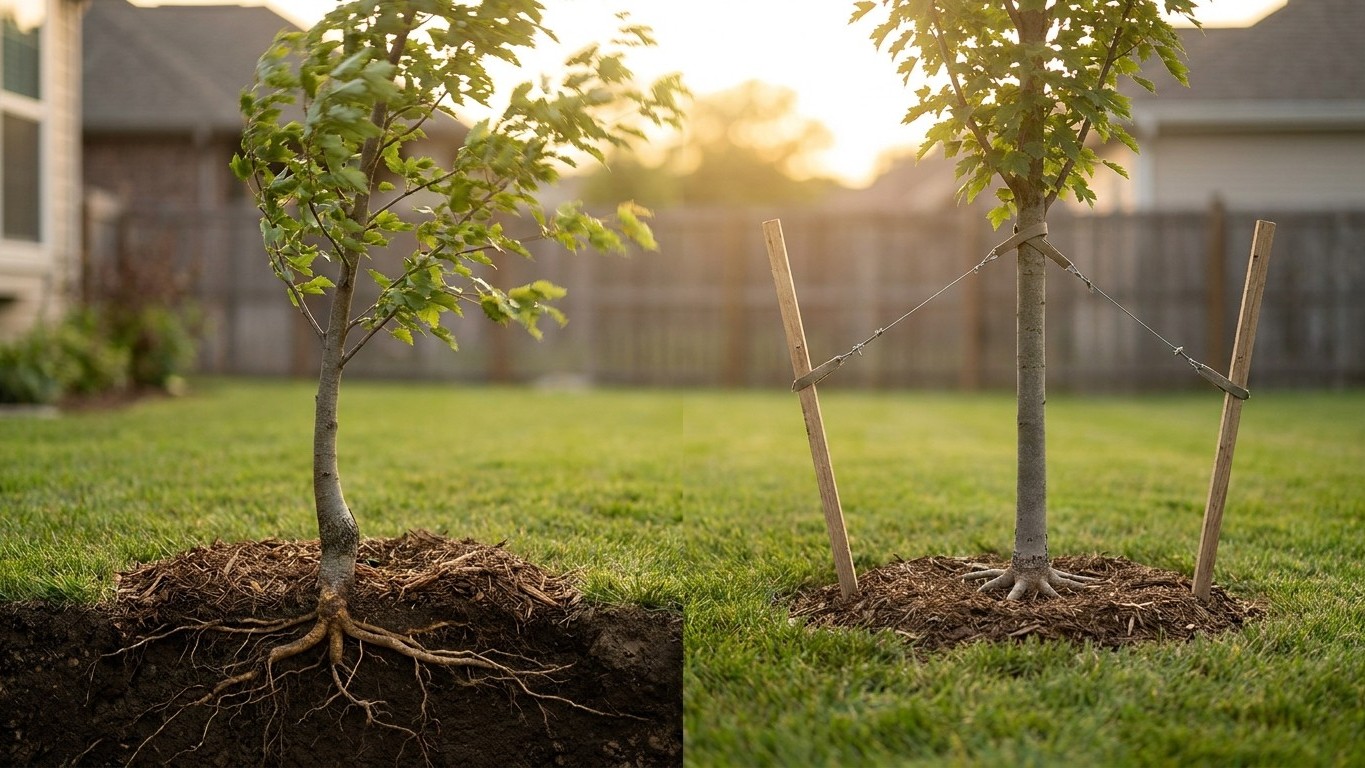

For most young trees, the honest answer is no. A tree left free to sway in the wind develops a stronger, tapered trunk and a root system that anchors itself. Stake it and it skips that lesson. The exceptions are narrow: exposed sites, top-heavy plants, bare-root stock with little root contact, or a spot where foot traffic or equipment will knock the trunk sideways. And if you do stake, the stakes come out fast, usually within a single growing season.
Most new trees do not need it

Here is the mechanism that gets skipped in most advice: a trunk that flexes in the wind triggers a response inside the tree called thigmomorphogenesis, a fancy word for a simple idea. Movement signals the tree to lay down extra wood at the base and taper the trunk so it’s thicker low and narrower high, which is exactly the shape that resists bending. A tree locked to a stake doesn’t get that signal. The trunk grows tall and thin, uniform in diameter, because it never had to hold itself up. Pull the stake later and that trunk often can’t stand on its own, at least not right away.
The root system tells the same story underground. A tree that rocks slightly in wind pushes its roots to spread and thicken in the direction of the strain, building the kind of broad, gripping structure that keeps a mature tree upright through storms. A staked tree, held rigid above ground, has no reason to build that. The roots stay shallow and centered, because the stake is doing the job the roots should be learning to do. This is why a tree staked for two or three years, then released, sometimes falls over in the next stiff wind: it never developed the anchorage it needed.
When staking earns its keep
None of this means staking is always wrong. A few situations genuinely call for it:
- A site with no windbreak at all, where gusts hit the young tree with nothing to slow them
- A top-heavy plant, one with a full canopy on a trunk that hasn’t caught up in girth
- Bare-root stock, which has less root mass gripping the soil than a container-grown tree of the same size
- A spot near a driveway, sidewalk, or mowed lawn, where someone or something is likely to bump the trunk before it’s established
These are judgment calls made by looking at the tree and the site, not by consulting a chart of wind speeds or trunk heights. If the tree stands reasonably steady on its own when you give it a gentle push, it probably doesn’t need a stake. If it flops or the whole root ball shifts, that’s your answer too.
If you do stake it
Staking done badly causes more harm than no staking at all, so the method matters as much as the decision. Each step below exists to solve a specific problem, not just to follow a routine.
- Drive stakes outside the root ball, not through it. A stake pushed into the ball itself can pierce roots that are still trying to establish, undoing the whole point of staking in the first place.
- Attach ties low on the trunk, not high. The goal is to steady the base while leaving the upper trunk and canopy free to flex in wind. Tie high and you recreate the rigid-trunk problem, just with extra hardware.
- Use a broad, soft material for the tie. Wire, twine, or rope concentrates force on a narrow band of bark. A wide strap spreads the pressure and is far less likely to cut in as the trunk moves and grows.
- Leave enough slack that the tree can still sway. A tie should hold the tree upright, not clamp it rigid. If you can’t see any movement at the top of the trunk on a breezy day, the tie is too tight.
One method shows up constantly in yard advice and needs to be retired: running wire through a length of garden hose and looping it around the trunk. The hose is supposed to cushion the wire, but it doesn’t stop the girdling, it just delays it. As the trunk thickens, the wire inside the hose still bites in, and because the hose hides the damage from view, nobody notices until the bark has already been cut. Skip this method entirely and use a proper flat tie instead.
None of the steps above involve counting stakes or measuring heights. The test is simpler than that: the trunk holds its position at the base but can still bend and sway above the tie point. If it can’t, loosen the tie.
Taking it off is the part people forget
Staking gets plenty of attention when a tree goes in the ground. Taking the stake back out gets almost none, and that’s the step that actually causes damage when it’s skipped. A stake left in place doesn’t just sit there harmlessly. The tree starts to depend on it as permanent support, which means the trunk never builds the strength it would have developed on its own. Meanwhile the tie, however soft it started out, becomes a growing problem as the trunk thickens against it year after year.
NC State Extension puts a firm ceiling on how long this should go on: “Remove all staking within one year after planting or growth may be reduced.” That one year is a maximum, not a target, and the same source expects most trees to come free sooner: “It may be possible to remove stakes for fall-planted trees by midspring.” A tree that went into the ground in autumn has often built enough root contact to stand alone well before its first full year is up.
Whether a specific tree is ready doesn’t require a calendar so much as a hands-on check. Two things to look for:
- Push the trunk gently. If it springs back upright and doesn’t lean or wobble at the base, it’s likely ready to stand alone.
- Check the ties for any sign of cutting in. If the strap has started to bite into the bark or disappear into the trunk’s surface, remove it immediately regardless of how long it’s been there.
That second check matters more than the calendar deadline. A trunk that’s been girdled by a tie left too long or tied too tight is often beyond saving. Girdling cuts off the flow of nutrients between the roots and the canopy, and once it’s gone deep enough, the tree above the girdle point can decline and die even though the roots are perfectly healthy. It’s one of the few planting mistakes that’s entirely avoidable and almost entirely irreversible once it happens. Checking the ties takes thirty seconds. Skipping that check is how a well-intentioned stake kills the tree it was meant to protect.
Guys, wraps and the things sold alongside
Stakes aren’t the only hardware sold at the nursery register alongside a new tree, and the same logic that applies to stakes, temporary support with a firm exit date, applies to most of it.
Guy wires for larger transplants
A guy wire system, anchored to the ground at two or three points around the trunk, is sometimes used for a large transplanted tree whose root ball is too big and too heavy for a simple stake to steady. It does the same job as staking, just at a bigger scale, and it should come off on the same schedule: as soon as the tree can hold itself upright under its own root strength, not left in place indefinitely because it’s already there. Guy wires around a tree can also be a real hazard to anyone walking through the yard, so mark them clearly while they’re in use.
Trunk wraps
Trunk wraps go on for a couple of mechanical reasons, mainly to shield thin young bark from direct sun scald and from rodents gnawing at the base over winter. Whatever protection a wrap provides, it works only while it’s on, and it has to come off for the same reason a stake does: bark that stays wrapped too long can trap moisture against the trunk and, like a tie, start to constrict the trunk as it thickens. There’s no solid evidence on how much bark damage a wrap actually prevents in typical yard conditions, so it’s worth treating wraps as a precaution rather than a guarantee.
Sleeves and mulch clearance
Plastic or mesh sleeves serve a similar rodent-deterrent purpose and carry the same removal rule. Mulch plays into this too: NC State Extension advises to “pull mulch 6 inches away from the base of plants to prevent bark decay and vole damage.” Voles tunnel under mulch piled against a trunk and chew bark all winter without being seen, so the fix is as much visual as numerical, the base of the trunk should be visible, not buried in a mound of mulch. Whether it’s a stake, a guy wire, a wrap, or a mulch ring, the pattern repeats: useful for a season, harmful if forgotten.
Common questions
How do I know if my newly planted tree needs staking at all?
Give it a gentle push at the base. If it stands reasonably firm and only the top sways, skip the stake. If the whole root ball shifts or the tree leans hard to one side, it’s a candidate for temporary support.
Can I reuse the same stake and tie for a second tree?
There’s nothing wrong with reusing wooden stakes and straps, provided you check the ties for wear before reattaching them and place the stakes outside the new tree’s root ball just as you would the first time.
What happens if I forget to remove the stake for two or three years?
The trunk likely hasn’t built the taper or root spread it needs to stand alone, and the tie may already be cutting into the bark. Check for girdling immediately, and if the trunk looks compressed or grooved where the tie sits, loosen it right away rather than waiting for a better moment.
Do all newly planted trees need a trunk wrap?
No. Wraps are mainly useful for thin-barked young trees at risk from winter sun scald or gnawing rodents. A tree in a sheltered spot with no rodent pressure often does fine without one, and any wrap that goes on should still come off on the same short timeline as a stake.