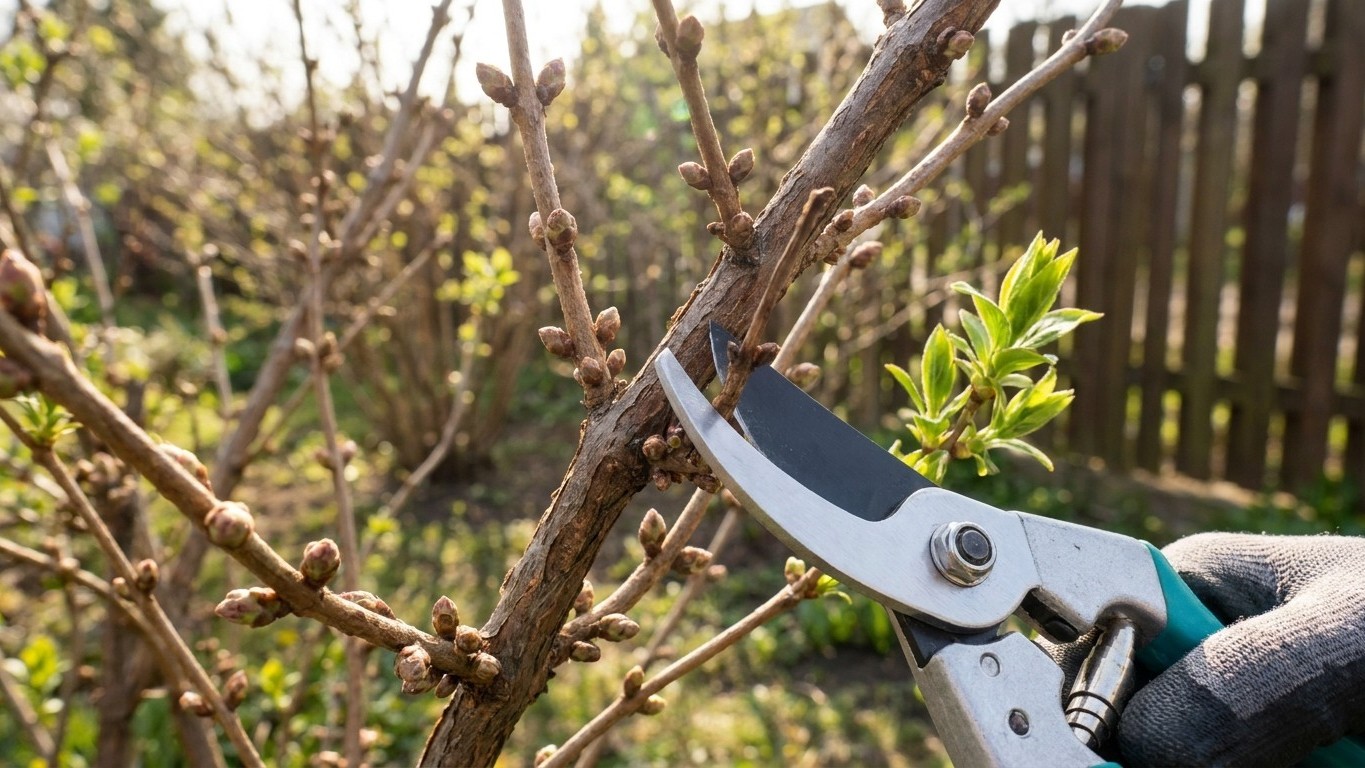

The rule has nothing to do with the calendar and everything to do with where the flower buds are sitting. A shrub that blooms on last year’s growth is carrying its flower buds through the cold months, so cutting it back before it blooms removes the flowers along with the wood. A shrub that blooms on this year’s growth hasn’t formed those buds yet, so it can be cut back hard before it starts growing without losing a single bloom.
The rule is about the flower buds

Every pruning decision on a flowering shrub comes down to one question: did this plant already build its flower buds inside last year’s wood, or does it build them fresh on the stems it grows this season? The answer sorts every shrub into one of two camps, and once you know which camp a plant belongs to, the timing writes itself.
A shrub that flowers on old wood set its buds the previous growing season. Those buds sit dormant on the stems all winter, tiny and easy to miss, waiting for warmth to open. If you prune that shrub while it’s still leafless or just starting to leaf out, you’re cutting off wood that’s already loaded with the flowers you were hoping to see. The fix is simple: wait until the plant has finished flowering, then prune. The plant spends the rest of the season growing new wood, and that new wood is what carries next year’s buds.
A shrub that flowers on new wood does the opposite. It puts out fresh growth as the season warms up, and the flower buds form on the tips of that new growth, opening later in the same season they were built. Because the buds don’t exist yet when the plant is dormant, there’s nothing to lose by pruning before growth starts. In fact, pruning at that point often means more new stems, and since the flowers ride on those new stems, more new stems can mean a fuller bloom.
Put those two mechanics together and you get the rule of thumb gardeners actually use in the field: prune spring-flowering shrubs right after they finish blooming, and prune summer-flowering shrubs before they break dormancy. That’s the whole system. It doesn’t require knowing a species name, a hardiness zone, or a pruning technique. It requires knowing when the plant flowers and matching the cut to that window.
What it doesn’t give you is a month. When “before growth begins” or “right after bloom” actually falls depends on where you live, because a plant that breaks dormancy on a set date in one climate might sit dormant for another six weeks a few states over. That’s a local question, not a species question, and it’s answered by the frost dates listed on your state’s page, not by a generic calendar that assumes everyone gardens on the same schedule.
How to tell which kind you have
Nurseries and plant tags rarely spell out whether a shrub blooms on old wood or new wood. The label might mention height, spread, or hardiness, but bloom timing in relation to wood age is treated as a detail for people who already garden, which means most people find out the hard way, usually by pruning at the wrong time and wondering why the flowers never showed up.
The fix doesn’t require a manual. It requires watching the plant for one season and writing down what you see, in this order:
- Note the date the shrub starts to leaf out in spring, even roughly.
- Note the date it opens its first flowers, and whether those flowers appear on bare or barely-leafed stems, or only after the plant is already fully leafed out.
- If it flowers early, before or right alongside leafing out, that’s a strong sign it bloomed on wood it grew the previous year. Old wood bloomer.
- If it flowers later in the season, on the ends of stems that are clearly new growth put out that same year, that’s new wood behavior.
- Keep the note somewhere you’ll find it again next year. A phone photo with the date attached works fine.
One season of watching settles the question for good, because the behavior repeats year after year. It’s a habit of the plant, not a fluke of one particular spring.
If you’d rather not wait a full growing season, the shortcut is to look up the plant by name. Its bloom season lives on its own page on this site, and bloom season is the detail that tells you which side of the rule it falls on. A plant that’s listed as blooming early in the season, before most other shrubs have leafed out, is almost always working off last year’s wood. A plant listed as blooming in the middle or later part of the season is almost always building its buds fresh that year. The page for the specific plant you’re growing is the more reliable source than a memory of what a similar-looking shrub does, because two shrubs that look alike in the landscape can have completely different bud timing.
The pruning that has no season
Every rule above assumes the shrub is otherwise healthy. Dead, damaged, and diseased wood doesn’t wait for a season, and neither should you. That kind of pruning happens the moment you notice it, whether that’s the middle of winter or the peak of bloom, because leaving compromised wood in place doesn’t protect the plant. It can cost the plant more the longer it sits there, giving decay or insects a foothold that spreads into healthy tissue.
Telling dead wood from dormant wood on a bare shrub in winter is where most people hesitate, but two quick checks settle it. The scratch test: use a fingernail or the blade of clean pruners to scrape a thin sliver of bark off a small section of the stem. Green tissue underneath means the wood is alive. Brown, dry tissue means that section is dead. The snap test backs it up: a live stem bends before it breaks, and the wood inside is pale and moist. A dead stem snaps cleanly and dry, with no give at all, and the wood inside often looks gray or brittle straight through.
Damage from wind or heavy snow looks different from ordinary dead wood. Look for branches that are cracked but still partly attached, hanging at an odd angle, or stripped of bark along one side where they scraped against something as they bent. Splits that run down into the main stem or trunk are worth taking seriously, since a split left in place can widen every time wind moves the branch, eventually tearing further than the original damage.
When you’re cutting out wood you suspect is diseased, rather than just dead or storm-damaged, clean your tools between cuts and between plants. It’s a small habit, but it’s the one that keeps a problem confined to a single shrub instead of spreading it through the whole planting bed on the same blade.
One safety note that applies regardless of season: never prune anything near a power line, and never bring a saw up a ladder. If a damaged branch is tangled in utility lines or too high to reach safely from the ground, that’s a job for a professional, not a weekend project.
The two habits that ruin a shrub
Bud timing explains when to cut. It doesn’t excuse how a lot of shrubs actually get cut, and two habits in particular do more damage over time than pruning at the wrong point in the season ever does.
The first is shearing everything into a tight ball, box, or hedge line, regardless of what the plant naturally wants to do. Shearing cuts the outer layer of a shrub uniformly, which forces a dense flush of new growth right at the surface. That outer shell looks tidy, but it also shades out everything underneath it. Over a few years, the interior of the shrub goes bare, because the leaves that would normally live inside the plant never get enough light to survive. Cut into a sheared shrub and you’ll often find a thin green skin wrapped around a hollow, twiggy core. The shape holds up from a distance and falls apart the moment you look closely.
The second habit is cutting the entire shrub back hard on the same schedule every year, no matter what kind of plant it is or how it actually grows. Some shrubs tolerate that treatment. Many don’t, and repeated hard cuts back to the same point year after year weaken the plant’s structure, produce weak regrowth that’s more prone to breaking, and can eventually reduce flowering instead of encouraging it.
The alternative that avoids both problems is called renewal pruning, and it’s simpler than it sounds. Instead of shearing the outside or cutting everything down at once, you go into the shrub and remove some of the oldest, thickest stems at the base, cutting them off close to the ground, and leave the younger stems in place. The oldest wood is usually the least productive anyway, often the wood that flowers less and grows slower. Taking it out at the base opens up light and space inside the shrub, which encourages fresh stems to come up from the base to replace what you removed. Done on a regular basis, it keeps a shrub full from the ground up instead of hollow in the middle, and it lets the plant keep its natural shape instead of forcing it into a shape it was never going to hold on its own. The full walkthrough of how to make those base cuts, how many to take in a single season, and how to space the work out over a few years lives in the shrub pruning guide on this site.
Common questions
What happens if I prune a spring-flowering shrub too early?
You won’t harm the plant, but you’ll cut off the wood carrying that year’s flower buds, so the shrub will leaf out fine and simply skip its bloom, or bloom only on the parts you didn’t cut.
Is it ever too late to prune a summer-flowering shrub?
Pruning it later in the season, after it’s already put on a lot of new growth, just means you’re removing wood the plant already invested energy into. It’s not harmful, but pruning before growth starts gets more out of the season ahead.
Can I prune a shrub I can’t identify by bloom type yet?
Yes, if you stick to removing only dead, damaged, or diseased wood. That kind of pruning is safe on any shrub at any time. Hold off on shaping cuts until you’ve watched a season and know which wood carries the flowers.
Do all shrubs need the same pruning treatment every year?
No. Some shrubs go years between any real pruning beyond removing dead wood. How often a specific plant needs shaping or renewal cuts depends on its growth habit, which is covered on that plant’s own page rather than a single blanket schedule.