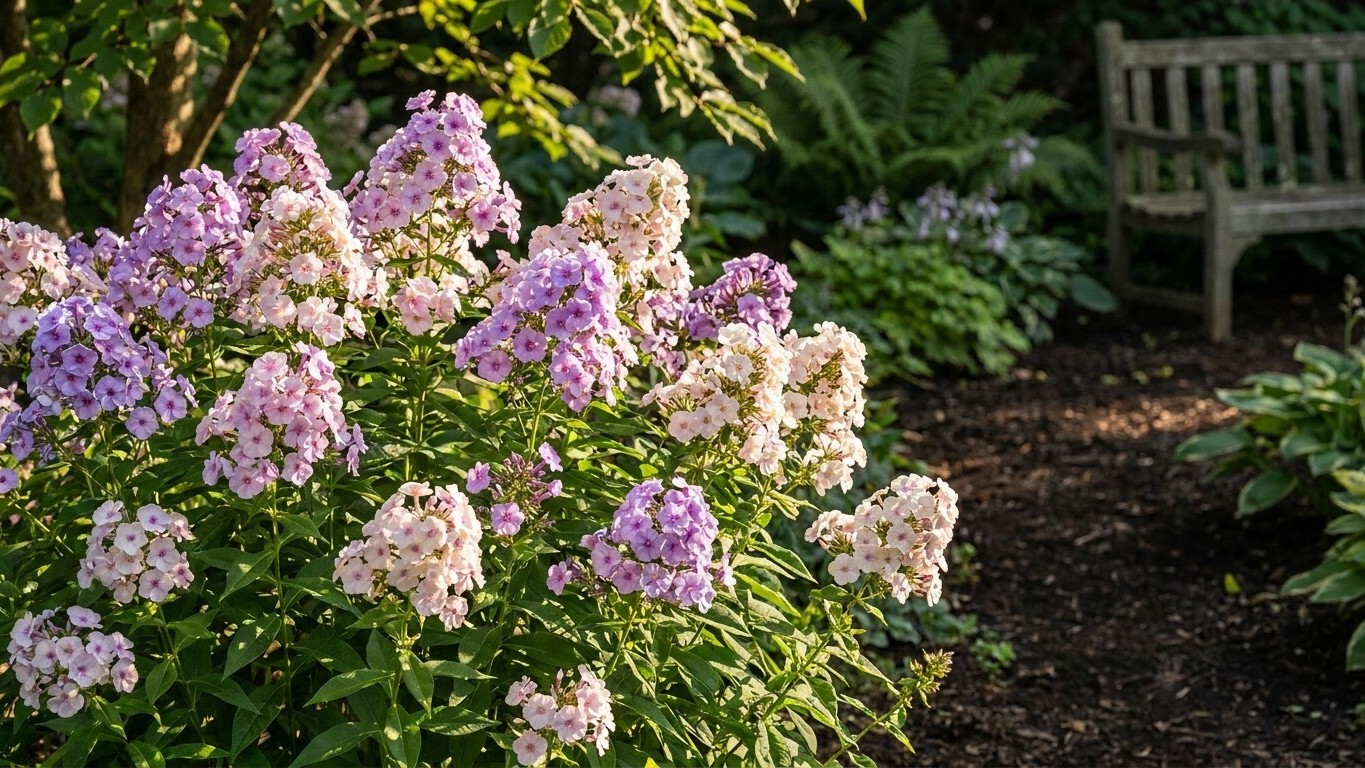

Garden phlox survives winter reliably across USDA hardiness zones 4a to 8b, needs full sun to partial shade in soil that drains well even though it wants steady moisture, blooms through summer for weeks at a stretch, and eventually needs to be dug up and split once the middle of the clump goes bare. That’s the outline. The details are where the trouble usually starts: a bed that drains fine in July but sits wet in February, a clump crowded against a fence three years after planting, or a gardener assuming “native” on a plant label means native to their own backyard.
Where it will and will not survive

The USDA hardiness range for this plant is 4a-8b. That’s the number to work from, and it works in both directions. Below the bottom of that range, winter cold will kill the crown outright in a normal year, not just an unusually hard one. Above the top of it, the plant runs into the opposite problem: summer heat and humidity stress it even when winter cold was never the issue, and it tends to decline rather than thrive.
A hardiness range describes survival, not comfort. A plant rated to the warm edge of its range, 8b in this case, is not necessarily happy there for a full season. It may hang on, flower poorly, or need more water and shade than a plant of the same species grown three zones cooler. The same caution applies at the cold edge. Don’t read 4a-8b as a recommendation for either end of that stretch; read it as the boundary past which the plant simply doesn’t make it through winter or summer.
Zone maps are drawn at the county level, and a single state can straddle two or three zones without much trouble. Rather than guess, look up the actual zone for your county on this site’s hardiness zone guide before deciding whether this plant belongs in your yard at all.
The name on the tag isn’t the only name it goes by
This plant shows up on nursery tags and in catalogs under a handful of names: Autumn Phlox, Cross-leaved Phlox, Fall Phlox, Garden Phlox, Perennial Phlox, Summer Phlox, and Tall Phlox. None of those is the official name, which is exactly why the botanical name, Phlox paniculata, is what identifies the plant with any certainty. Worth flagging directly: “Cross-leaved Phlox” describes a leaf arrangement that doesn’t match the erect, multi-stemmed habit typical of this species, and it’s the kind of common name that sometimes gets attached to a different phlox altogether. If a tag uses that name, check the botanical name printed alongside it before you buy.
The plant is also classified as a Herbaceous Perennial, a Native Plant, and a Wildflower. That “Native” label, sourced from a North Carolina extension database, means native to the southeastern United States specifically, not native across the whole USDA range where it happens to survive. A plant can be hardy several zones beyond where it’s actually native.
Light, soil and drainage
The growing requirements below come straight from the plant’s classification data. Read them as a set of tolerances, not a single ideal condition.
| Condition | Tolerance |
|---|---|
| Light | Full sun (6+ hours of direct sun) or partial shade (2-6 hours) |
| Soil texture | Clay, high organic matter, loam (silt) |
| Soil pH | Acid (below 6.0), neutral (6.0-8.0), or alkaline (above 8.0) |
| Drainage | Good drainage, moist |
That pH tolerance is unusually wide, which takes soil chemistry off the list of things to worry about for most yards. Light is flexible too: full sun produces the fullest flowering, but partial shade is listed as acceptable, not just tolerated as a compromise.
Drainage is the line that actually decides whether this plant makes it through a winter, and it matters more than the hardiness number does. A perennial rated for a cold zone still dies in a bed that stays saturated from November through March, because the crown rots before spring ever gets a chance to test the cold tolerance at all. Frozen, drained soil is survivable. Frozen, waterlogged soil usually isn’t. This is the single most useful thing to know about growing any perennial, and it’s the detail most plant tags never mention.
Testing your own soil doesn’t require equipment. Dig a hole about a foot deep and a foot across, fill it with water, and let it drain once. Fill it again and time how long it takes to empty. If water is still standing after several hours, that spot drains too slowly for a plant that’s listed as needing “good drainage” alongside moisture, and it will need amending with organic matter, raised planting, or a different spot entirely before this phlox goes in the ground.
When it flowers and how long
Bloom time for this plant is listed as summer, which is a season rather than a fixed month, because bloom timing shifts with latitude and elevation. A planting at higher elevation or farther north will flower later in the summer window than the same variety grown at lower elevation farther south, even within the same general hardiness range.
Deadheading, removing spent flower clusters before they set seed, extends the bloom window on many summer perennials by redirecting the plant’s energy back into producing new flowers instead of seed. Once the main flush is finished for the season, cutting the stems back tidies the planting and can encourage a second, lighter round of blooms depending on how much of the season remains.
What’s left after the flowers are gone
Flowering is a relatively short window in a plant’s yearly cycle, and this species is no exception. For most of the growing season, what a gardener actually sees is the habit: clumping, erect, multi-stemmed, and pyramidal in outline, with a medium growth rate that fills in steadily rather than sprawling or spreading aggressively. That upright, structured form is doing the visual work in the border for months before and after the bloom period, which is worth factoring in when deciding where to plant it relative to shorter, earlier-blooming perennials nearby.
The plant is listed as attracting bees, butterflies, hummingbirds, and pollinators generally, and that’s a property of the open flower specifically. Once the bloom period ends and the stems are cut back or fade on their own, that pollinator activity stops with it, since there’s nothing left to attract. Anyone planting this specifically for pollinator support should treat the flowering season as the full extent of that benefit, not a year-round feature of the plant.
Planting, and dividing it later
Getting a new planting established comes down to a short, fairly forgiving sequence:
- Plant in spring or fall, when temperatures are moderate and the new roots aren’t under immediate heat or freeze stress.
- Space plants 12 inches to 3 feet apart, using the wider spacing where soil is rich and the plant is expected to reach its full mature spread.
- Set the crown at grade, level with the surrounding soil surface, rather than buried below it, since a buried crown is more prone to rot.
- Water consistently through the first growing season while roots establish, tapering off once the plant shows steady new growth.
- Mulch around the base to conserve moisture and moderate soil temperature, keeping mulch pulled back an inch or two from the crown itself so it doesn’t smother new shoots.
Unlike a shrub or tree, this perennial doesn’t just sit and grow larger year after year. It eventually needs to be dug up and split, and the signs are visible rather than tied to a fixed number of years. Watch for a bare or hollowed-out center in an otherwise full clump, a noticeable drop in the number of flowers compared to previous seasons, or a clump that has simply outgrown the space allotted to it and is crowding neighboring plants.
Once those signs show up, dividing follows a straightforward process:
- Dig up the entire clump, lifting from well outside the root mass to avoid cutting through healthy roots.
- Separate the clump into smaller sections, using a garden fork, spade, or knife to pull or cut apart natural divisions in the crown.
- Discard the old, woody or hollow center section, keeping only the vigorous outer divisions.
- Replant the divisions at the same spacing used for new plants, setting each crown at grade and watering them in well.
What it resists, and what it does not
Resistance in a plant description means a tendency to shrug off a particular pressure, not immunity from it. A “resistant” plant can still be damaged under high pressure; it just holds up better on average than a plant with no listed resistance at all.
For this species, the classification data doesn’t spell out a specific list of pest or disease resistances. Rather than guess at what isn’t stated, it’s more accurate to work from what the growing conditions do confirm:
| Factor | What the data shows |
|---|---|
| Deer | Not specified in the source data; treat deer pressure as an open question for this particular plant rather than assuming resistance either way |
| Wet soil | Drainage is listed as “good drainage, moist,” meaning the plant tolerates consistently moist soil but still depends on that moisture draining rather than pooling |
That distinction matters because gardeners often conflate “tolerates moisture” with “tolerates standing water,” and this plant’s own drainage listing draws that line explicitly: moist, well-drained soil, not wet, saturated soil.
Maintenance is rated as medium, which in practical hours means this isn’t a plant-it-and-forget-it perennial. Medium maintenance here covers deadheading through the bloom period, cutting the stems back once flowering ends, watering during dry stretches even after establishment, and eventually dividing the clump when the signs above show up. None of those tasks is time-consuming individually, but together they add up to periodic attention across the whole growing season rather than a single spring cleanup.
Common questions
Can garden phlox survive in a colder zone if it’s given extra winter protection?
The 4a-8b range already reflects survival under normal conditions for that range. Extra mulch or winter protection can sometimes buy a small margin at the cold edge, but pushing well below zone 4a isn’t something the hardiness data supports, and reliable survival isn’t guaranteed by protection alone.
Does full sun or partial shade produce better flowering?
Both are listed as tolerated light conditions, but full sun (6 or more hours of direct light) typically produces a fuller flower display than partial shade, since more light generally supports more energy for blooming in full-sun-tolerant perennials.
Is a plant labeled “Native Plant” always native to my region?
Not necessarily. In this case, the native designation comes from a North Carolina extension source and refers to native status in the southeastern United States specifically. A plant can carry that label and still be an introduced or non-native species wherever else it happens to survive within its hardiness range.
How do I know if my soil actually drains well enough for this plant?
Dig a test hole about a foot deep, fill it with water twice, and time the second drain. If water still stands after several hours, the site drains too slowly for a plant listed as needing good drainage, even though it also tolerates moisture, and the bed will need amending or a different location before planting.