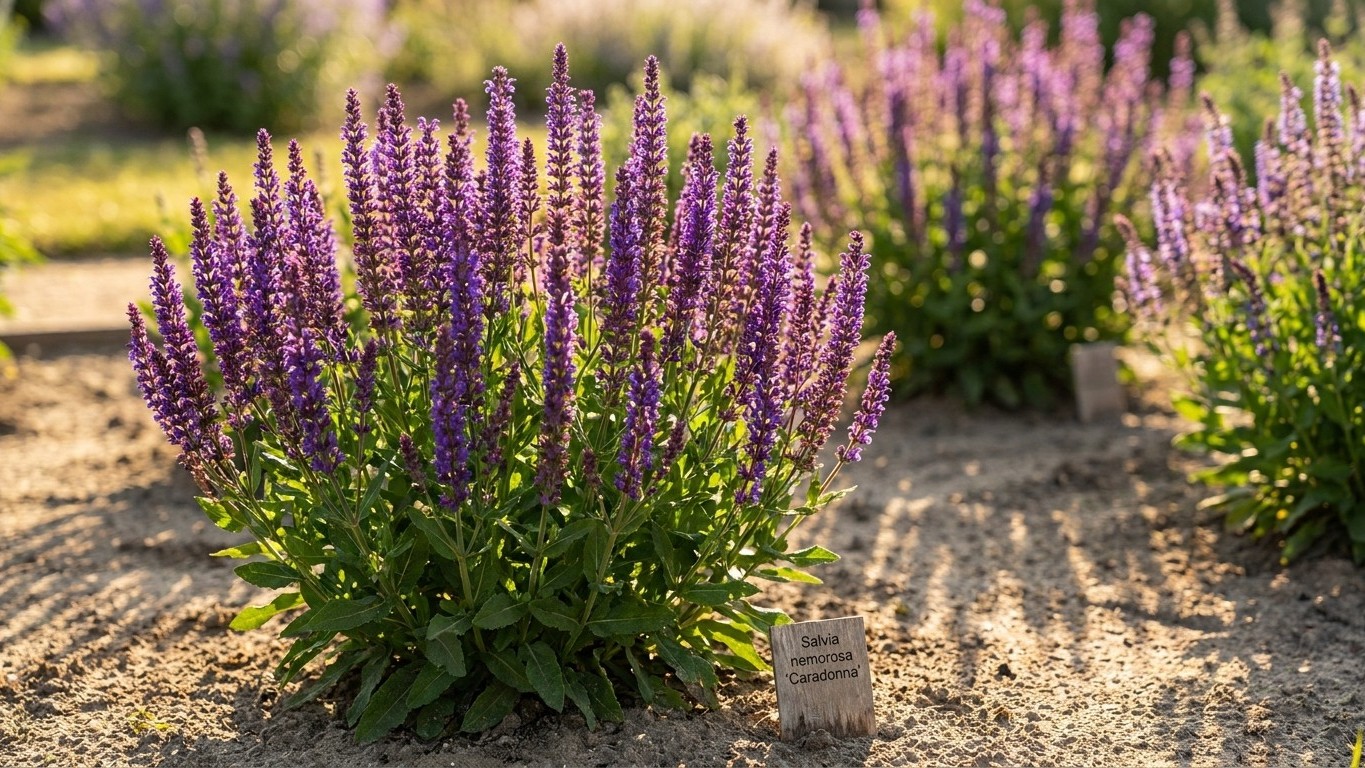

Sold under several names, including Balkan Clary, Violet Sage, and Woodland Sage, Salvia nemorosa is a low-maintenance perennial that does best in full sun with sharp drainage, blooms through summer into fall, and asks for little beyond an occasional shearing and, eventually, a division. It’s hardy across USDA zones 4a-8b, tolerant of deer, rabbits, and drought once established, and compact enough for a border at 12 inches to 3 feet wide. Whether it survives your specific winter, and how it should be planted and split, comes down to a few concrete details.
Where it will and will not survive

The USDA hardiness range for Salvia nemorosa is 4a-8b. That’s a range, which means survival across it, not comfort at either end. A plant that makes it through winter in zone 4a is surviving near its cold limit, not thriving the way it might in the middle of that range, and a plant pushed to the warm edge at 8b isn’t necessarily enjoying the conditions there either. It’s simply within the documented tolerance.
What matters more for planning is what falls outside that range. Below the bottom of it, winter temperatures go past what the plant is rated to take, and the roots don’t come back in spring. Above the top of it, the plant is outside the conditions this hardiness rating was built for, and there’s no documented basis for expecting it to perform as a reliable perennial there. In both directions, the safer assumption is that it won’t hold up as a permanent planting, not that it might get lucky.
The catch is that nobody should guess their own zone from memory. Zone boundaries shift in ways that surprise people, sometimes over a short distance, and a county line can separate two different ratings. Rather than assume where you fall, check your specific zone against this site’s hardiness zone guide before deciding whether this plant belongs in your ground at all. That single check prevents more failed perennials than any amount of soil prep.
One more note on the source behind these growing details: it comes from a North Carolina extension program. The USDA hardiness figures are national and apply everywhere. Any advice tied to that source’s own coastal, piedmont, or mountain regions is specific to North Carolina and shouldn’t be carried over to a different state’s conditions.
Light, soil and drainage
Salvia nemorosa isn’t fussy about soil type, but it is specific about how that soil handles water. Here’s what the growing data actually calls for:
| Condition | What it tolerates |
|---|---|
| Light | Full sun (6 or more hours of direct sunlight a day), or partial shade (2-6 hours of direct sun) |
| Soil texture | High organic matter, sand, or shallow rocky soil |
| Drainage | Good drainage, moist, or occasionally dry |
Notice what’s missing from that drainage row: standing water or heavy, slow-draining clay. For a perennial like this one, winter drainage decides survival more often than cold does. A plant rated hardy to zone 4a can still rot at the crown over a wet winter in soil that never dries out, regardless of how low the temperature drops. Cold tolerance and wet tolerance are two separate questions, and this plant’s rating only answers the first one.
Before planting, it’s worth running a simple check on your own ground rather than assuming your soil behaves like anyone else’s. Dig a hole about a foot deep, fill it with water, and time how long it takes to drain. If water is still standing after several hours, that spot holds moisture longer than this plant wants through winter, and either the site needs amending with coarse material or the plant needs to go somewhere else in the yard. Sandy or rocky soil that drains within an hour or two, even if it’s lean on nutrients, is closer to what this species actually prefers.
When it flowers and how long
Bloom time for Salvia nemorosa spans summer into fall, a season-long window rather than a fixed few weeks. Exactly when that window opens and closes shifts with latitude and elevation, so a garden at higher altitude or farther north will see it start later than one at lower elevation farther south.
Shearing back the spent flower spikes, rather than leaving them to fade on the plant, is the practice that keeps this display going the longest. Cutting the flowering stems back by roughly a third once the first flush fades often encourages a second round of bloom before the season ends. Left uncut, the plant will still flower on its own schedule, but the display tends to taper off sooner.
Outside of that flowering window, which covers most but not all of the year, the plant holds a clumping, erect, multi-stemmed habit, a mounded mass of foliage rather than a showpiece. That’s worth knowing before planting it somewhere it needs to look good every month, since its foliage phase is quieter than its bloom phase.
The flowers are also what draws in bees, butterflies, hummingbirds, and songbirds, and that traffic is tied directly to the blooms themselves. Once flowering stops for the season, that pollinator and bird activity drops off with it rather than continuing on the foliage alone. After bloom, the plant sets its seed in a schizocarp, a dry fruit with four chambers and one nutlet in each, a structural detail rather than anything worth harvesting.
Planting, and dividing it later
Getting a new plant established comes down to a short list of steps that most failures skip:
- Plant in spring once the soil has warmed and can be worked easily.
- Space plants 12 inches to 3 feet apart, matching the mature spread it will eventually reach.
- Set the crown level with the surrounding soil grade, not buried below it.
- Water consistently through the first growing season while roots establish, even though established plants later tolerate occasional dryness.
- Mulch 1 to 2 inches deep, keeping the mulch pulled back from direct contact with the crown to avoid rot.
What separates a perennial like this from a shrub is that it doesn’t just sit there and get bigger. Its clumping habit means the center of the plant eventually ages out, and the signs are easy to spot: a bare or woody patch in the middle of the clump, noticeably fewer flower spikes than in previous seasons, or a plant that’s simply outgrown the space it was given. None of those signs are tied to a fixed number of years, since growth rate varies by site, soil, and climate. The clump itself tells you when it’s time, not a calendar.
When those signs show up, division is the fix:
- Dig up the entire clump, keeping as much of the root mass intact as possible.
- Split it into sections by hand or with a spade, making sure each section has both roots and healthy shoots attached.
- Discard the old, woody center that’s no longer producing new growth.
- Replant the divisions at the same spacing used for new plants, again with the crown at grade.
- Water the divisions in thoroughly, treating them like fresh transplants until they reestablish.
What it resists, and what it does not
Resistance on any plant list describes a tendency, not a guarantee. A resistant plant is less likely to suffer damage than a susceptible one, not immune to it, and that distinction matters most with the two items that decide the fate of many perennials: deer and wet soil.
| Factor | What the resistance means |
|---|---|
| Deer | Less likely to be browsed, not deer-proof |
| Rabbits | Less likely to be eaten, not rabbit-proof |
| Drought | Tolerant once established; new plantings still need regular water |
| Dry soil | Handles lean, dry conditions once roots are in |
| Pollution | Tolerant of roadside or urban air conditions |
Notice that wet, poorly drained soil isn’t anywhere on that list. That absence lines up with the drainage requirement covered earlier: this is a plant built to shrug off dry spells and deer pressure, not standing water at the roots.
The maintenance level is listed as low, which is accurate but shouldn’t be read as no maintenance. Low means an hour or two a season for shearing spent blooms, an occasional cutback of the whole clump, and division once every few years when the signs call for it, not zero hands-on care across the year.
Common questions
Is Salvia nemorosa deer resistant?
It has a reputation for being browsed less often than many other perennials, but resistant doesn’t mean deer will never touch it, especially when other food is scarce.
Does it need full sun to bloom well?
It tolerates both full sun and partial shade, anywhere from 2 to 6 hours of direct sun, though its documented range gives it flexibility most sun-loving perennials don’t have.
How far apart should plants be spaced?
Match the spacing to its mature spread of 12 inches to 3 feet, since that width is what the clump will eventually fill.
How do I know when it’s time to divide?
Watch for a bare or woody center, a drop in the number of flower spikes, or a clump that’s spread past its allotted space, rather than counting years since planting.