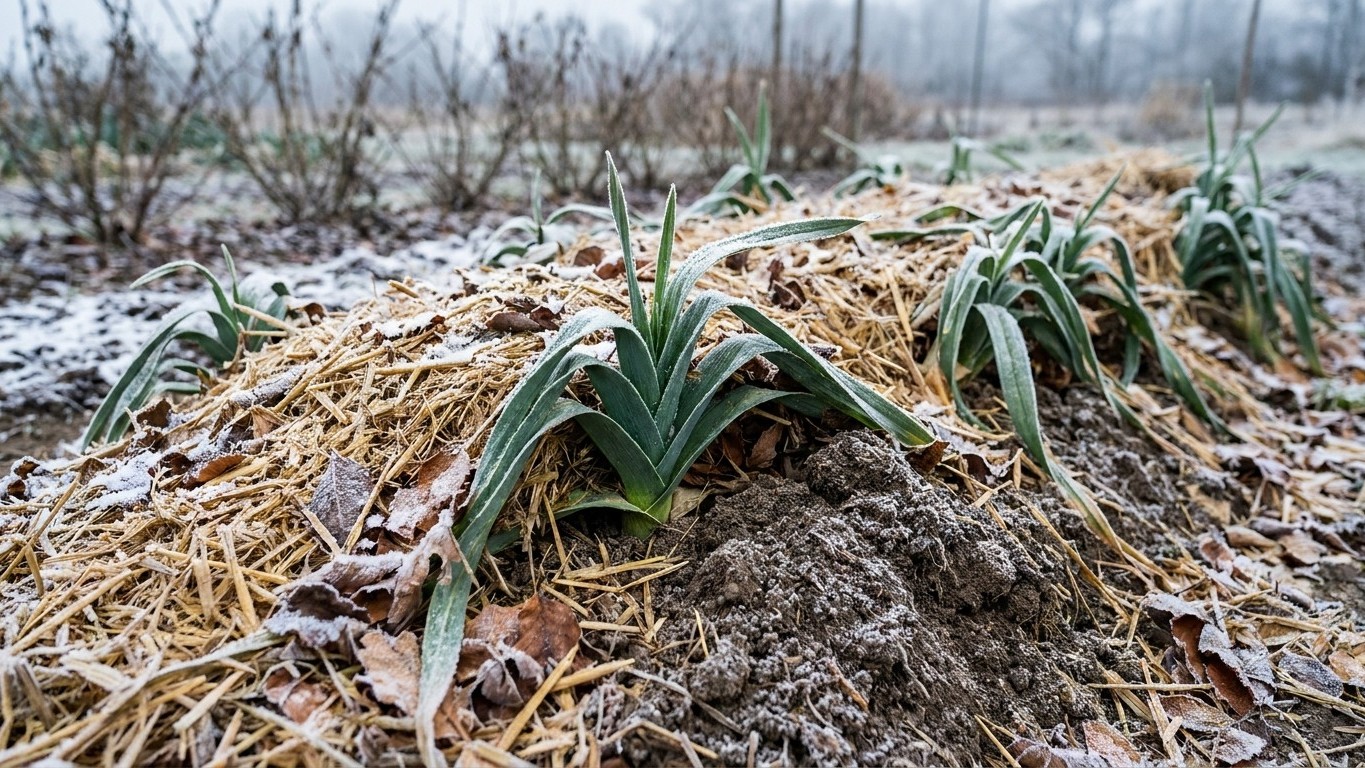

Leeks can stay right where they grew, through the coldest months, with no digging required. Utah State University Extension confirms it plainly: leeks can be overwintered in the garden in most areas by hilling soil around the stalks and burying them under a thick layer of mulch, leaves, or more soil. The ground becomes the root cellar.
The short answer
Yes, in most climates you can leave leeks in the ground all winter and harvest them as you need them. Utah State University Extension states it directly: leeks can be overwintered in the garden in most areas if you hill up the soil around the plants and cover them with a thick layer of mulch, leaves, or soil. That insulation layer is what makes the trick work. Without it, the same leeks would be exposed to freeze-thaw cycles that damage the stalks and make harvest nearly impossible once the ground locks up.
This is the detail that separates a leek from an onion in the garden. Onions get pulled, cured, and stored indoors because their bulbs don’t tolerate sitting in frozen soil. Leeks, with their long fibrous sheath instead of a bulb, handle cold soil just fine as long as they’re insulated from the worst of it. The garden itself becomes the storage container, and you pull stalks fresh through winter the same way you’d reach into a pantry.
There’s a regional limit, though. In very cold areas, the extension recommends a different approach: harvest the leeks before the ground freezes solid, then store them in cold, humid conditions, between 32 and 40 degrees Fahrenheit, packed in wet sand to minimize moisture loss. That’s essentially a root cellar substitute for gardeners in climates where the soil itself won’t stay workable all winter. If you can still push a trowel into your garden bed in January, in-ground storage is likely your best option. If your ground turns to concrete for months at a time, dig first and store in sand instead.
Either method traces back to the same source guidance from Utah State University Extension’s leek-growing publication. There’s no separate trick for warm-winter states versus cold ones. It’s the same two options, and your local frost severity decides which one applies to your garden.
What actually decides it

The insulation layer does the work
Nothing about leeks surviving winter is automatic. The result is manufactured, not grown. Hilling soil up around the base of the stalk buries the tender growing point below the frost line, and the mulch or leaf layer on top acts as a buffer that slows how fast cold penetrates. Remove that buffer and the same plant in the same climate zone can suffer real damage. Add it, and the plant rides out temperatures that would otherwise kill exposed growth. The leek isn’t naturally frost-proof; the gardener is building a shield around it.
Soil as a thermal battery
Soil below the surface holds heat far longer than the air above it, which is why burying anything, whether it’s a leek stalk or a water pipe, protects it from air temperature swings. A thick hill of soil plus a mulch cap traps that residual ground warmth and slows moisture loss around the stalk. This is a physical process, not a variety trait. Utah State University Extension names three leek varieties commonly grown in home gardens (Large American Flag, Comanche, and King Richard) but assigns no hardiness rating, days-to-maturity figure, or cold tolerance number to any of them individually. The overwintering method works the same way regardless of which variety you planted.
Climate severity sets the ceiling
There’s a threshold where insulation alone can’t keep up. In regions where the ground freezes deeply and stays frozen for extended stretches, no amount of mulch will keep the soil workable enough to dig a leek out in February. That’s the line between the two approaches: hill-and-mulch for most areas, harvest-and-store in wet sand for the very cold ones. The decision isn’t about the plant’s genetics. It’s about how hard and how long your local ground freezes.
How to do it
- Grow the leeks to full size first. They need 100 to 120 days from seeding to mature, though they can technically be harvested as early as 60 days. Count backward from your area’s average first fall frost date using that 100-to-120-day window to figure out roughly when your stalks should reach full size before winter insulation goes on.
- Check stalk diameter before you plan for winter storage. Utah State University Extension considers leeks ready to eat once the stalks reach about 1 inch in diameter. Thinner stalks can still overwinter, but they won’t be at peak size.
- Hill soil up around the base of each plant, mounding it against the stalk the way you would with potatoes. This buries the lower portion below the surface and gets it started toward the frost line.
- Add a thick layer of mulch, dry leaves, or additional soil over the hilled rows before the ground begins to freeze in your area. The thicker the layer, the more insulation value it provides.
- In regions where winters turn severe and the ground freezes solid for long stretches, skip the in-ground wait and harvest before that freeze-up happens instead.
- Pack harvested leeks in wet sand and hold them in cold, humid conditions between 32 and 40 degrees Fahrenheit if you’ve chosen the harvest-and-store route.
- Pull leeks from the mulched rows as needed through winter if you’re using the in-ground method, replacing the mulch cap after each harvest to keep the remaining plants insulated.
What goes wrong

- Mulch layer too thin. A light scattering of leaves looks tidy but doesn’t insulate much. Skimping here is the single most common reason overwintered leeks get damaged by cold. The remedy is simple: pile it on thick, whether it’s mulch, leaves, or extra soil, following the same guidance Utah State University Extension gives for hilling and covering.
- Waiting too long to harvest in a hard-freeze climate. If the ground freezes solid before you dig, the leeks become unreachable until a thaw, and by then quality may have suffered. The fix is to harvest before that freeze-up and switch to storing the stalks in wet sand at 32 to 40 degrees Fahrenheit instead of relying on in-ground access.
- Harvesting stalks that are still too thin. Pulling leeks before they’ve bulked up gives you a disappointing, spindly result. Let stalks reach roughly 1 inch in diameter before counting them as ready, whether you’re eating them fresh or setting some aside for winter.
- Rows planted too close together. Crowded leeks compete for space and don’t size up well, which shrinks your usable winter supply. Planting 3 to 6 feet of row per person, per Utah State University Extension’s spacing guidance, gives each plant room to form the 6-to-8-inch sheath it’s capable of producing.
Common questions
Do leeks actually need to be dug up before a hard freeze?
Only in very cold regions where the ground freezes solid for extended periods. Utah State University Extension recommends harvesting first and storing the stalks in cold, humid conditions (32-40 F) packed in wet sand in those areas. Everywhere else, hilling and mulching in place works.
How thick should the mulch layer be over overwintered leeks?
The source doesn’t give an exact depth, only that it should be “thick.” The practical takeaway is to err on the generous side, since a mulch layer that’s too thin is the most common reason overwintered stalks suffer cold damage.
Can I still harvest leeks throughout winter if they’re left in the ground?
Yes. That’s the entire point of hilling and mulching. You pull stalks from the mulched row as needed, then replace the mulch cap over the remaining plants so they stay insulated until your next harvest.
How many leeks should I plant if I want some for winter?
Utah State University Extension recommends 3 to 6 feet of row per person, with each seed or transplant yielding one sheath roughly 6 to 8 inches long and 1 to 2 inches wide. Plant on the higher end of that range if you’re counting on some for winter harvest.