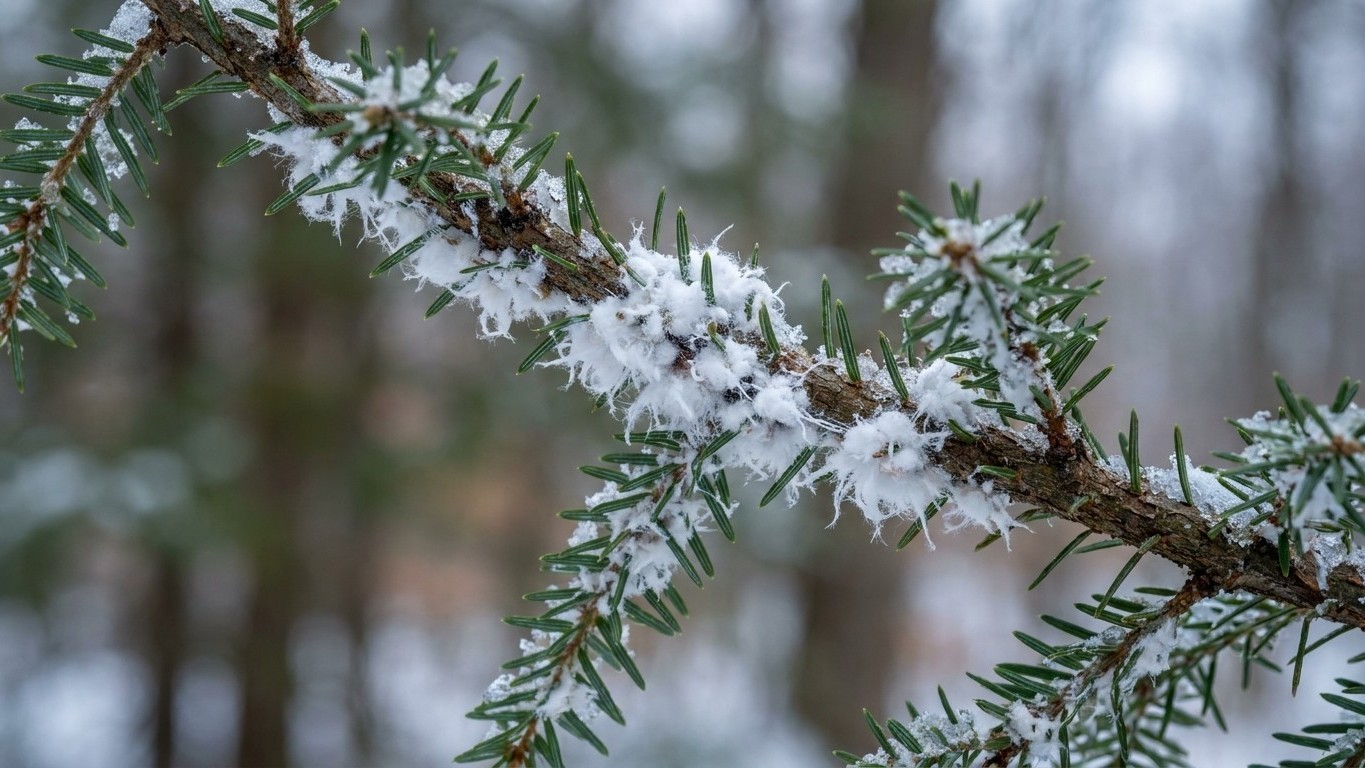

Hemlock woolly adelgid doesn’t follow a garden calendar. In North Carolina, this insect stays active on eastern and Carolina hemlocks nearly year-round once it takes hold, showing up as white, woolly masses that persist through every season rather than in one short window. NC State Extension doesn’t publish a specific outbreak date for it. Stopping it comes down to inspection, pruning, and keeping the tree healthy enough to outlast the feeding damage.
The weeks to watch

NC State Extension keeps a season-by-season pest calendar for North Carolina gardens, but hemlock woolly adelgid isn’t on it: that calendar tracks vegetable-garden insects like tobacco thrips, tomato fruitworm, and flea beetles, not a scale insect living on evergreen conifers. There’s no published NC State Extension window to quote for this species specifically. What fills the gap is the insect’s own biology, which runs on a different clock than a garden pest tied to planting dates.
Unlike an aphid or thrips that dies back with the first freeze, hemlock woolly adelgid stays put through the cold months, wrapped in the white waxy filaments it spins for protection. An infested hemlock can show those woolly masses in the dead of winter just as easily as in early summer. The insect runs two overlapping generations a year instead of one clean cycle, so a tree that checks out clear in spring can still pick up new crawlers later that same year.
The overwintering generation
One generation matures through the colder months, feeding at the base of the needles while the tree is otherwise dormant. This is often when the woolly masses stand out most, against bare winter branches.
The spring generation
A second generation develops as temperatures climb and new needle growth flushes out, giving young crawlers fresh tissue to settle on. This is the generation most likely to spread to a neighboring branch or tree, since crawlers move for only a short window before they anchor down for good.
Reading the calendar from your last frost

North Carolina gardeners plan around one date more than any other: the last spring frost, which falls between March 23 and April 5 in the Charlotte area, per NOAA’s 1991-2020 climate normals. Hemlock woolly adelgid doesn’t answer to that date the way a transplanted tomato seedling does, since hemlocks are perennial trees, not something planted and pulled up each year. But the frost window still marks something useful: it’s roughly when hemlocks break winter dormancy and put out new needle growth, exactly the tissue the season’s second crawler generation needs to settle on.
That relationship gives homeowners a rough sequence to work from, even without an exact date for the insect itself:
- Note your local last-frost window. In the Piedmont around Charlotte that’s late March into early April; the Blue Ridge Mountains run several weeks behind that, and the coastal plain runs ahead of it.
- Time a hemlock inspection to the new-growth flush that follows, rather than to a fixed calendar day, since an early or late spring shifts that flush by roughly the same amount.
The mountains matter more here than the frost date alone suggests. Eastern and Carolina hemlock stands concentrate in the cooler, higher elevations of western North Carolina, where spring arrives later and stays cool longer, so the practical inspection window there lags behind what a Piedmont homeowner would use.
What it attacks, and what the damage looks like

The first sign is rarely the insect itself. Homeowners usually notice a hemlock’s needles turning a dull grayish-green, thinning from the inside of the canopy outward, or branches dying back starting at the bottom of the tree and working upward over a season or two. Only on closer inspection, turning a twig over to check the underside of the needles, does the insect show up: small, round, white woolly tufts clustered at the base of each needle, resembling bits of cotton or spider silk caught on the branch.
Those woolly masses are ovisacs, the protective covering the insect spins around its eggs, not the insect’s body itself. The actual feeding damage comes from the nymphs, called crawlers while they’re still mobile, which insert piercing mouthparts into the base of the needle and stay there once settled, cutting off the tree’s ability to move stored nutrients into its foliage. Adults barely move once settled, which is why the visible wool tends to hold its spot on a branch rather than spreading evenly across the whole tree at once.
Only two host trees in North Carolina carry this pest in any meaningful way:
- Eastern hemlock (Tsuga canadensis)
- Carolina hemlock (Tsuga caroliniana)
Because the crawler stage is the only one that can still move to new tissue or a new tree, it’s also the only stage where a treatment applied to the outside of the tree has much chance of reaching the insect before it seals itself under its own wool.
How North Carolina sits in this pest’s range

This site currently documents hemlock woolly adelgid in one territory, North Carolina. That’s a narrow footprint by itself, and it says more about how the pest is being tracked here than about where the insect actually lives, since it’s established well beyond this one state across much of the eastern United States wherever hemlocks grow.
Within North Carolina, the pest’s real range follows the tree, not the county line. Eastern and Carolina hemlock are mountain and foothill species, concentrated in the cooler elevations of the Blue Ridge and the western Piedmont, thinning out fast moving east and essentially absent from the coastal plain. A homeowner in Asheville or Boone is gardening in the middle of this pest’s practical range in the state, while one in Charlotte or Wilmington may not have a host tree on the property at all.
The frost-date spread already hints at that same west-to-east divide: the mountains run cooler and later into spring than the Piedmont, and the coastal plain runs warmer and earlier. For a tree pest tied to elevation and host distribution rather than to soil-warming or planting schedules, that geography matters more than any single statewide date could.
What actually works against it

None of these steps require hiring anyone, though a few reach their limit fast once an infestation is heavy or the tree is too tall to treat by hand.
- Inspect regularly. Check the undersides of hemlock twigs each season, especially the older growth near the trunk, since that’s usually where an infestation starts. This costs nothing and catches the problem while it’s still small enough to manage by hand.
- Prune out infested branches. Cutting and destroying branches carrying visible woolly masses removes both the insect and its eggs in one step. This works well on a small, low infestation but stops being practical once wool has spread through most of the canopy.
- Wash crawlers off with a hard water spray. A strong jet of water can dislodge the mobile crawler stage before it settles and anchors itself. It only reaches branches within hose range and does nothing once the insect has settled under its wool.
- Avoid moving firewood or nursery stock from infested areas. Crawlers and egg masses travel on cut branches and transplanted stock, which is how the pest reaches new stands. This prevents new introductions but does nothing for a tree already infested.
- Keep the tree watered through drought. A hemlock under drought stress declines faster once it’s carrying an infestation, since it has fewer reserves to compensate for the nutrient loss. Watering doesn’t remove the insect, but it buys the tree time.
- Apply horticultural oil or insecticidal soap to reachable branches. These coat and smother exposed crawlers and young nymphs on trees small enough to spray thoroughly. They don’t penetrate the waxy wool once the insect is fully settled, and they’re not practical on a mature, forest-sized hemlock.
Biological control is also part of the picture in North Carolina, where predatory beetles that feed specifically on hemlock woolly adelgid have been released in forest settings by state and federal agencies. That’s a landscape-level tool rather than something a homeowner sets up in a backyard, and its effect plays out over years, not a single season.
Common questions
Can hemlock woolly adelgid kill a tree, or just weaken it?
Left untreated, it can kill a hemlock, sometimes within just a few years on a tree already stressed by drought or poor site conditions. Healthier trees can sometimes carry a light infestation longer, but Extension guidance treats this pest as a serious threat to hemlock survival, not a cosmetic problem.
Does hemlock woolly adelgid affect anything other than hemlock trees?
No. It feeds exclusively on hemlock species, specifically eastern hemlock and Carolina hemlock in North Carolina. A homeowner without a hemlock on the property doesn’t need to watch for it, even if other conifers like pines or spruces are nearby.
How is hemlock woolly adelgid different from spider mites on the same tree?
Spider mites leave fine webbing and stippled, yellowing needles, and they’re most active in hot, dry weather. Hemlock woolly adelgid leaves distinct white, woolly tufts at the base of the needles rather than webbing across them, and it stays active through the colder months when spider mite activity drops off.