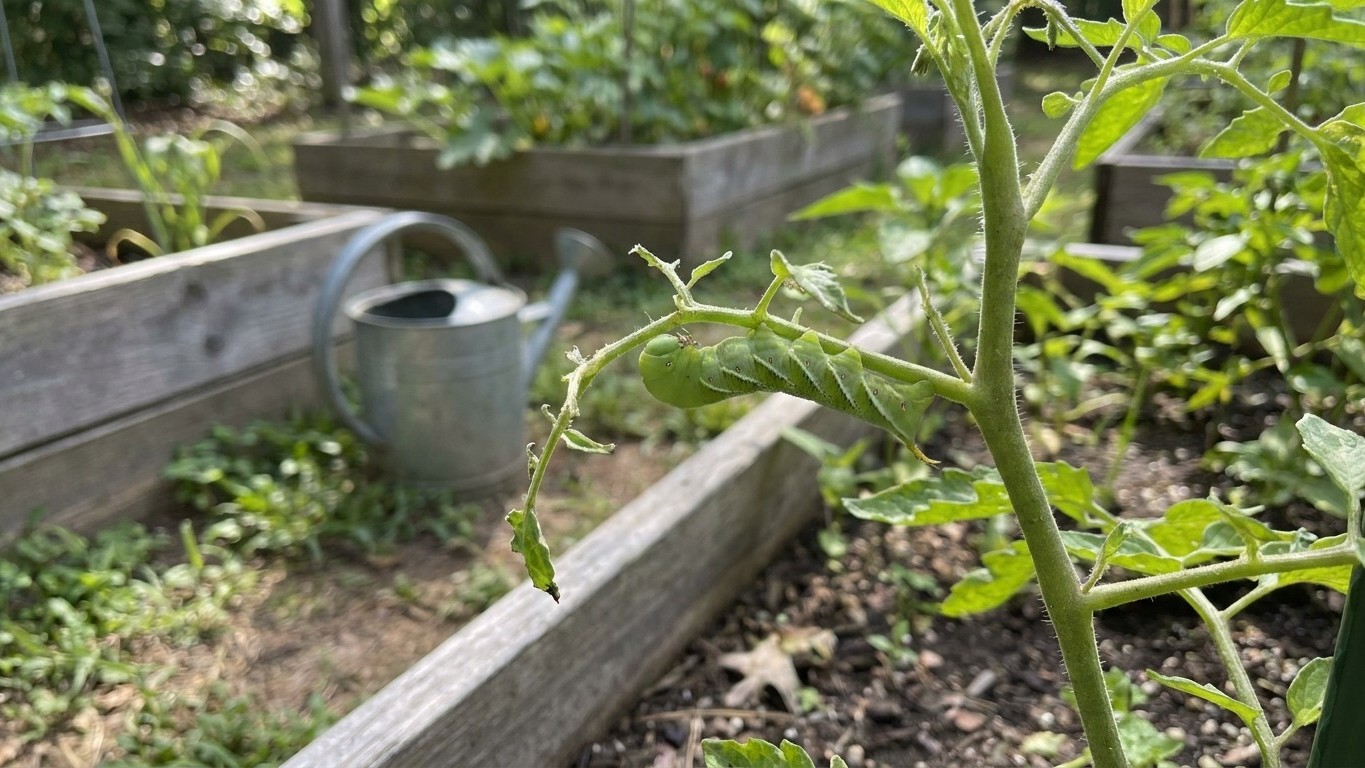

North Carolina gardens deal with a defined list of insects that NCSU Extension’s Extension Gardener Handbook flags as recurring statewide: corn earworm and tomato fruitworm, cabbage looper, imported cabbageworm, striped cucumber beetle, flea beetles, thrips, stink bugs, Japanese beetle, Fall webworm North Carolina and hemlock woolly adelgid. Check under leaves and at the soil line within a week of transplanting, since flea beetles and cucumber beetles are usually the first to arrive.
What North Carolina gardens actually deal with

Long, humid growing seasons let several generations of the same insect build up in a single year, and mild winters mean fewer of them die off before spring. That combination is why the same short list of pests shows up in beds across the state rather than one bad year followed by a quiet one. Many of these species turn up in neighboring states too. See Garden Pests in South Carolina for how the mix shifts once you cross the border.
Flea beetles

Tiny, shiny black or bronze beetles about the size of a pinhead, they jump when disturbed like fleas. Gardeners spot Flea beetles in North Carolina chewing small round holes in leaves, giving foliage a shot-hole look, especially on young transplants of eggplant, tomato and brassicas. The adult beetle does the visible damage. Row cover installed at transplanting keeps them off before they find the bed.
Striped cucumber beetle

About a fifth of an inch long, yellow with three black stripes running down its back and a black head, the Striped cucumber beetle in North Carolina attacks cucumbers, squash and melons as soon as seedlings emerge. Adults chew ragged holes in leaves and can transmit bacterial wilt, which wilts a vine suddenly even when soil moisture is fine. Floating row cover, removed only once flowers need pollinators, is the most reliable defense.
Thrips (tobacco, western flower)

Thrips are barely visible without a hand lens, slender and pale yellow to dark brown, rarely longer than a pinhead. Both tobacco thrips and western flower thrips feed by rasping leaf and petal surfaces, leaving silvery streaks and dark flecks of excrement behind. Western flower thrips also spreads tomato spotted wilt virus, so damage on new growth is worth checking early, before populations build.
Imported cabbageworm

The damaging stage is a velvety green caterpillar, about an inch long with a faint yellow stripe down its back, that chews irregular holes through cabbage, broccoli and kale leaves and burrows into developing heads. The adult is a white butterfly with one or two black spots on each forewing. Handpicking works well on small plantings since the caterpillar is easy to spot against the leaf.
Corn earworm / tomato fruitworm

This caterpillar changes color from pale green to brown or pink as it grows, reaching up to an inch and a half, with faint stripes running the length of its body. It bores directly into corn ear tips and tomato fruit, hollowing out the inside and leaving a ragged entry hole plugged with frass. Once a caterpillar is inside the fruit, spraying the surface does nothing, so scouting fruit early matters more than the product chosen later.
Japanese beetle

Adults are unmistakable once seen: a metallic green body under coppery bronze wing covers, about half an inch long, with small tufts of white hair along each side of the abdomen. They skeletonize leaves, eating tissue between the veins and leaving lace behind, favoring roses, beans and grape leaves in particular. Traps often pull in more beetles than they catch, so knocking beetles into a bucket of soapy water in the cool of morning works better.
Brown marmorated stink bug and native stink bugs
Brown marmorated stink bug is mottled brown and shield-shaped, about five-eighths of an inch, with pale bands on its antennae and legs. Native stink bugs sharing the same beds are similarly shield-shaped but often green or dull brown. Both feed with a needle-like mouthpart, leaving cloudy, corky spots inside tomatoes and pitted patches on beans, and the damage shows up well after the bug has already moved on.
Fall webworm
Late in the season, loose silken webs appear wrapped around the ends of branches on pecan, walnut and ornamental trees, enclosing a colony of pale yellow-green to gray caterpillars covered in fine hairs. The caterpillars feed only within the web, skeletonizing leaves inside it, and the damage usually looks worse than it is on an established tree. Pruning out the webbed branch tip while the colony is still small is the simplest fix.
Hemlock woolly adelgid
This one hides in plain sight. Look for small white, woolly masses stuck to the underside of hemlock twigs at the base of the needles, each about the size of a cotton fragment. The insect itself is a tiny reddish-brown aphid relative that stays hidden beneath that wax. Left alone it feeds season after season and can eventually kill the tree, so it needs ongoing management rather than a one-time spray.
Telling damage apart

Reading the damage correctly, before reaching for anything, decides whether the response is a spray, a barrier, or nothing at all.
- Ragged chewed edges: a caterpillar or beetle feeding at night, worth checking with a flashlight after dark.
- Stippling or bronzing: something rasping the leaf surface, usually thrips or spider mites.
- Small round holes, evenly spaced: flea beetle adults.
- Large irregular holes with veins left behind: Japanese beetle skeletonizing.
- A single vine wilting while the rest of the bed stays fine: bacterial wilt following cucumber beetle feeding.
- Sticky residue with black sooty mold growing on top: honeydew from aphids or thrips, not a chewing pest.
Wilting is the symptom gardeners misread most. A plant that droops in afternoon heat and recovers by morning is dealing with normal moisture stress, not a pest. A plant that wilts and stays wilted, one vine at a time in a cucumber or squash bed, points toward bacterial wilt spread by the striped cucumber beetle. Check the base of the vine and the beetle’s feeding scars before assuming a watering problem, because no amount of extra water brings that plant back.
Disease lesions, nutrient deficiency and pest damage can all leave similar-looking spots to the naked eye once the insect itself has already moved on. A hand lens is worth more than a guess at that point. Send a photo, or the actual leaf, to your county extension office when the pattern does not match anything above.
When each one shows up
A rhythm tied to plant stage, not the calendar
The plant’s growth stage matters more than the date on the calendar, though NCSU Extension’s monitoring from the Charlotte area gives a rough order to expect. Flea beetles show up first, arriving just after transplanting while seedlings are still soft and uncovered, according to NCSU Extension. Tobacco thrips build early too, becoming a concern in April and May, while western flower thrips takes over as the more damaging vector from June into July, spreading virus into pepper and tomato plantings, per the same source.
Once tomatoes, corn and peppers set their first fruit, corn earworm and tomato fruitworm become the priority pest and stay a threat straight through harvest, per NCSU Extension, which makes scouting fruit rather than foliage the better use of time. Aphids, spider mites and stink bugs settle in for the mid-to-late stretch of the season on whatever crop is carrying the most foliage and fruit at that point. Cabbage looper becomes common in August and September, a second wave that hits fall brassica plantings after the spring crop has already finished, per NCSU Extension.
These figures come from monitoring near Charlotte, and gardeners in the mountains or along the coast will see the same insects arrive on a different schedule, since spring warms later at higher elevation and the coast runs on its own microclimate. Start checking two weeks earlier than the schedule above if the county sits west of the Piedmont, since a later frost there shifts planting and every pest’s arrival right along with it. Gardeners gardening in a colder, drier climate altogether, like Nebraska, see this sequence compressed into a shorter window. See Garden Pests in Nebraska for that state’s own timing.
What actually works
Prevention beats intervention on every pest above, and it starts before the first insect appears. Rotating nightshades, cucurbits and brassicas to a different bed each year breaks the life cycle of beetles and worms that overwinter in soil where their host crop grew. Holding cucumber and squash transplants a week or two past the earliest planting window can let a bed miss the first flush of striped cucumber beetles hatching to expect food nearby.
- Floating row cover over brassicas and cucurbits keeps cabbageworm, cabbage looper and cucumber beetle off entirely, removed only once flowers need pollinators.
- Interplanting flowering herbs such as dill and alyssum brings in the parasitic wasps and hoverflies that keep aphid and looper numbers down without a spray.
- Leaving some spent brassica or cucurbit debris for a season lets ground beetles and spiders that overwinter there keep working the bed.
- Handpicking Japanese beetles and cabbageworm caterpillars in the first two weeks of an outbreak keeps numbers from ever reaching the point that needs a spray.
When prevention isn’t enough, targeted intervention matters more than a broad spray schedule. Bacillus thuringiensis, sold as Bt, kills caterpillars such as cabbage looper and imported cabbageworm while leaving bees and predatory insects alone, though it has to be reapplied after rain since it breaks down in sunlight within days. Insecticidal soap and horticultural oil smother soft-bodied pests such as aphids and thrips on contact but do nothing once sprayed on the wrong stage, and they have to actually hit the insect to work at all.
Neem oil and garlic sprays sold as all-purpose pest deterrents do very little against an established infestation of beetles or stink bugs, whatever the label implies, because both break down fast and were never formulated to kill an insect with a hard shell. Pheromone traps for Japanese beetle carry the same problem in reverse: they draw beetles in from well beyond the yard and often leave a garden with more damage than if the trap had never gone up. Read the label on any spray for which life stage it actually kills, since a product aimed at larvae does nothing to an adult beetle already skeletonizing the leaf.
What control costs
The four common approaches trade money for time in different amounts, and none of them is free once the season’s repeat applications are counted.
| Approach | Money cost | Time cost | How often repeated |
|---|---|---|---|
| Hand picking | None beyond a bucket of soapy water | A few minutes daily during an outbreak | Daily while numbers build, then as needed |
| Row cover and barriers | One-time purchase, reused for several seasons | Minutes to install at planting, minutes to lift for pollination | Once per planting, removed at flowering |
| Biological controls (Bt, encouraged predators) | Low, a small bottle of Bt concentrate lasts a season | A few minutes to mix and spray | Every one to two weeks during an active outbreak, or after rain |
| Broad-spectrum sprays | Higher, and ongoing through the season | Mixing and application each round, plus a pre-harvest interval to track | Every seven to ten days through the active window, more with rain |
For a home garden, hand picking and row cover cost the least overall once the repeat applications a broad-spectrum spray needs through a season are added up. Handpicking costs nothing but time and works on a plot small enough to walk daily. Row cover asks for a bigger upfront cost than a spray bottle but pays it back within one season, since the same cover works again the next year over a different bed under rotation. Broad-spectrum sprays end up costing the most in the long run precisely because most of the pests above need repeated treatment through their whole active window, and a spray that kills the predatory insects doing free pest control adds a cost the label never mentions.
Local help
NCSU Extension runs the county offices that identify a pest for free when a photo or sample isn’t enough to be sure, and the service tracks outbreaks as they build through the season. Reach the statewide directory through the North Carolina Cooperative Extension website and find the office covering your own county, since pressure in the mountains, Piedmont and coastal plain doesn’t move in step. Bring an actual sample when you can, since a clear photo plus the insect itself gets a faster answer than a description alone. Browse our other North Carolina guides for region-specific topics beyond pests.
Look Closer at a Specific Pest
Most of what shows up in a North Carolina garden falls into a handful of recognizable patterns once you know what you’re looking at, and one of the more visible ones each year involves the sudden appearance of loose, silvery webbing wrapped around the ends of tree branches. If you’ve spotted that kind of nest on a hickory, pecan, or other hardwood in your yard sometime between midsummer and fall, it’s worth reading up on fall webworm, where you’ll find out when it shows up in the state, what’s actually inside those tents doing the damage, and what steps stop it before it spreads to more branches. It’s easy to mistake the nest itself for the problem, but the real culprit is a caterpillar working inside that webbing long before any moth appears, and knowing that distinction changes how and when you should act. That page walks through the timing and the fix in plain terms, so you’re not guessing at what’s chewing through your trees this season.
Common questions
My cucumber vine wilted overnight, is that a borer or the cucumber beetle wilt you mentioned?
Check the base of the stem first. Sawdust-like frass at a stem’s base points to a boring insect, while a wilted vine with no visible entry wound and beetle feeding scars on nearby leaves points to bacterial wilt spread by the striped cucumber beetle. Either way there’s no cure once a vine has collapsed, so pull it and focus prevention on the next planting.
Do I need to spray if I only see two or three Japanese beetles?
No, not at that count. Knock them into a bucket of soapy water in the early morning while they’re sluggish, and check again in a few days, since a spray at low numbers costs more in killed predators than it saves in leaf damage.
Is neem oil safe to use close to harvest?
Check the product label for its own pre-harvest interval, since that varies by formulation. Neem oil can still harm bees if it lands on open flowers, so spray in the evening after pollinators have finished for the day rather than at midday.
Why did my row cover fail to stop cucumber beetles this year?
Almost always a gap at the edge. Beetles walk in along soil-level gaps as easily as they’d fly in over an open bed, so the cover needs its edges buried with soil or weighted down with stones, not just draped over the row.