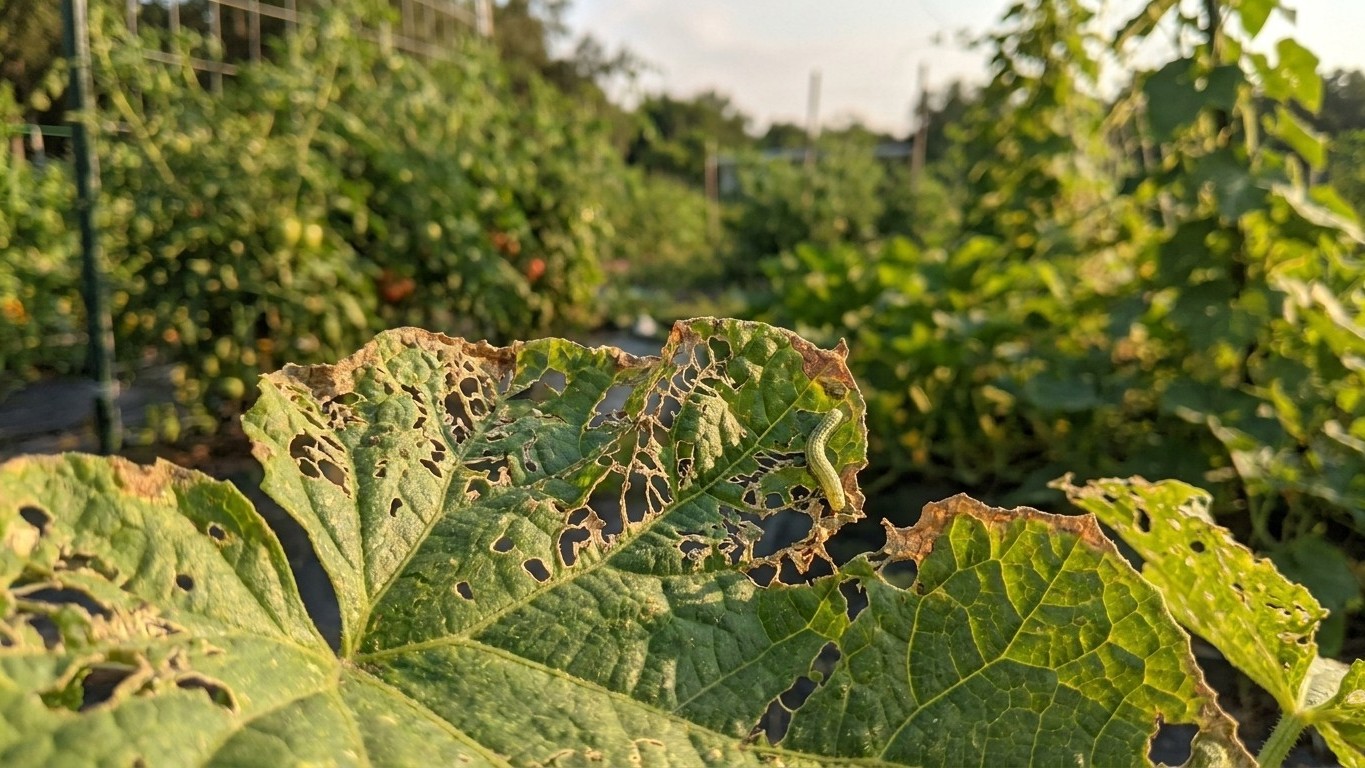

Melonworm shows up in Mississippi gardens late in the growing season, from midsummer into early fall, and disappears again with the first hard freeze because the insect can’t survive a Mississippi winter. Row covers timed to that late-season window, hand-picking exposed larvae, and clearing spent cucurbit vines after harvest are the tools that actually slow it down.
The weeks to watch

Melonworm pressure in Mississippi builds from midsummer and peaks in the weeks before the first fall freeze, not in spring or early summer when cucurbit vines are just getting established.
No dedicated MSU window for melonworm
Mississippi State University Extension Publication 2347, Insect Pests of the Home Vegetable Garden, doesn’t list melonworm with its own separate entry and date range. What it does say, in detail, is that its close cousin on cucurbits, the Pickleworm, runs “much heavier late season” and does not overwinter in Mississippi, which makes Pickleworm mainly a late-season pest here. That’s the source of record, and it’s honest to say the local extension service simply hasn’t published a melonworm-specific window.
The late-season pattern that applies
Melonworm and pickleworm are both in the genus Diaphania, both feed on the same cucurbit crops, and both share the same basic limitation: neither species survives cold winters this far north. That shared biology is why gardeners and extension agents across the Gulf South treat melonworm the same way MSU treats pickleworm, as a pest that arrives from farther south as the season warms and builds through summer, with the heaviest damage showing up in August and September rather than in June.
Reading the calendar from your last frost

Melonworm doesn’t answer to a date on a calendar. It answers to how warm the soil is and how far along the cucurbit vines are, which means an early spring or a late one shifts everything downstream.
- Start from your local last spring frost. At the Jackson-area reference station, NOAA’s 30-year climate normals put the last spring freeze between March 6 and March 22, a two-and-a-half week window, not a single day. Suburban and rural gardens away from that station often see their own last frost run one to two weeks later, so check your county before you rely on the airport figure.
- Count forward roughly two weeks past your local last frost before soil is reliably warm enough for squash, cucumber, or melon seed and transplants to go in without stalling. In most Mississippi gardens that lands somewhere in the first half of April, again a range rather than one fixed date.
Because melonworm activity is a late-season phenomenon, the first real damage rarely shows up right after transplanting. The bigger risk builds through June and July as vines mature, which means row covers matter less in the first weeks after planting and more as summer wears on, right up until vines finish producing or the first fall frost ends the season.
What it attacks, and what the damage looks like

A gardener almost always spots the wreckage before they spot the worm. Leaves develop ragged, skeletonized patches where only the veins are left, vines get webbed together with fine silk, and on younger plants whole leaf sections can collapse and turn brown within a few days. On more mature plants, the damage moves from leaves to fruit, with larvae boring into the rind of squash and melons and leaving small, ragged entry holes that are easy to mistake for other feeding damage until the plant is opened up.
It’s the larval stage, the caterpillar itself, that does essentially all of this damage. Adults are night-flying moths that lay eggs and move on; by the time feeding is visible, the worm is already at work on leaf tissue or, later, tunneling into fruit, which is exactly why timing a response matters more than the specific product used.
Crops at risk in a Mississippi garden include:
- Summer squash and zucchini
- Cucumbers
- Cantaloupe and other muskmelons
- Watermelon
- Pumpkin and winter squash
How Mississippi sits in this pest’s range

Mississippi State University’s own publication is explicit that pickleworm, melonworm’s closest relative on cucurbits, does not overwinter in the state and is “mainly a late-season pest” as a result. That detail matters because it tells you Mississippi isn’t a place where this insect lives year-round; it’s a place the insect reaches each year by moving up from warmer ground.
The practical effect is that counties closer to the Gulf Coast, where winters are milder and the insect’s overwintering range sits nearest, tend to see cucurbit-feeding Diaphania caterpillars earlier in a given summer than gardens farther north in the state, simply because the population has less distance to travel. MSU’s publication doesn’t break this down county by county for melonworm specifically, so it’s worth treating that as a general pattern rather than a guaranteed schedule for any one garden. What’s consistent across the state is the shape of the season: absent in spring, building through summer, gone with the first hard freeze.
What actually works against it

Cheapest and easiest to try first, then more involved from there:
- Time plantings to dodge peak pressure. Since damage is heaviest late in the season, an early planting that produces its main harvest before midsummer avoids the worst of the pressure entirely, while a very late planting walks straight into it.
- Use row covers while vines are young. Covers work as a physical barrier that keeps egg-laying moths off the plant. They stop working the moment cucurbits start flowering, because covers also block the bees and other pollinators the plant needs to set fruit, so covers have to come off at bloom, right when late-season pressure is often building.
- Hand-pick larvae and remove webbed leaves. This works only while the caterpillar is exposed on foliage. Once it has bored into a stem or fruit, hand-picking and removing damaged leaves can no longer reach it.
- Rotate cucurbits to a different bed each year. Rotation reduces local buildup of many garden pests, but since melonworm reinvades from outside the state each season rather than overwintering in the soil, rotation offers only modest benefit against this particular insect.
- Clear vines and fruit debris promptly after harvest. Removing spent plants reduces the amount of late-season foliage and fruit available for a growing population to feed and multiply on for the rest of the summer, which matters most in years when the insect arrives early.
Common questions
Does melonworm survive winter in Mississippi?
No. MSU Extension notes that its close relative pickleworm does not overwinter in the state, and the same limitation applies to melonworm, which is why both are treated as late-season arrivals rather than year-round residents.
Can I still save fruit that already has a hole in it?
Once a larva has bored into the rind, the damage is already done to that fruit, and the insect is largely out of reach of surface treatments or hand-picking. The more useful move at that point is removing the affected fruit to slow the buildup of larvae feeding nearby.
Should I keep row covers on all summer to be safe?
No. Covers have to come off once cucurbit plants start flowering, since they’ll otherwise block the pollinators the plant needs to produce fruit at all, even though that timing often coincides with rising late-season pest pressure.