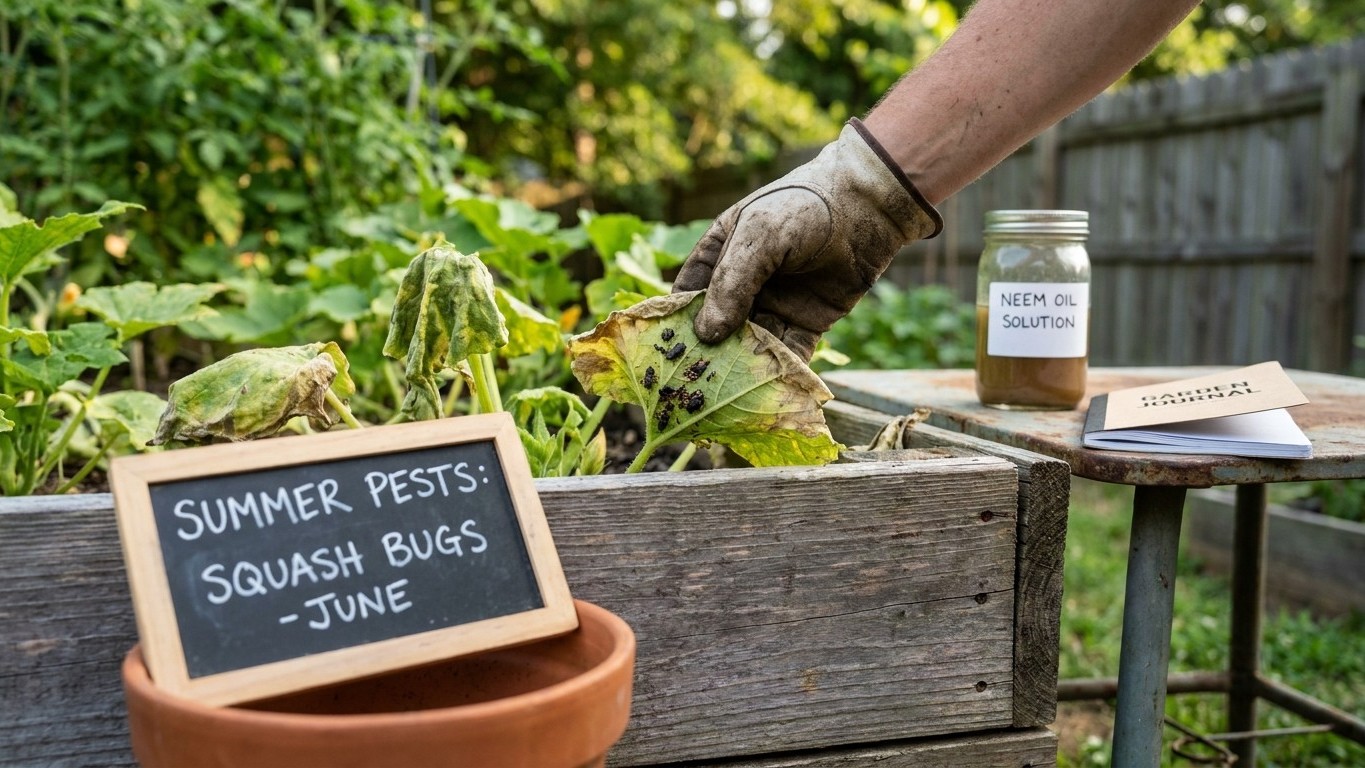

Mississippi gardens deal with ten pests that MSSTATE Extension singles out as the ones home growers run into most: Fire ants in Mississippi, pickleworms and melonworms, cowpea curculios, harlequin bugs, yellowmargined leaf beetles, vegetable weevils, leaf-footed bugs, squash vine borers, several armyworm species, and mole crickets in the sandy soils of the southern half of the state. Walk your rows twice a week starting the day seedlings go in, and check leaf undersides first, since that’s where most of these show up before the damage does.
What Mississippi gardens actually deal with

Collards that looked fine on Sunday can be stippled pale and gasping by Friday, and by then the harlequin bugs have already glued another row of black-and-white egg barrels under the leaves you didn’t check. Spray too late, or spray for the wrong pest entirely, and you’ve lost the planting while the beetles move on to your turnips. Mississippi’s mild winters mean these pests barely pause — which is exactly why timing the response, not just naming the bug, is what actually saves the bed.
Harlequin bugs

Shield-shaped, roughly 3/8 inch, black with bold red-orange or yellow blotches. Nymphs and adults both feed by sucking sap from brassica leaves, leaving pale blotches and stunted growth. MSSTATE Extension notes they stay active right through winter and hibernate through summer, so most of the damage on collards and turnips shows up from fall into spring. Hand-crush the black-and-white striped egg barrels stacked on leaf undersides, and knock adults into a jar of soapy water.
Yellowmargined leaf beetles

A small, oval, black beetle about 1/4 inch with a yellow band running around the edge of each wing cover. Adults and their dark, spiny larvae both chew ragged holes and skeletonize the leaves of turnips, mustard, and other greens. MSSTATE Extension lists this beetle as active from fall through late spring, so a bed of fall turnips can take a beating just as the beetle population peaks. Floating row cover over young greens keeps most of them off before numbers build.
Vegetable weevils

A grayish-brown, snouted weevil about 3/8 inch long, faintly marked with a light V near the wing tips. The pale green larvae, legless and grub-like, do the real damage, tunneling into roots and chewing foliage of carrots, turnips, and other greens. Like the yellowmargined leaf beetle, MSSTATE Extension places this pest’s active season from fall through late spring, with adults hiding in soil or debris through the hottest months. Clean up old crop debris in fall, since that’s where the next generation overwinters.
Fire ants

Reddish-brown ants, small at 1/8 to 1/4 inch, best identified by the mound: a dome of loose, powdery soil with no obvious entrance hole, often thrown up right next to a garden bed or path. They don’t damage plants as often as they damage the gardener, delivering a burning sting when a mound is disturbed while weeding or harvesting. Treat mounds you find in the bed itself rather than broadcast-baiting the whole yard, since bait works best applied directly onto or beside an active mound.
Cowpea curculios

A small, grayish-black weevil around 1/5 inch, humped in the back with a curved snout, that punctures cowpea and southern pea pods to lay eggs. The puncture wounds show up as pinprick-sized dark spots on the pod, and inside, a white grub feeds on the developing seeds. Pods that look fine from the outside can be hollowed out by harvest, so split a few suspect pods rather than judging by the surface alone.
Squash vine borers

The adult is a day-flying moth built like a wasp, with an orange-red body banded in black and clear hind wings, easy to mistake for something that stings. The larva, a cream-white caterpillar with a dark head, is the one that matters: it tunnels into the base of squash and zucchini stems, and a plant that looked fine yesterday can be collapsed today. MSSTATE Extension notes damage from this pest and from pickleworm gets much heavier late in the season, so a second planting of squash timed to mature earlier often outruns the borer entirely.
Leaf-footed bugs
A brownish-gray, elongated bug up to 3/4 inch long, named for the flattened, leaf-shaped flare on its hind legs. Nymphs and adults pierce tomatoes and peppers to feed, leaving pale or discolored spots under the skin that show up as fruit ripens. MSSTATE Extension flags this one as building to high numbers in late summer and early fall, right when tomatoes are loaded on the vine, which is the point to start checking fruit clusters daily rather than weekly.
Pickleworms and melonworms
Pickleworm larvae start cream colored with dark spots and lighten to greenish white as they grow, reaching about 3/4 inch before boring straight into squash, cucumber, and melon fruit. Melonworm larvae are pale green with two white stripes running the length of the back and feed more on foliage and blossoms than fruit. Because pickleworms do not overwinter in Mississippi, MSSTATE Extension notes they’re mainly a late-season problem, arriving as moths move up from further south, so damage concentrates on the last squash and melon plantings of the year.
Armyworms
Several species, including fall, beet, yellowstriped, and Southern armyworm, show up in Mississippi gardens, and all are smooth caterpillars with lengthwise stripes, ranging from green to brown or nearly black, growing past an inch long. They earn the name by moving through a planting in numbers, stripping leaves down to the veins in days once a population builds, a pattern gardeners see further afield too, including in Garden Pests in North Carolina: What Shows Up, When, and How to Stop It. Catching the first ragged leaves before the group is full grown makes the difference between minor damage and a defoliated row.
Mole crickets
A brownish, cylindrical cricket about 1.5 inches long, with oversized, shovel-like front legs built for digging rather than jumping. MSSTATE Extension flags mole crickets specifically for the southern half of the state, especially in sandy soils, where their tunneling loosens root zones and leaves raised, spongy ridges across turf and garden edges. A raked-out tunnel that refills within a day confirms an active population rather than an old, abandoned one.
Telling damage apart

Insect damage, disease damage, and a watering problem can look alike from ten feet away, but they leave different signatures up close. A wilted squash plant that was fine yesterday points to squash vine borer tunneling through the stem base, not underwatering, because the wilt shows up on one vine at a time rather than the whole plant sagging evenly. Split the stem near the soil line before reaching for a watering can.
Stippling, a fine pale speckling across a leaf surface, usually means a sucking insect like a leaf-footed bug rather than a chewing one. Ragged holes with the leaf tissue actually missing, not just discolored, point to a chewer: a beetle, a caterpillar, or a weevil larva working from the edges inward. The clearest tell is where the damage sits: chewing pests leave debris and frass behind, while sucking pests leave the leaf intact but discolored or curled.
Reading the signs before you treat anything
- Ragged holes with tissue missing: a chewing pest such as a beetle, weevil, or caterpillar
- Pale stippling with no holes: a sap-sucking pest such as a leaf-footed bug
- Sudden one-sided wilting on a squash or melon vine: a borer working inside the stem
- Sticky residue or black sooty mold on leaves: an insect excreting honeydew, not a fungal disease starting on its own
- Yellowing that starts at the leaf edge and moves inward evenly: often a watering or nutrient issue, not a pest
Frass, the sawdust-like or granular droppings insects leave, is one of the most reliable tells and the most overlooked one. A pile of greenish or brown pellets at the base of a squash stem, or caked at the entrance of a stem tunnel, confirms a borer before the plant even wilts. Check leaf undersides for eggs too: clusters, rows, or single eggs glued to the surface tell you a population is building before you see any feeding damage at all.
Disease usually shows a pattern insects don’t: symmetrical spotting, a powdery coating, or a soft, water-soaked rot spreading outward from one point rather than a cluster of individual holes. A watering fault, too much or too little, tends to hit the whole plant evenly rather than one leaf or one side. If the damage is confined to a few leaves while the rest of the plant looks normal, that argues for a localized insect rather than a systemic disease, and it’s worth a closer look with a hand lens before treating for anything.
When each one shows up
The season starts with holdovers from winter rather than a clean slate. Harlequin bugs stay active right through the cold months, according to MSSTATE Extension, so they’re often already established on any brassica that made it through winter by the time spring transplants go in. Yellowmargined leaf beetles and vegetable weevils are working the same fall-through-late-spring window, which means the greens bed needs watching from the day seedlings go in, not just once summer heat arrives.
As soil warms and the garden moves into beans, peas, and squash, fire ant mounds become more visible and cowpea curculios start showing up on blooming southern peas. This is also when squash vine borer moths begin laying eggs at the base of young vines, though MSSTATE Extension notes damage from both squash vine borer and pickleworm gets much heavier as the season goes on rather than at first planting. A squash bed that looks untouched early can be overwhelmed by late summer.
Late summer into fall
Leaf-footed bugs build to their highest numbers on tomatoes and peppers in late summer and early fall, right as fruit is loaded on the vine, which is exactly when MSSTATE Extension says to expect the heaviest feeding. Pickleworms and melonworms arrive later still, since pickleworms do not overwinter in the state and instead move in as the season progresses, concentrating on whatever squash, cucumber, or melon planting is still producing. Armyworm outbreaks tend to follow the same late-summer-to-fall stretch, moving through a planting in days once a population builds. In the southern half of the state, mole cricket tunneling is most obvious in warm soil, especially where the ground is sandy.
By the time cool nights return, harlequin bugs and the leaf beetle and weevil pair are already easing back into activity on fall greens, which is why a fall garden needs the same early scouting as a spring one: the cool-season pests never really left, they just went quiet over summer.
What actually works
Prevention
Rotating squash, melons, and cucumbers away from the bed they grew in the previous year cuts down on borer and pickleworm pressure carrying over in the soil and nearby debris. Clearing old crop debris in fall matters just as much, since it’s where vegetable weevils and several of the leaf beetles overwinter, and a clean bed in October means fewer adults emerging the following spring. Timing plantings to mature before pest pressure typically peaks, especially for squash and melons, works better than any spray applied after the fact, since MSSTATE Extension notes damage from squash vine borer and pickleworm builds heavily as the season goes on. The same seasonal build-up shapes control decisions further north too, as covered in Garden Pests in Missouri: What Shows Up, When, and How to Stop It, though the timing shifts with a shorter growing season.
Floating row cover over young transplants keeps yellowmargined leaf beetles, vegetable weevils, and squash vine borer moths off the plant during the vulnerable seedling stage, and it has to come off once flowers open so pollinators can reach the blossoms. Fine mesh or cheesecloth wrapped loosely around a squash stem base does the same job against borer moths trying to lay eggs at the soil line. Encouraging predators, ground beetles, parasitic wasps, and birds among them, by leaving some flowering plants in and around the vegetable bed reduces pest numbers before they reach damaging levels, and it costs nothing beyond a few square feet of bed space.
Intervention
Hand-picking works for a surprising number of these pests: crushing harlequin bug egg masses, knocking leaf-footed bugs into soapy water in the cool of the morning when they’re sluggish, and pulling armyworms off a planting before the group strips it bare. For squash vine borer, slitting the stem lengthwise where frass appears and pulling the larva out by hand often saves a vine that would otherwise collapse. Insecticidal soap and horticultural oil work against soft-bodied sucking insects but do little against a borer already inside a stem or a weevil grub already inside a root.
What doesn’t work: broadcasting fire ant bait across the whole yard instead of onto active mounds wastes most of the product, and spraying a squash plant after it’s already wilting from vine borer damage is too late, since the larva is inside the stem and out of reach of a foliar spray. Marigolds and other companion plants often get credited with repelling pests, but MSSTATE Extension’s pest list doesn’t attribute control to any companion planting, so treat that advice as folklore rather than a substitute for row cover or rotation.
What control costs
| Method | Money cost | Time cost | How often repeated |
|---|---|---|---|
| Hand-picking and crushing egg masses | Lowest, no material cost | A few minutes per bed, several times a week during peak activity | Ongoing through the pest’s active window |
| Row cover and stem barriers | Low to moderate, one-time purchase reused for years | Set once at planting, removed at flowering | Once per planting, replaced only if damaged |
| Biological controls (predatory insects, habitat plants) | Low, mostly the cost of habitat plants | Slow to establish, little ongoing labor once set up | Builds over a season, not a quick fix |
| Sprays (soap, oil, or a labeled insecticide) | Moderate, repeated purchases | Requires reapplication after rain and as new pests emerge | Every 7 to 10 days during an active outbreak, typical of most labeled products |
For a home garden, hand-picking and barriers are the cheapest route by a wide margin, since both rely mostly on time rather than repeated purchases, and row cover in particular pays for itself over several seasons of reuse. Biological control costs little in dollars but asks for patience, since a predator population needs weeks to build up before it makes a visible dent. Sprays cost the most over a full season once repeat applications are counted, and they carry a cost that doesn’t show up on a receipt: broad-spectrum products can knock back the same predatory insects that would otherwise be doing some of the work for free.
The pest matters as much as the method when weighing cost. A squash vine borer caught early with a hand search and a slit stem costs nothing but a few minutes, while the same infestation ignored until the plant collapses costs the whole plant. Fire ant mounds treated individually with bait cost less product and less risk to the rest of the yard than a blanket treatment, and they only need repeating on mounds that reappear.
Local help
MSSTATE Extension identifies specimens, tracks regional outbreaks, and publishes updated pest bulletins through the season, and county offices are the fastest way to confirm what’s actually chewing on a specific plant rather than guessing from a photo. Bring an actual sample, a leaf, a beetle in a jar, a section of tunneled stem, when you visit or call, since identification from a description alone is unreliable. The pest pressures above are measured around Jackson, and county-level pressure can run higher or lower elsewhere in the state, so check with your own county office through MSSTATE Extension before treating for something you haven’t confirmed. For other Mississippi growing topics, our Mississippi guides cover the rest of the season.
Common questions
Why do I keep finding squash vine borer damage even after I sprayed?
Because the spray never reached the larva once it’s inside the stem, and by the time you see wilting, treatment has to be surgical rather than chemical. Slit the stem where you find frass, remove the larva by hand, and mound soil over the wound so the vine can root along the buried section.
Are fire ant mounds dangerous to leave alone if they’re not near where I work?
A mound left alone anywhere in the yard can keep growing and eventually shift toward garden edges as it expands looking for food, so it’s not just a nuisance to ignore. Treat any mound you find rather than only the ones directly in a planting row.
Do ladybugs actually control the pests on this list?
Ladybugs help against soft-bodied aphids and some small larvae, but they do little against a squash vine borer already inside a stem or a cowpea curculio inside a pod. Store-bought ladybug releases also tend to fly off within a day or two rather than settling into the garden, so they’re a weaker tool than leaving habitat for the predators already living nearby.
Can I just plant resistant varieties to skip pest control?
Disease resistance and pest resistance aren’t the same thing. Most of the pests on this list attack the plant physically, chewing, sucking, or boring, rather than through a susceptibility a seed catalogue’s disease-resistance code addresses, so a resistant tomato variety helps against wilts and blights but does nothing against a leaf-footed bug or an armyworm.