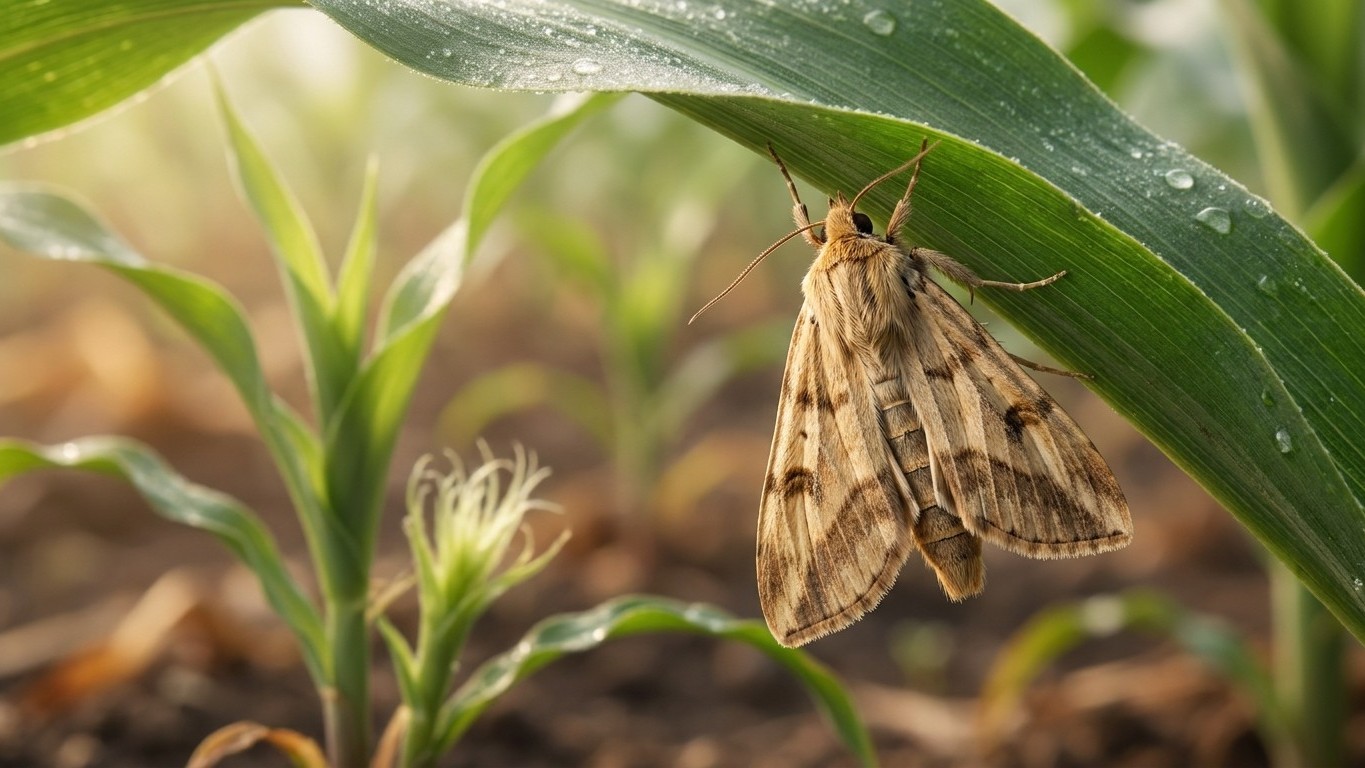

European corn borer moths typically start flying in Virginia from late May through June, with a second generation active in July and August in most of the state. There’s no official Virginia-specific emergence date published by county extension offices for this insect, so gardeners work off the general regional pattern rather than a single calendar date.
The weeks to watch

Virginia Cooperative Extension publishes seasonal notes for a number of garden pests, but not a dedicated emergence calendar for European corn borer. That gap matters: it means no county-level source pins this insect to a specific week in Virginia. What follows is the general life-cycle pattern used across the mid-Atlantic corn belt, adjusted for the fact that Virginia spans a mild coastal strip and a much cooler mountain interior.
First flight
The overwintered generation emerges as adult moths once nighttime temperatures settle into the 50s and 60s, generally sometime between mid-May and mid-June depending on how the spring ran. These moths mate, then lay egg masses on the undersides of leaves near the whorl of young corn plants. Eggs hatch in about a week, and the larvae bore into stalks within days of hatching.
Second flight
A second generation of moths typically appears in July, sometimes stretching into early August in warmer years. This second wave is the one that does the most damage to garden peppers and later plantings of sweet corn, since by midsummer stalks are tall enough to offer plenty of hiding spots for tunneling larvae. In cooler parts of the state, particularly the Blue Ridge and points west, this second flight runs later and can be lighter, since the season simply doesn’t give the insect as much warm time to complete a full second cycle.
Reading the calendar from your last frost

Virginia Beach’s last spring frost falls between March 20 and April 3, based on 30-year NOAA climate normals for that station. That’s a useful anchor for garden planning, but it’s a normal built from three decades of weather, not a promise about any single spring. European corn borer doesn’t check a calendar either. It responds to soil and air warming up, so a stretch of unusually cold nights after that window can delay the first flight by a couple of weeks, and an early warm spring can pull it forward just as easily.
Here’s how a gardener actually uses that frost date to plan around this pest:
- Start from your local last frost date (March 20 to April 3 for the Virginia Beach area; check your own county’s normal if you’re inland or in the mountains, since it runs later there).
- Add roughly six to eight weeks for corn or peppers set out after that frost to reach the growth stage where moths start laying eggs, which lines up with that general late May to June first-flight window.
That math gives a range, not a date. If a gardener transplants right at the frost-free mark, the first sign of borer activity (small pinholes in leaves, sawdust-like frass near the stalk) usually shows up sometime in that six-to-eight-week stretch, not on a fixed day.
What it attacks, and what the damage looks like

Most gardeners spot the damage before they ever see the insect. A corn stalk that suddenly snaps or leans over in a wind that wouldn’t have bothered it a week earlier is a classic sign, since larvae hollow out the inside of the stalk as they feed. On peppers, look for a small entry hole near the stem cap and a fruit that rots from the inside out. On beans, a wilting shoot tip that doesn’t recover overnight, even with normal watering, often means a larva has tunneled into the stem.
The damage is done almost entirely by the larval stage. Once a larva has bored into a stalk, stem, or pepper, it’s protected from most surface treatments, which is why timing matters more with this insect than with pests that stay out in the open. Adult moths themselves don’t feed on the plant at all; they just lay the eggs that become the problem.
Crops affected in Virginia gardens include:
- Sweet corn (stalks, ears, and tassels)
- Bell and other garden peppers
- Snap beans and lima beans
- Potatoes (stems, less commonly)
- Some ornamental grasses and dahlias in home landscapes
How Virginia sits in this pest’s range

European corn borer is established across nearly every corn-growing state in the country, and Virginia is well within that range rather than sitting near an edge of it. That’s the important distinction for a Virginia gardener: the question here isn’t whether this insect is present, it’s When It Shows Up and how many generations it manages to complete before the season ends. Widespread presence means the difference between one part of the country and another is almost entirely about timing, not about whether the pest exists there at all.
Within Virginia itself, that timing shifts across the state’s own climate range. The coastal plain and Tidewater area, including the Virginia Beach frost data cited above, warm up earliest in spring and hold warmth longest into fall, which gives the insect the best shot at completing two full generations in a season. Moving west toward the Blue Ridge and into southwest Virginia, spring arrives later and fall frost comes sooner, which compresses the window and can leave the second generation weaker or incomplete some years. A gardener in the mountains isn’t dealing with a different insect, just a shorter season for it to work with.
What actually works against it

Once larvae are inside a stalk or pepper, almost nothing reaches them. That single fact drives the order of everything below: the earlier a measure is used relative to the insect’s life cycle, the more good it does.
- Clear old stalks and plant debris in fall. Larvae overwinter inside leftover corn stubble and stalks left in the garden. Removing and destroying that debris after harvest cuts down the number of moths that emerge the following spring, since there’s simply less shelter for them to survive the winter in.
- Rotate corn and peppers to a different bed each year. Moths that do survive the winter emerge near where they overwintered. Moving susceptible crops away from last year’s planting site makes it harder for that first generation to find host plants right away.
- Time planting to avoid the peak egg-laying window. Very early or late plantings sometimes miss the heaviest part of a flight, since the plants aren’t at the right growth stage when moths are laying eggs. This won’t eliminate the risk, but it can reduce how much of the crop is exposed at the worst moment.
- Use row covers on young plants before the first flight begins. A cover keeps egg-laying moths off the plant entirely, but it has to come off once corn tassels or peppers start flowering, since those crops need pollinator access at that stage. This measure only works before eggs are laid; once a moth gets under a cover, it does no good at all.
- Check leaves for egg masses and scrape them off by hand. Egg masses look like small, flat, overlapping clusters on the underside of leaves near the whorl. Catching them before they hatch is the last point where hand intervention actually stops the insect, since once larvae hatch and bore in, they’re out of reach.
Some gardeners also try beneficial nematodes applied to the base of plants, on the idea that they attack larvae in the soil or as they enter the stalk. Field trials on this approach have produced mixed results, so treat it as a possible add-on rather than a reliable fix on its own.
Common questions
Does European corn borer only attack corn?
No. It’s named for corn but also damages peppers, snap beans, lima beans, and occasionally potato stems and ornamental plants like dahlias.
Can I treat a stalk after I see wilting?
Once wilting shows up, a larva is usually already inside the stem or stalk, past the point where hand-picking or covers help. At that stage, removing and destroying the affected plant limits the number of larvae that survive to become next generation’s moths.
Is European corn borer worse in coastal Virginia or the mountains?
Coastal areas like Virginia Beach have a longer warm season, which gives the insect a better chance at completing two full generations. Mountain regions have a shorter window, which can limit it to a lighter or incomplete second generation some years.