
British Columbia’s European earwig population follows soil temperature, not the calendar. Nymphs start moving in late winter once the ground warms past roughly 50°F, adults are most visible and most destructive from June through August, and the whole cycle resets each fall when mated females burrow underground to overwinter. No single date marks its arrival here.
The weeks to watch

Earwig nymphs typically leave their underground nests in late February through April in coastal British Columbia, though the exact week shifts with how quickly the soil warms that particular year. The BC Ministry of Agriculture and Food does not publish a specific emergence window for the European earwig the way it does for some orchard pests, so the timing below follows the general pattern documented across the temperate Pacific Northwest rather than a province-specific date.
Spring hatch
Eggs laid the previous fall hatch underground during winter, and the young nymphs stay in the burrow, fed by the female, until conditions outside are mild enough to forage. In a typical Lower Mainland spring that means late February to April. A cold, wet March delays this by weeks; a mild one pulls it forward.
Adults through summer and fall
By June, nymphs have molted into recognizable winged adults, and this is when gardeners start noticing damage. Activity peaks through July and August, when populations are largest and nights are warm enough for heavy nocturnal feeding. Numbers taper by September as adults pair off, mate, and burrow down for winter, closing the loop.
Reading the calendar from your last frost

The one date most British Columbia gardeners actually track is the average last spring frost, which sits at March 18 for the Vancouver area, based on Environment and Climate Change Canada’s 1981-2010 climate normals for Vancouver International Airport. That figure is a mean, not a guarantee: in one year out of two, frost arrives later than March 18, and the same normals run weeks behind for upland or northern parts of the province. Earwigs respond to soil warmth, so an early or late spring shifts their emergence right along with your planting window.
- Start from your local average last frost date (March 18 for the Vancouver area, later inland or at elevation).
- Expect the first visible feeding damage on transplants roughly 3 to 6 weeks after they go in the ground, once nymphs are active and foraging at night.
That arithmetic gives a range, never a single day. If you transplant seedlings right at your frost date, plan to have row covers ready by the time that 3-to-6-week window opens, and don’t pull them until nighttime temperatures are consistently warm enough that the plants can outgrow minor nibbling.
What it attacks, and what the damage looks like

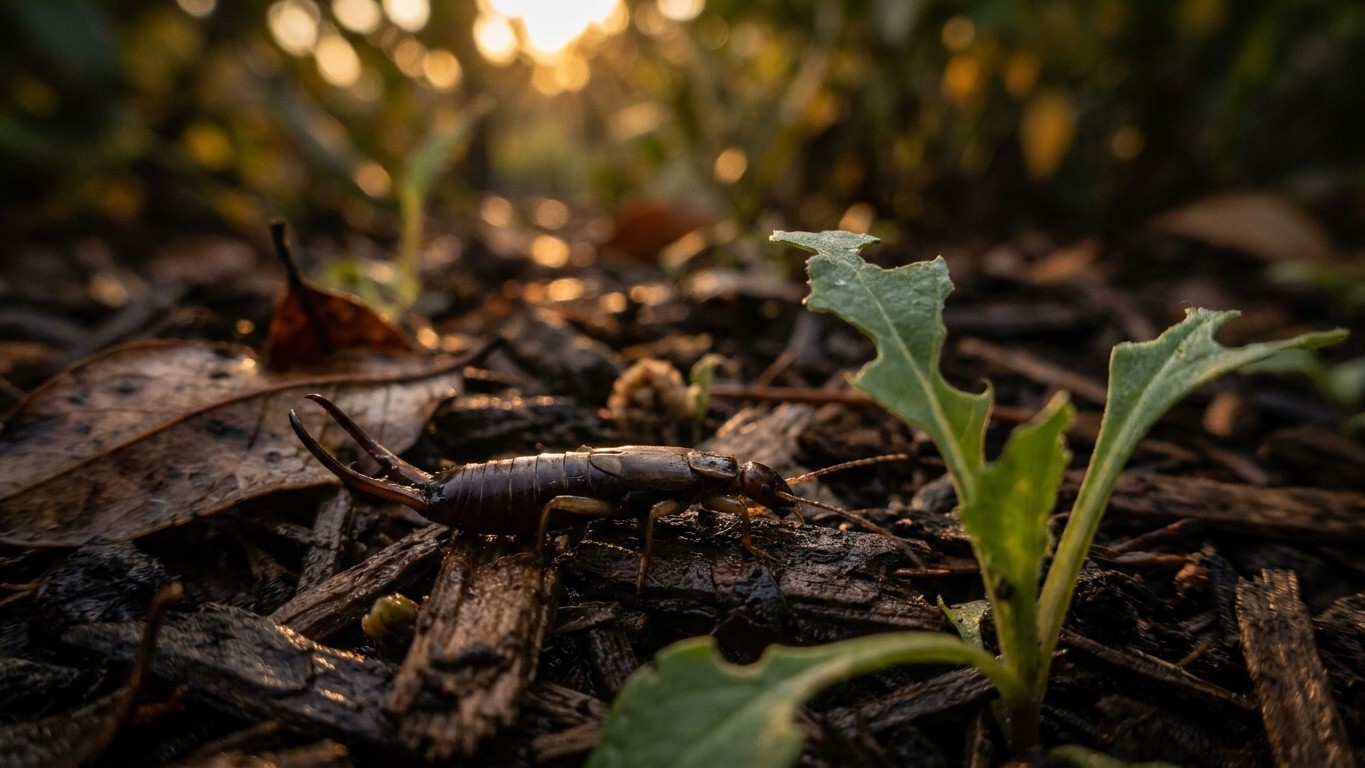
Most gardeners meet this pest through the damage first: ragged, irregular holes chewed into leaves that look like something took random bites overnight, seedlings clipped clean at the soil line, or soft fruit with shallow gouges near the stem end. Flower buds on dahlias and zinnias sometimes fail to open at all because the inside was hollowed out before the petals could unfurl. The insect itself, dark reddish-brown with the distinctive pincers at the tail end, is rarely seen during the day because it hides in cracks, mulch, and folded leaves until dark.
Adults do the bulk of the visible damage, since they’re larger, more mobile, and feed more aggressively than nymphs, which explains why symptoms intensify from June onward even though the population has been present since spring. Crops and plants commonly affected in British Columbia gardens include:
- Seedlings and young transplants (lettuce, beans, and other tender starts)
- Soft fruit, especially strawberries and raspberries
- Ornamental flowers, particularly dahlias, zinnias, and marigolds
- Sweet corn silk, which gets clipped before pollination completes
- Leafy vegetables with tender, low-growing foliage
Because adults feed at night and retreat to shelter by dawn, the plant damage almost always shows up before the insect does, which is why identifying the symptom pattern matters more here than spotting the bug itself.
How British Columbia sits in this pest’s range

The European earwig is established broadly across temperate North America, and British Columbia’s coastal climate, mild winters, damp springs, moderate summers, sits well within its comfort zone. Available sources don’t rank BC’s earwig pressure against other provinces or states, so no claim here should be read as a severity comparison. What can be said plainly is that presence is not the variable that changes from one region to the next; timing is.
Coastal and Lower Mainland gardens, with their reliable moisture and moderate temperatures, tend to see earlier and more sustained earwig activity than drier interior valleys, where hot, dry summers slow foraging and can shorten the active season. Higher-elevation and northern parts of the province follow the general pattern later, in step with their later frost dates and cooler soil. None of this means the insect is absent anywhere in the province, only that the weeks when it’s most active shift with local climate.
What actually works against it

Cheapest measures first, because most of the effective control here costs nothing but attention.
- Clear damp debris and mulch piles near beds. Earwigs need dark, moist shelter to survive daylight hours; removing rotting wood, thick mulch layers, and leaf litter close to vulnerable plants takes away the hiding spots they depend on.
- Time transplants to outgrow the worst damage window. Seedlings set out well before or well after peak nymph activity have a better chance of establishing sturdy stems before heavy feeding starts.
- Set out rolled newspaper or corrugated cardboard traps at night. Earwigs crawl into the tight, dark folds to hide before dawn; shake the traps out into soapy water each morning. This works because it exploits the same shelter-seeking behavior that draws them under mulch.
- Try shallow oil traps. A shallow dish with a small amount of vegetable oil, sunk level with the soil surface, draws and traps foraging adults overnight. Results vary by garden and population size.
- Apply diatomaceous earth around plant bases in dry weather. Its abrasive particles damage the insect’s outer cuticle, causing water loss; it stops working once it gets wet, so it needs reapplying after rain or irrigation.
- Copper tape and ultrasonic repellers are widely sold for garden insects, including earwigs. Gardeners report mixed results, and available trials on both remain inconclusive for this species specifically, so treat them as a low-cost experiment rather than a proven fix.
None of these measures reach nymphs or adults once they’ve bored into a corn ear or hollowed out a flower bud from the inside; at that point the damage is already done, and control shifts to protecting the next planting rather than saving the one already hit.
Common questions
Do earwigs actually help the garden at all? Yes, in modest amounts. They scavenge dead insects and eat some aphids, which is why many gardeners tolerate a small population rather than eliminating it entirely, reserving control for years when numbers spike.
Can row covers keep earwigs off young seedlings? Floating row covers block adults from reaching foliage above ground, but they do nothing for earwigs already sheltering in the soil or mulch beneath the cover, so clearing debris first matters more than the cover itself.
Why do earwig numbers seem to explode some summers and not others? A mild, damp spring lets more nymphs survive to adulthood, and a warm summer extends the feeding season; a cold, dry spring does the opposite, which is largely why populations swing from year to year in the same garden.