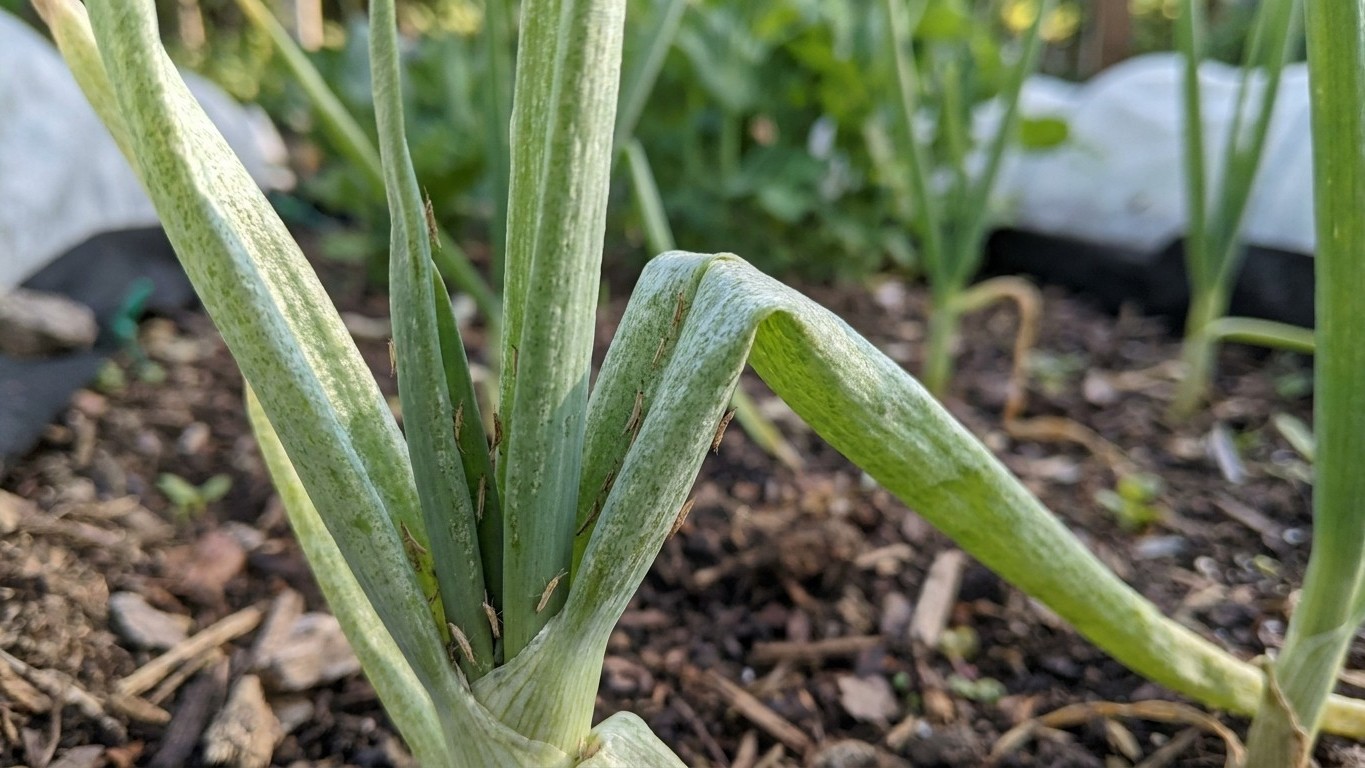

Onion thrips turn up in Washington gardens once the soil warms past the chilly, wet stretch that follows the last frost, then build through the hot, dry weeks of summer before tapering off in fall. There’s no fixed calendar date for this pest here; it tracks temperature, not the almanac. The controls that actually help start weeks before you see the first silvery streak on a leaf.
The weeks to watch

Washington State University’s extension network does not publish a specific flight window for onion thrips the way it does for some fruit pests with pheromone-trap data. So the honest answer is: no local start date exists in the published record. What does exist is the general biology of the species, and it applies here as much as anywhere else in the temperate United States.
Spring emergence
Adult onion thrips overwinter in plant debris, grass clumps, and the outer leaves of cover crops. They become active once soil and air temperatures climb consistently into the 50s Fahrenheit, which in Washington means late spring in most years. This first wave is usually small and easy to miss.
Summer generations
The real trouble builds afterward. Onion thrips complete a generation in as little as two weeks under warm, dry conditions, and a single season can bring several overlapping generations. Populations peak during the hottest, driest stretch of summer, typically July into August in the Pacific Northwest, then decline once cooler, wetter weather returns in fall. Because generations overlap, you can find eggs, nymphs, and adults on the same plant at the same time by midsummer.
Reading the calendar from your last frost

The one date most Washington gardeners actually track is the last spring frost. For western Washington, NOAA’s 30-year climate normals put that window between February 27 and March 18, based on freeze-probability data from a Seattle-area station. That’s a mild, maritime range. East of the Cascades, the climate turns high desert, with a shorter season and later, harder frosts, so this window does not transfer statewide.
A mild frost date is not an invitation to plant early, though. Cold, wet soil and short daylight hold onion transplants back well after the last freeze has passed. Onion thrips answer to soil warmth and plant growth stage, not the frost date itself, so an early or late spring shifts their arrival along with it.
- Start from your local last-frost window (late February to mid-March in western Washington, later east of the Cascades).
- Add the weeks it typically takes soil to warm enough for onion transplants to take hold, then figure on the first feeding damage showing roughly three to five weeks after transplanting, once nights consistently warm.
That arithmetic gives you a range to watch, not a date to circle. Row covers should go on at transplanting, before that window opens, and come off only once the crop needs pollinators or the covers start trapping too much heat.
What it attacks, and what the damage looks like

Most gardeners notice the leaf before they notice the insect. Onion thrips feeding leaves behind silvery-white streaks and blotches on the leaf surface, often with tiny black specks of frass mixed in. Heavily fed leaves curl, turn papery, and can collapse at the tip. On onions specifically, damage concentrates in the neck and the folds where new leaves emerge, which is also where the insects hide from sprays and rain.
The crops most at risk in a home garden include:
- Onions
- Garlic
- Leeks
- Shallots
- Cabbage and other brassicas, as secondary hosts
Both nymphs and adults rasp the leaf surface and suck the released sap, but nymphs do the bulk of the damage. They can’t fly, so they stay put on one plant, feeding continuously in the sheltered neck tissue while adults disperse to lay eggs elsewhere. That distinction matters for treatment timing: knocking down nymphs where they sit is more effective than chasing adults across the bed.
How Washington sits in this pest’s range

Onion thrips are about as widespread as a garden pest gets, present across nearly every US state and much of the world’s temperate growing regions. In a range that broad, the difference between Washington and, say, California or Ohio isn’t whether the insect shows up. It’s when. Washington’s split climate makes that point inside its own borders before you even cross a state line.
West of the Cascades, the mild, wet-to-dry seasonal swing described by the Seattle-area frost data means thrips build slowly through a cool spring and peak later in a milder summer. East of the Cascades, the high-desert climate warms faster and dries out sooner, which tends to push thrips activity earlier and can support larger populations sooner in the season because dry heat favors this insect. No published dataset ranks Washington’s severity against its neighbors, and none should be inferred here. What the record supports is simply that a Washington gardener needs to know which side of the state they’re gardening on before applying any general guidance about timing.
What actually works against it

Cheapest and easiest measures first, since most of what stops onion thrips has to happen before the population builds, not after.
- Rotate onion-family crops. Avoid planting onions, garlic, or leeks where they grew in the last one to two years. Thrips overwinter in soil debris and old plant residue, so moving the bed breaks that carryover.
- Clear debris after harvest. Removing old onion tops, cull piles, and nearby grassy weeds strips away the overwintering sites adults use to survive the cold months.
- Put row covers on at transplanting. Lightweight fabric keeps migrating adults from landing and laying eggs on young plants. It stops working the moment thrips are already established underneath, or once the crop needs uncovering for heat or pollination.
- Try reflective mulch. Many growers use silver or aluminum-surfaced mulch around onion beds; some field trials show reduced colonization, others show little difference. The results don’t point to a settled mechanism, only to a practice worth testing on a small scale before relying on it.
- Use overhead water to dislodge nymphs. A firm spray of water can physically knock nymphs out of the leaf folds where they hide, since thrips generally favor dry conditions and struggle to climb back into shelter. It won’t reach eggs laid inside plant tissue.
- Avoid heavy nitrogen fertilizing. Lush, soft growth is more attractive to feeding thrips than a plant grown at a steadier pace.
Once thrips are established deep in the neck tissue of an onion plant, covers and water sprays lose most of their effect, since the insects are physically shielded by the leaf folds they’re feeding in. At that point, cultural controls shift from stopping the infestation to limiting how far it spreads to the rest of the bed and preventing carryover into next year’s crop.
Common questions
Do onion thrips only attack onions?
No. They favor the onion family, but garlic, leeks, shallots, and even cabbage can host feeding populations, especially when onion beds are nearby.
Can I still eat onions with thrips damage?
Yes. The damage is cosmetic and structural to the leaves; it doesn’t make the bulb unsafe. Heavily damaged plants often just yield smaller bulbs because the leaves can’t photosynthesize as well.
How do I tell onion thrips damage from onion maggot damage?
Thrips leave silvery streaking and black specks on the leaf surface itself. Onion maggots work below ground, causing wilting and rot at the base of the plant with little visible leaf damage until the plant is already collapsing.